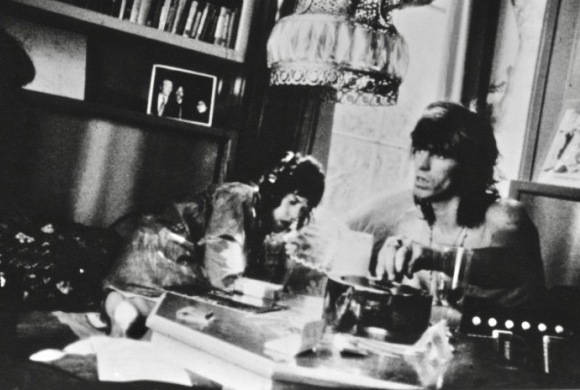
Cocksucker Blues (USA, 1972) 93 min color DIR: Robert Frank. PROD: Marshall Chess. STARRING: The Rolling Stones.
If The Rolling Stones’ Altamont Speedway concert (as documented in the film Gimme Shelter) was the beginning of the end of Flower Power, the dream had been completely eroded by the time cameras rolled for this notorious documentary. Robert Frank was given unlimited access to shoot whatever he wanted while following The Rolling Stones in their Exile on Main Street tour. However, the band suppressed the movie after viewing it, no doubt for its drug use (heroin is injected onscreen, but not by any of the principal players), and people performing sexual acts for the camera (namely, the infamous segment on the plane where a roadie picks up a half-terrified groupie and begins nuzzling her breasts). Although Robert Frank won a court injunction allowing the film to be shown once a year in his attendance, this much-coveted title has been available for the curious in bootlegs with suspect quality.
Following the tradition of 60s Cinema Verité (no voiceover or talking heads, just filming the action as it happened) this film should therefore be scrutinized like other titles of that Direct Cinema movement, in which we question the authenticity of what is onscreen. In other words, the camera is such a powerful object that people change in front of it. Frank himself admits that the airplane scene was planned, just to make the movie more exciting.
Regardless, Cocksucker Blues is a necessary document of the time bridging the gap between the 1960s idealism and 1970s burnout. The dream had faded, but the drugs got harder in the pursuit of pleasure. This minimalist movie alternates between restless backstage antics and impossibly dreary concert footage. (We all know that Mick Jagger is a better stage talent than this!) The Stones onstage are filmed from such a distance that they seem devoid of personality– that is what this movie wants to achieve. This film deglamourizes the rock star myth in its depiction of a draining and repetitious lifestyle. (Perhaps it is for this reason that Keith Richards humourously called this the greatest rock ‘n’ roll film ever made, as reported in Tony Sanchez’s book, Up and Down with The Rolling Stones.) By contrast, the trashing of hotel rooms or feeling up some groupies can be read as rebel acts for identity in an endlessly cyclical world which has sucked the lives out of its participants. They resemble cursed vampires trying to be human in a forever night.
Ooriginally published in Vol. #1, Issue #10, (“Summer in the 70s”).
Greg Woods

Greg Woods has been a film enthusiast since his teens, and began his writing "career" at the same time- prolific in capsule reviews of everything he had watched, first on index cards, then those hardcover dollar store black journals, then an old Mac IIsi. He founded The Eclectic Screening Room in 2001, as a portal to share his film love with the world, and find some like-minded enthusiasts along the way. In addition to having worked in the film industry for over two decades, he has been a co-programmer of films at Trash Palace, and a programmer/co-founder of the Toronto Film Noir Syndicate. He has also written for Broken Pencil, CU-Confidential, Micro-Film, and is currently working on his first novel. His secret desire is for someone to interview him for a podcast or a DVD extra.