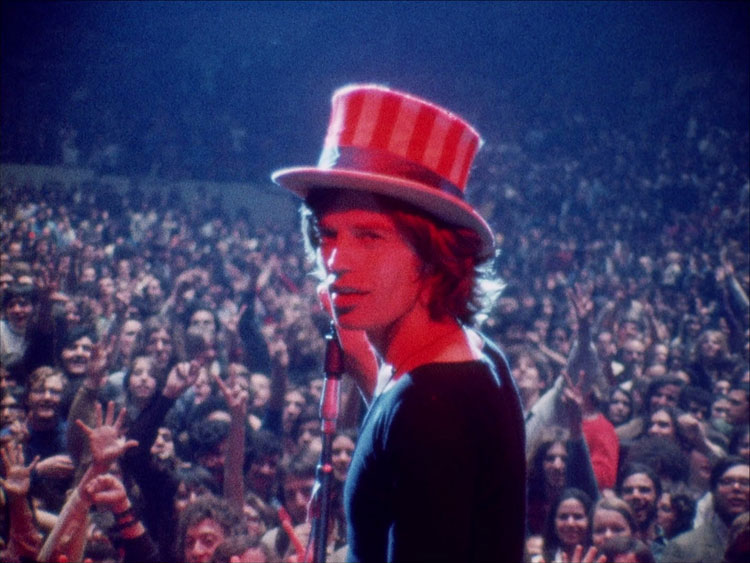
Gimme Shelter (USA, 1970) 91 min color DIR: Albert & David Maysles, Charlotte Zwerin. PROD: Porter Bibb. DOP: Albert & David Maysles. EDIT: Ellen Hovde, Charlotte Zwerin. (Criterion)
While it could be, and likely has been, argued that Jean-Luc Godard’s interpolation of the Stones in the studio, working out their relationship to the then new song “Sympathy for the Devil” during his cubist refraction of sixties radical politics One Plus One, reveals not only the most intimate view of a working rock band, and that their self-produced TV show Rock and Roll Circus conveys the band’s most honest assessment of themselves and their place in the culture, the Maysles Brothers’ Gimme Shelter still stands as perhaps the definitive deconstruction of the twin prevailing and propulsive myths of the sixties: rock music and counterculture.
I first saw it circa 70-71, on its initial theatrical release, and was seriously impressed. Its non-linear melange of electrifying concert action and on the road tour-diary style footage was as magical as it was unprecedented. Within a few years such rock verité would become almost commonplace (Mad Dogs and Englishmen immediately comes to mind), but back then Monterey Pop and Woodstock were the only other items on the shelf, and they were celebrations rather than examinations of the new culture.
In the performance footage (from Madison Square Gardens) the sexy charging vibe of the band was as immediately palpable as sweat, the viewer trapped in the sleazy rapture, and in the backstage/travel/hotel/studio playback portions, the warts n’ all demystification was as deftly handled as any craving fly on the wall could ask for. Now the viewer could live the myth and carry the bags.
The opening sequence, as with any great filmic work of art, says it all. To some grainy hand held shots of Mick Jagger and Charlie Watts and a donkey in an emptied early morning overpass, posing for the ideas that would become the cover of the ’69 tour’s aural document Get Your Ya-Yas Out, is added the soundtrack for the Gardens’ gig. Inside and outside as one. Watching the Criterion DVD release recently, with its customarily impeccable esthetic standards, I was taken, once again, after all these decades, by its wonky audacity and surreal relevance.
Expertly edited, from what must have been miles of footage, by Charlotte Zwerin, who went on to produce the great Straight, No Chaser doc on Thelonious Monk, arguably as much a benchmark in jazz as Gimme Shelter is in rock, repeated viewings reveal what a tightly controlled and disciplined project this was. Not a wasted shot anywhere, no star fucker indulgence, no gloating on the trappings of glamour, just a living museum of the moving image, captured and translated by artists carving their vision.
The climactic unfolding of catastrophe at the ill-fated instant festival of Altamont is beautifully orchestrated from the swirling chaos of bodies, sweat and promises broken. The post-mortem debates over who was careless, who naive, and who overwhelmed by greed, seem somehow superfluous in the bleakly beautiful unfolding of the crowd’s stoned insanity. To be plunged in the center of the Dionysian revels with their requisite blood sacrifice is to live for the moment in the eye of the storm, and not the sober answers of analysis.
To the received wisdom of Film History 101, that the Maysles Brothers were launched by their 1968 masterpiece Salesman, one could add the following: (1), The Gimme Shelter project was jump started with a phone call from Haskell Wexler to Albert Maysles, whose content was basically ‘My Stones project has fallen through, why don’t you have a go?’ (2), The Maysles Brothers contribution to classic cinema verité really started in 1964, with the Beatles TV doc What’s Happening?. Now rereleased on DVD (Apple), with fabulously upgraded sound and vision as The Beatles First US Visit, it is obvious that much of the Maysles innovations, were, shall we say, adapted by both D.A. Pennebaker, for Don’t Look Back, and Richard Lester, for A Hard Day’s Night. The small, mobile, intelligent unit of handheld cameras and synchronised tape was not only invented by the Maysles, but stylistically patented by them, all the way back in ’64. For the roots of ‘knock on a stranger’s door and film whoever answers’ school of filmmaking (Michael Moore fess up now), look no farther. It’s all here, especially in the DVD extras.
Although initially overshadowed by the massively celebratory & widescreen megabuck of Michael Wadleigh’s Woodstock, whose giddy indulgences can somewhat weary with the passing years, Gimme Shelter‘s self-referential & grim navel gazing now looks all the more timely and fascinating. Perhaps embracing the shadow which the grisly debacle that Altamont represents has become easier with hindsight, but the multi-faceted exposition of that time and that place now seems more dizzyingly accurate than ever. As a spry but aging Albert Maysles observes on the DVD commentary of the Beatles ’64 visit, “A good documentary is an ode to reality”.
And though the reality of that day, with its Hells’ Angels brutalizing everyone in sight while the bands on stage (the Airplane, Santana, Flying Burrito Brothers) bravely tried to construct a soundtrack for the golden myth of sixties youth, is forever stamped on celluloid, the reality of the counterculture was never as crushed as the mainstream media would declare. A few months later, hundreds of thousands would gather across the pond on the Isle of Wight to continue the celebrating. That myth immortalized in Murray Lerner’s long-delayed DVD Message to Love.
Originally published in Vol. #1, Issue #17, “Rock And Roll Goes To The Movies”.
Gordon Phinn

Gordon Phinn has been active as writer since 1975, his first book Lyrical Shifts being issued that year. Many chapbooks and books since, both literary and metaphysical/esoteric. Amazon has the most complete listing. His blog is at https://www.anotherwordofgord.wordpress.com, video blog at www.YouTube.com/thewordofgord. His Instagram portal is FineOldPhinn More recently his work has appeared on Reality Unmasked, The InnerVoiceMagasine, The Seaboard Review, The Miramichi Reader and the Asemana Journal. His Facebook pages Gordon Phinn and Gord's Poetry Show contain many links to current essays, poems and sundry points of interest.