Perhaps it is the feature-length’s ultimate revenge on the videocassette. Video’s notorious life of crime began with the killing the cinematic experience, from getting there for show time all the way down to ruining aspect ratios and colour schemes and the loss of summer employment for ushers and snack bar staff. Instead of going out on the town for a dinner and movie, now you could rent and collect them easily from the convenience of strip malls and gas stations. Own it on videocassette… for $89.95!
Videocassettes may be the equivalent of a cheap, flimsy paperback in comparison to the sturdy “hardcover” experience of going out to the movies and seeing it on a big screen. There is a mystery to the video cassette. For the first time, feature length movies and television programming could be recorded and stored into a mysterious black box. Inside that black box were all sorts of plastic and metal parts. At $20 a tape you couldn’t really afford to open it up and find out what’s inside. It was different from 8mm and 16mm film reels where you could easily see how the images work together when projected. With videotape it was a simple process of tearing off shrink wrap and toploading it into the recorder. You could control the images by fast forwarding or taping over them. How exactly modern technology did all that… well who cares? A friend has owned the only season of Manimal on tape for three decades without ever pondering the question.
What harm could videos do? In the early 1980s British video retailers and distributors became the target of public and political outrage for allowing violent videos to be easily available. Certificates for cinema release were required but in the newly created video market there were no such regulations. Lurid video cover art with titles like The Driller Killer and Cannibal Holocaust led to the formation of the Video Recordings Act in 1985. Films containing controversial amounts of violence were labeled “video nasties” and led to charges of obscenity to anyone caught renting them out. A list of all the films involved in prosecutions was made. The Exorcist and Straw Dogs shared the list with an endless amount of cheap gut munching zombie films from Italy.
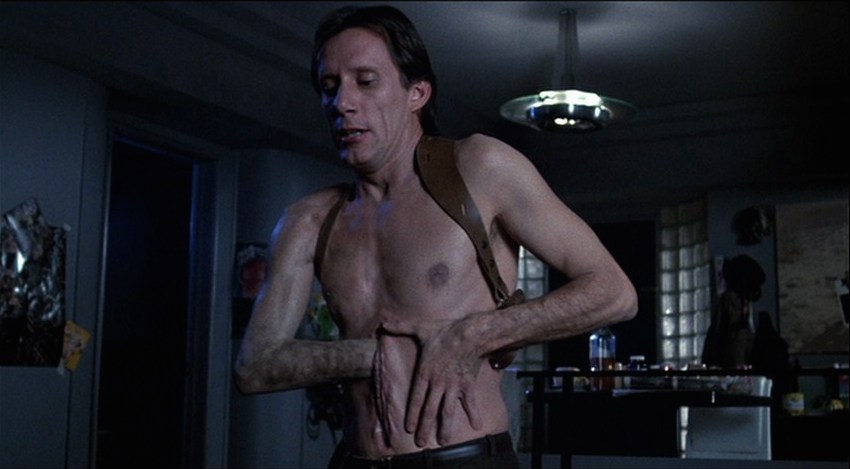
David Cronenberg’s 1982 Videodrome is the earliest and most popular of films to utilize video as a tool of perversion and destruction. It was made during the height of the format wars of VHS and Betamax. While not influenced by the United Kingdom’s video nasty scare, it was based on events occurring closer to Cronenberg’s visit to the Ontario Film Censor Board. Cronenberg already experience problems with the Board regarding the removal of a few seconds to the Ontario version of The Brood. The scene in which Samantha Eggar licks the blood off her bloody deformed newborn was cut out, effectively suggesting that the mother is actually eating her newborn, not gently licking it. While Cronenberg was at the Board’s office, members were showing torture footage they had removed from Emanuelle in America, using it as an example of what type of obscene material they deemed inappropriate for Ontario residents.
In Videodrome, Max Renn (James Woods) is the president of a UHF television station which specializes in low-brow programs of sex and violence to attract viewers. His assistant encounters a pirate satellite signal of Videodrome, a program in which victims are tortured and killed. Enticed by the excitement of finding daring new programming, Max has more episodes recorded off the signal so he can watch at home. He finds out that the signals are actually part of a corporate conspiracy to take over the station, developed to cause brain tumors in the viewers. As the tumor grows inside inside his head, he begins to hallucinate; the videocassettes begin to “breathe” and become amorphous. Soon his body becomes a giant living video playback device. His enemies manipulate him by inserting video cassettes into him and control him to do their evil schemes.
In high school I told a friend that I wanted to see Eraserhead badly. She was always wearing an Eraserhead shirt all the time, and her being really cute and unobtainable made it even more unbearable for me. I had to see it, but there weren’t any video stores in town who had the old Columbia Pictures VHS. She told me that the Rogers Video in town did in fact have it. It was in their Cult section but someone had stolen the box. So the only way to rent Eraserhead was to ask for it at the counter. When I tried to rent it not even the staff knew they had it. So the only way you could rent it was through hearing about it from someone else who had rented it. If that’s not a perfect introduction to cult films, or at least a perfectly fine suburban equivalent to a downtown midnight screening, I don’t know what is.

In Hideo Nakata’s Ring (1998), rumours of a cursed videotape circulate among Japanese youth. The tape contains a series of grotesque images, ending with the image of a strange figure climbing out of a well. It is believed that when a person watches the videotape, the nearest telephone rings immediately afterward and announces that they have seven days to live. The only way to remove the curse is by making a duplicate of the tape and passing it on to another person.
The film was successful enough to inspire several sequels, a television series as well as Korean and American remakes. The original method of death in Kôji Suzuki’s book is that the victim dies from a tumor which quickly grows in the throat and chokes them to death. The film versions both clarify and alter the details as the series continues; in the early films the same mysterious figure comes out of the television screen and approaches the victim, frightening them to death. In later entries the deadly curse is a virus which uses alternate modes of transportation; it contaminates the medical report of the murder, the paperback based on the report, a television special based on that book, and even other marketing tools such as the official website for the film within the film! In fact this article probably contains the curse as well, so you now have a week to go. Send your photocopies of this issue to ESR c/o Greg, not me. I hardly check my mail. Thanks.
In David Lynch’s Lost Highway (1997), an affluent couple in Los Angeles discover a brown envelope left on their doorstep early one morning. Inside is an unmarked videotape, contains grainy footage of the outside of their home. It abruptly cuts out after several seconds. “Maybe it’s from a real estate agent”, Renee nervously dismisses to her husband Fred. Another package turns up the next morning. This tape picks up where the last one left off, panning around the exterior and slowly zooming in on the doorway entrance. A few glitches appear and instantly the camera is inside their home, floating at a bizarre angle that hovers over their living room furniture. The camera enters the bedroom where the couple are asleep in the bed. Police detectives are called in to see if there are signs of forced entry. They are stumped. As more of these tapes arrive, relations between Renee and Fred deteriorate. It becomes apparent to him that Renee is having an affair. Fred watches the latest tape that morning by himself. He sees an image of himself in the bedroom, kneeling on the floor with a bloodied, mutilated body of Renee on the bed.

A similar circumstance is used as the basis of Michael Haneke’s Caché (2005) in which an affluent Parisian couple (Daniel Auteil and Juliette Binoche) receive anonymous videotapes on their doorstep. The tapes are wrapped in plastic shopping bags. The footage is surveillance of their home, a camera placed across the street, filming their daily lives for several hours. These tapes continue to be left on the doorstep throughout the film, giving no peace at all for the couple or the audience. Haneke has used videocassettes in his earlier films in his observations on how people are disconnected from society.
In Benny’s Video, a privileged and neglected teenage boy collects and rents violent films on video, from cheap splatterpunk of The Toxic Avenger to homemade footage of a pig being killed in a slaughterhouse. He kills a girl and inadvertently records it on videotape. In Funny Games, two sadistic teenagers terrorize a family in their summer vacation home. During one act of violence which goes horribly wrong (from the villains’ point of view that is), one of the teenagers (big spoiler ahead!) breaks the wall between audience and film by reaching for a remote control and rewinding the film a few minutes back to correct the error!
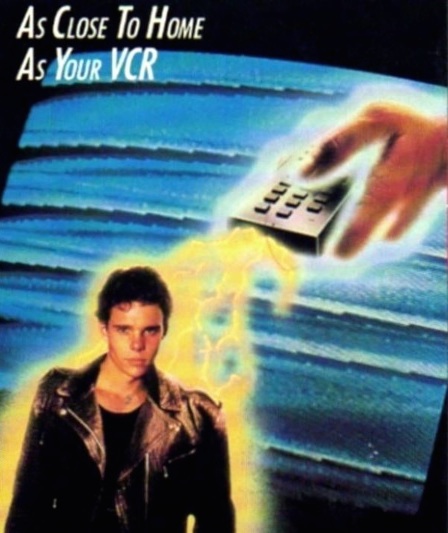
In Jeff Lieberman’s Remote Control (1987), the setting is inside a video store, situated inside the lobby of a majestic old movie theatre. A new in-store cardboard display is set up for a video release of an old 1950s science fiction film called Remote Control. Customers are attracted to the giant display and the video becomes a big renter. Unfortunately the video triggers people to kill after a few minutes into the film. A video clerk and his friend uncover a plot that involves aliens who have picked up a transmission of the film and opened a video manufacturing plant as part of their scheme to exterminate the human race. The film is a highly exaggerated view of the 1980s — not since Liquid Sky has there been so much neon and pointy hair! – and a great time capsule of 1980s video store culture, from the cardboard advertisements to the varying, Russian doll-like diminishing sizes of video boxes (sadly, no sign of those majestic big-box MGM/UA silver boxes… Golan-Globus productions never deserved such luxurious treatment!)

It was inevitable that video would finally meet its match. Videodiscs and Laserdiscs never appealed to the masses, probably due to their higher retail price and size. Video liquidation sales have been going on for the last decade now, the result of the rising popularity of DVD as well as the increasing number of old video chain stores going bankrupt. Each sale I go to appears to be the last death cry of the format, as I walk out with several bags of videos. It leads me to believe that perhaps this is the last gasp of video, but then another sale comes along with even bigger deals. One thing is for sure. Video is the damaged produce that nobody wants. The compact size of DVD was certainly an appealing aspect along with the lower price. DVD has now become ridiculously cheap. It’s amusing trying to peel off so many security tags off a $1.99 DVD purchased in a supermarket impulse item bin.
Are there any mysteries to unlock in a DVD? Appearance wise, no. I am reminded of how much musician and recording engineer Steve Albini passionately hates the compact disc format, calling it “the rich man’s 8 track.” On his band Shellac’s At Action Park album, the compact disc states: “this was not mastered directly to metal or pressed into 165 grams of virgin dye-blacked vinyl. There is in fact, nothing at all special about the manufacture of this compact disc.” The same could be said about DVD. There is nothing which stands out when looking at a stack of 100 DVD-Rs.
What if someone were to leave a DVD-R outside your doorstep? You could watch the content and if the compression rate is poor, determine that the surveillance-happy culprit is harmless. If he can’t even burn a DVD properly, what possible harm could he do? If there’s a virus on a cursed DVD, you could easily run off a 50-pack of blank DVDs and be done with it. Digital just lacks that warm analog touch of evil.
Originally published in Vol. #1, Issue #19 (the ever-popular VHS RIP issue).
Brian Random

Brian Random occasionally dabbles in music and film and if you make it three yards, we'll have us an automobile race!