
Music and film have always had an interesting and unusual relationship, which steadily evolved throughout the course of the 20th Century. The arrival of home video and the widespread public embrace of VHS in the 1980s opened up a whole new realm of possibilities for musicians and record companies, as well as for the music enthusiast and general consumer. Music fans were suddenly able to watch their favourite artists in action at the press of a button, and record labels and film companies responded to the newfound demand with a proliferation of music-related titles on VHS (and briefly Beta, the 8-track tape of home video) for viewers to rent or purchase. VHS was also importantly a recordable medium – one could now capture anything broadcast on television for later viewing. This was a revolutionary concept in the early 80s, and crucially for pop music fans, the VCR became a common household item just as MTV (and MuchMusic in Canada) was getting up to speed, so the amount of music video in stores and on the air was at an all-time high. New ground was being broken, new horizons were opening up, and music on film was now firmly entrenched in the home. It was a great time to be a music fan.
Looking back a quarter of a century later, the music video explosion seems almost naïve and overly ambitious in retrospect, the ephemeral product of early 80s pop culture. But as DVD sweeps the market and VHS titles disappear from the video shelf, one has to think twice about retiring the trusty VCR. A lot happened in that 20-plus year period that remains captured on VHS, and much of it will not make the transition onto 21st Century media. The music world in particular is ever-changing and driven by trends and personalities, so the incentive is generally not there to keep music product in print after its initial run. As VHS becomes obsolete, it is not necessarily the format itself that will be missed, but the content. The personalized tapes recorded from television broadcasts, the anthologies and concert tapes collected over the years, and the independently produced music videos that may pop up in your collection are what give VHS its staying power. Music video releases on VHS covered an extensive range of musical genres; however, it is within the pop world that the music video was most widely developed, produced, and ravenously consumed.
Music fans are quite seasoned to the whole concept of the “format change”, moreso than film collectors, so the implications of the move from VHS to DVD are quite well understood. Most film collectors are probably undergoing their first format transition in moving from VHS to DVD (unless they got into Laserdisc or film prints), and are either saving their more obscure titles on VHS or transferring them onto DVD. Music lovers have learned that it is not so easy to let go of old technology despite the lure of the latest and greatest. Audio collectors have moved through various forms of vinyl, 8-track tape, cassette, DAT, CD, and most recently MP3, and each of these formats has its enthusiasts, even the inferior 8-track tape. As a result, music fans know all too well the value of “obsolete” formats, and VHS will be no exception. Sure, the picture quality in VHS is inferior to DVD (in some cases!); sure, the sound is often muffled; sure, the tracking can be impossible to stabilize; sure, the tapes are bulky and awkward to store; but again, the content is the key. As any vinyl collector will tell you, not everything enters the digital realm, and even if and when it does, it’s not the same – a transformation has occurred. Ironically, the option of saving VHS tapes has its own downside, as the tapes themselves deteriorate over time, so their lifespan is ultimately finite. The only way to preserve the content may be to convert it to a digital format.
Like those vaults of vinyl records and boxes full of audio cassettes safely stored away in homes across the globe, the VHS collection is a storehouse of unique recordings that may or may not rematerialize in the digital realm: a time capsule that will become more valuable as the years pass. In terms of music videos, the material to be found in the average VHS collection covers a wide range, from feature length concert films and documentaries to promotional tapes and music video anthologies, which saturated the market throughout the 80s and 90s. In addition, feature films with ties to the music world, from biopics to films with musicians as actors fall into our sphere of interest. And the numerous personalized tapes recorded from television broadcasts complete the equation. A quick dig through my own personal VHS collection uncovered a substantial array of videos falling within each of the above mentioned categories, which are sweeping at best. There are certainly many music-related gems to be found on VHS, and I will outline a few examples in each category just as a brief survey of what’s out there.
Concert Films
The concert film is a favourite of music lovers, a form which really came of age in the late 60s with the release of such landmarks as Monterey Pop and Gimme Shelter. Before VHS, concert films were a staple of late night TV and the repertory cinema circuit –The Song Remains the Same and The Last Waltz are two of the more popular titles of the 70s that lit up the big screen into the wee hours. Concert films such as Stop Making Sense and Laurie Anderson’s Home of the Brave continued to be theatrically released in the 80s, but they also found a new outlet on home video, where fans could watch the performances over and over at their leisure. Also, record companies could now fairly cheaply produce concert films aimed solely at the video market, bypassing the expense of a big screen release, so a whole stream of straight-to-video live releases became available. Some notable concert titles you may find in the VHS bins include Tom Waits’ Big Time, The Cure in Orange, Pink Floyd’s A Delicate Sound of Thunder, and the inimitable Urgh! A Music War (see below), among countless others.
Documentaries
Music documentaries profile either a specific artist (such as Bob Dylan in Don’t Look Back), a style of music (Ken Burns’ Jazz series), or a music scene or event (such as Penelope Spheeris’ Decline of Western Civilization films). The line between concert films and music documentaries often blurs, but a number of distinctive music docs found their way to VHS, and these efforts are often quite difficult to track down. The documentary section in your local video store was most likely relegated to a back corner, squeezed between the equally fringe “Canadian”, “Music”, and “Cult” sections. A lot of music documentaries saw the light of day through television broadcasts, so many of them are preserved on home video libraries and nowhere else. In Canadian content alone, Toronto punk films Not Dead Yet and The Last Pogo, and Alan Zweig’s Vinyl (which did receive a limited VHS pressing), to name but a few, are all next to impossible to get ahold of. VHS dubs from TV airings and “grey market” trading keep these and numerous other music documentaries from being lost completely.

Music Video Anthologies
The music video anthology became a very popular item on the home video market, an outgrowth of the MTV-driven music video boom of the 80s, and virtually every artist who had a music video or two had a tape available. Everyone from Soft Cell to Bruce Springsteen offered up their music videos for sale on VHS, although some collections were more carefully assembled than others. The Cure, for instance, catered to their rabid fan base with the release of Staring at the Sea: The Images (1986) and the follow-up Picture Show (1991). Both tapes intersperse rare home-movie footage of the group (backstage, live, on tour buses, etc.) with the actual music videos, some of which are presented in extended form. A variation on the music video anthology is the video EP or album. Artists occasionally produced a series of interrelated videos from one album, and assembled these as a video EP or album to accompany and promote the record release. Pink Floyd embraced the idea with The Final Cut (1983) video EP, and Roger Waters later did the same with his Radio Kaos (1987) video EP, each presenting four music videos taken from the album in question. The The notably took the concept further with Infected (1986), a video interpretation of the entire album, featuring the directorial work of Peter Christopherson (of Throbbing Gristle/Psychic TV notoriety), Tim Pope (The Crow: City of Angels), and others. And Lou Reed presented his critically-lauded New York album in full-length video form, opting for a live interpretation (see below). These creative opportunities were offered up by VHS, and were perfectly suited for home viewing.

Beyond single artist anthologies, record labels also assembled compilations of videos by various artists on their roster. These releases tend to veer a bit closer to the promotional video, simply presenting a cross-section of music and images to promote the label in general. A personal favourite is The Beast of I.R.S. Video – Volume 1 (1984). Not only does it contain a fun collection of videos from a colourful selection of artists, including The Fleshtones, R.E.M, and The Cramps, but I discovered that one of the clips, “Dance With Me” by The Lords of the New Church, was directed by none other than Derek Jarman. I.R.S. Records folded in 1996, so the likelihood of this title resurfacing is next to nil. Another tape that perfectly illustrates this category is Picture Music (1983). This anthology was passed to me by none other than ESR’s esteemed editor, Greg Woods (I didn’t write that- ed.), and is a real time capsule of early 80s music video in its infancy. Packaged in a cheesy box labeled with the declaration “Contains 14 of the hottest MTV videos”, Picture Music approximates the MTV experience with a mixed bag of videos, ranging from the new romantic strains of Talk Talk, to the bluesy rock of George Thorogood, to the absolutely ridiculous clip for the Steve Miller Band’s “Abracadabra”. The original price of $39.95 listed on the box still seems outrageous, but who knows what this would go for on eBay!
Promotional Videos
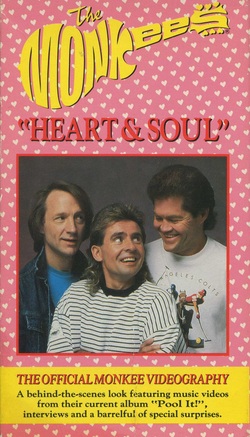
The boundaries between music videos created primarily for promotional purposes and those in the above-detailed categories tend to blur in most cases, but certain tapes do tend to fall more into this description. Of all music-related product, promotional tapes have the shortest shelf life, and usually the least to offer in terms of significant content. The bulk of promotional videos never even reach the general public – they are produced by record companies for circulation to the media and within the industry to bring attention to an artist or a new release. Promo videos could be anything from a quickly dubbed copy of a single music video, to a hastily assembled interview tape or an artist profile. Some promotional tapes have made it onto the market, often as free giveaways, and occasionally for purchase. Another dusty VHS tape unearthed by ESR’s editor and brought to my attention is a suitable candidate for inclusion in this category: Rhino Video’s The Monkees “Heart & Soul”. Billed on the cover as “The Official Monkee Videography”, Heart & Soul is in reality a 40-minute hodgepodge of a tape, put out in 1988 to help promote the group’s “comeback” album, Pool It! (deemed by the All Music Guide as “Unquestionably their worst output of all time”). While only three of the original “pre-fab four” show up for the festivities, Heart & Soul attempts to rekindle interest in The Monkees with a mix of contemporary interviews, lame concert footage, nostalgic flashback material (including Rice Krispie commercials from the 60s), and a couple of new music videos for songs from Pool It!, most of which are forgettable to embarrassing. A vaguely enjoyable watch for the hardcore Monkees fan maybe, but Heart & Soul just left me pining for the original series (or another viewing of Head). Ultimately, the bulk of promotional videos are disposable, for completists only.
Feature Films
Musicians crossed over into the acting field long before the advent of rock and roll, and this trend continued with countless rock and pop musicians from the 1950s onward. A vast multitude of theatrically-released films can be linked in some way to the music world, from obvious artist vehicles, to biopics, to more “serious” endeavours with musician actors. These feature films are definitely of interest to the music fan, and also generally have more appeal to a broader audience than the average music picture. Hence, they tend to remain in circulation more widely than titles which fall into the other above-mentioned categories, and a large number of them found new life on VHS. A whole volume could be written on the subject, so I’ll just touch on one or two examples that remain on VHS: Freejack, Just A Gigolo, and Candy Mountain (see below) are but the tip of the iceberg. In Canadian film, a specific title that comes to mind is Listen to the City. Directed by Ron Mann, this dystopian film is a largely-forgotten effort that includes roles for The Spoons’ Sandy Horne, and, significantly, Jim Carroll. It was never officially released on video, but the director will make you a VHS dub if you want to see it (apparently the master is not suitable for DVD standards). How’s that for supply and demand?
The relationship between music and film was greatly impacted and redefined by the VHS phenomenon in the 1980s, and this evolution continues into the 21st Century with the new opportunities offered by DVD. Many music films have been updated with new and improved editions on DVD, Monterey Pop, The Last Waltz, and Woodstock being a few examples. And as DVD takes over the market, a new chapter in music film is also unfolding. High-profile biopics like Ray and Walk the Line have raised the level of respect for music films, as have documentaries along the lines of Bob Dylan – No Direction Home and End of the Century: The Story of the Ramones. DVD is also a dream format for the completist, offering high-quality sound and image, and a more in-depth overall product, loaded with “extras”. Music retailers now devote significant shelf space to DVDs, and a vast quantity of music titles have already hit the market. Indeed, the music video is alive and well in the age of DVD. However, don’t put your VCR out to pasture yet, even though the temptation is probably there. Those elusive music tapes that I’ve hinted at above will start becoming available now more than ever, as collectors dump their VHS libraries just as vinyl records were discarded over a decade ago, and that VCR will suddenly seem not so obsolete after all.
FIVE MUSIC VIDEOS TO WATCH FOR:
With the demise of VHS, a wealth of music-related titles are quickly disappearing from the shelves of your local video store and record shop. Many of these videotapes are not available on DVD, and quite a few never will be, as public demand moves on to newer artists and more current releases. Music fans love their lists and charts, so I’ve compiled a “Top 5” of sorts: five cool music videos to watch for in the VHS clearance bins. These are not necessarily the most important or hard to find tapes that you might come across in your travels, but each one is a real find, and good solid entertainment. Good hunting!
Candy Mountain (1988)
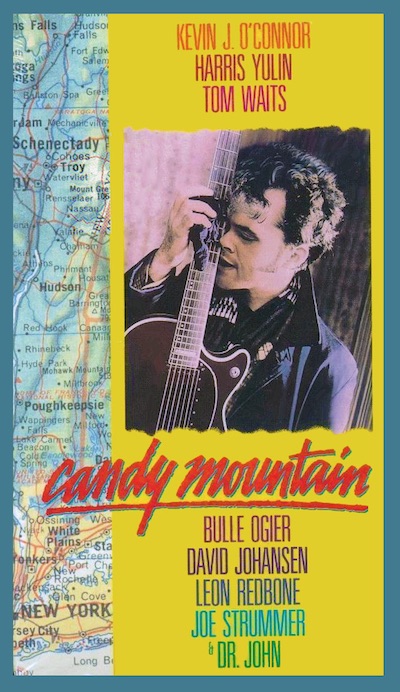
This obscure, offbeat late-80s road movie is a good companion piece to Jim Jarmusch’s downbeat classics of the period, Stranger Than Paradise and Mystery Train, as well as Bruce McDonald’s Roadkill. Directed by the infamous Robert Frank (Cocksucker Blues), Candy Mountain starts off in downtown New York City, and follows the exploits of a down-and-out musician (Kevin J. O’Connor) as he journeys along backwater highways into Canada, in search of a reclusive music legend famed for his custom-built guitars. What makes this meandering picture notable for music aficionados is the presence of a number of musicians in acting roles throughout the film. Viewers are treated to segments featuring David Johansen, Tom Waits, Dr. John, and Leon Redbone, as well as brief appearances by Joe Strummer, Arto Lindsay, and (surprisingly) Rita MacNeil. While not an entirely successful film, Candy Mountain is certainly a delightful curio worth tracking down.
The Decline Of Western Civilization (1981)
Penelope Spheeris’ feature film debut is a legendary document of the Los Angeles punk rock scene of the early 80s. Decline descends right into the trenches to capture the first wave of West Coast hardcore punk on its home turf, and the results are riveting. Riotous concert footage of Black Flag, X, Circle Jerks, and others, along with candid interviews, offer a captivating look at a volatile and desperate community of musicians and audience members literally living on the edge. The chaos and violence of the live performances is well represented on film (particularly in the footage of The Germs and Fear), with each group delivering between two and five songs at typical breakneck speed. Decline is a compulsory punk film, and is more gritty and vital than Spheeris’ hair metal follow-up, The Metal Years, which plays it a bit more for laughs.

Lou Reed – The New York Album (1990)
Lou Reed’s The New York Album video is a hybrid of the concert film, the video album, and the promotional video. Reed’s tight four-piece unit perform his New York album in its entirety, presenting an alternate live take of the acclaimed album. The endeavour was clearly intended for home video release, although for some reason, each song is presented as a separate segment, with intertitles introducing each number. This implies that the final product may also have been intended as a promotional vehicle for the New York album, and sent to broadcasters for airplay. Whatever the case, this videotape presents a decent snapshot of Reed in concert, live at Theatre St. Denis in Montreal, running through a variety of brisk politically-charged rockers, familiar hits (“Dirty Blvd.”, “Romeo Had Juliette”), and more arty material. If only a similar film had been made for Transformer…
Lonely Is an Eyesore (1987)
After a tentative debut at the tail end of the punk explosion, British label 4AD seemed to find its identity in the mid-80s, and the compilation Lonely Is an Eyesore is a beautiful document of the label and its artists at the time. Lonely Is an Eyesore was a multi-faceted project, encompassing an elaborately packaged vinyl record, and an accompanying video album, all designed to showcase 4AD’s distinctive talent. Groups such as The Cocteau Twins, The Wolfgang Press, and This Mortal Coil contribute stunning audio material, which was interpreted in video form largely by director Nigel Grierson. Grierson was head of photography at 4AD’s design studio, 23 Envelope, so the resulting videos convey a similar aesthetic to the label’s album packaging. And yet, while the anthology has an overall artistic coherence, there remains an individualism to each video. Visuals for moody tracks such as Dead Can Dance’s “The Protagonist” and Dif Juz’s “No Motion” are rendered in dreamlike sepia tones, while those for Colourbox’s playful “Hot Doggie” and Throwing Muses’ erratic “Fish” are more flashy and jagged. Lonely Is an Eyesore was an artistic achievement that far transcended the average record label video anthology. It also is a high point in 4AD’s catalogue, and later compilations such as All Virgos are Mad failed to match its standard.
Urgh! A Music War (1981)
You would be hard-pressed to find a better document of the post-punk “new wave” era than Urgh! A Music War. Filmed in 1980, Urgh! is a concert movie of sorts, although rather than focusing on one show or band, the film is a compilation of live footage shot at a number of different locations, brought together in one dynamic package. The vitality and individuality of the artists represented in the film really shines through in Urgh!, and many of the performances are truly unforgettable. Klaus Nomi’s chilling operatic pop, The Cramps’ frantic rendering of “Tear It Up” (complete with Lux Interior’s mike swallowing antics), Gary Numan’s sci-fi stage set, and a rare glimpse of XTC live are just a few of the endless delights to be found in Urgh! Throw in some John Cooper Clarke segments, and what more could you ask for? As the All Music Guide so eloquently puts it, “There are too many highlights to list them all.” Don’t expect to see this film on DVD anytime soon – apparently legal issues regarding music rights will be keeping it in limbo indefinitely. Scour the VHS clearance bins for this one!
Originally published in Vol. #1, Issue #19 (the ever-popular VHS RIP issue). Much has made the conversion to DVD since this was printed, but we’ve left it as is, to give a snapshot of what things were like for collectors in the middle of the great “format change”. Postscript to David: how much did you get for my copy of Picture Music on eBay?
David Faris

David S. Faris is a Toronto-based writer, musician, DJ, and graphic designer. He has written articles and reviews for music magazines Chart, Exclaim!, and Blue Suede News. He is also a founding member of the Toronto Film Noir Syndicate.