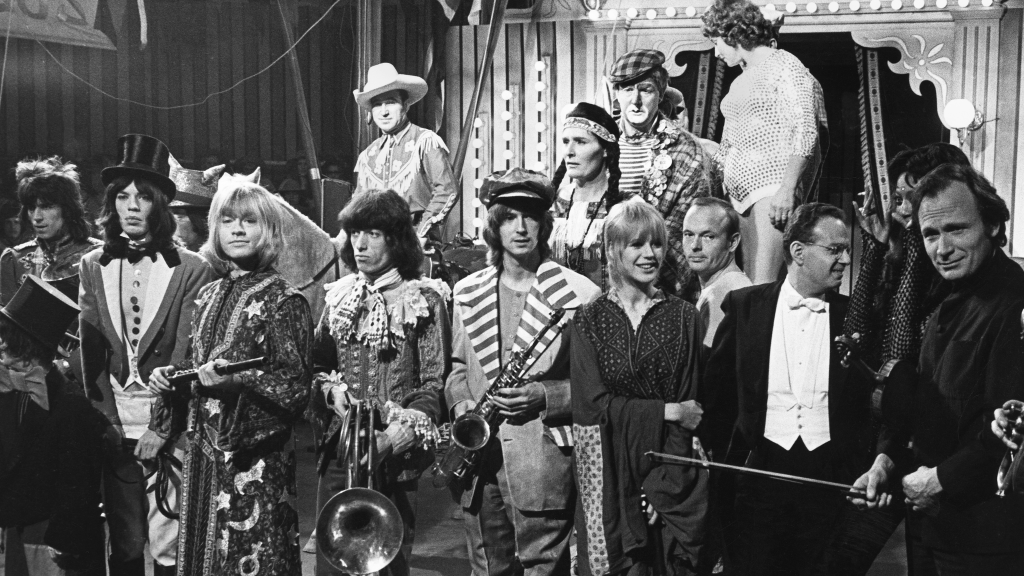
The Rolling Stones Rock and Roll Circus (UK, 1968) 63 min color DIR: Michael Lindsay-Hogg. PROD: Sanford Lieberson. DOP: Anthony B. Richmond. CAST: The Rolling Stones, Jethro Tull, The Who, Taj Mahal, Marianne Faithfull, The Dirty Mac, Yoko Ono. (ABKCO Films)
The Rolling Stones are a seemingly unstoppable force, moving confidently into their fifth decade as prolific songwriters and tireless performers, showing no signs of relinquishing their long-standing title as “The Greatest Rock and Roll Band in the World.” The group’s substantial legacy and surrounding mythology are virtually unsurpassed in the history of rock and roll, and as they embark on yet another mammoth concert tour, in support of yet another new studio album (A Bigger Bang this time around), it is refreshing to discover a lesser-known curio from their formative years such as The Rolling Stones Rock and Roll Circus. This colourfully staged extravaganza is a somewhat unusual entry in the Rolling Stones’ filmography, in that it remained in limbo for over a quarter century. A veritable time capsule, Rock and Roll Circus was originally committed to film in December of 1968, but due to disappointment on the part of the Stones themselves, the results were shelved, and ultimately, the finished product did not appear until 1996, when it was released to the public on video. A more satisfying expanded edition of the film was finally made available on DVD in late 2004, completing the picture with valuable commentary tracks, and several additional performance takes that didn’t make the lean 63 minute cut.
Rock and Roll Circus is, in effect, a staged ‘60’s “happening” of sorts, orchestrated by the Stones to coincide with the launch of their much-lauded Beggars Banquet album. The grandiose event, a rock and roll variety show that alternated musical and circus acts under the big top, was envisioned as a loosely-themed television special to promote the Stones, much in the same vein as The Beatles’ Magical Mystery Tour of the previous year. Marking the tail end of the Stones’ flirtation with psychedelic folly (most notably preserved on the group’s 1967 album Their Satanic Majesties Request), Rock and Roll Circus is a light-hearted, entertaining spectacle that offers a glimpse into the madcap world of late-’60s “swinging London.” Mick Jagger apparently spearheaded the idea, and brought in Michael Lindsay-Hogg (who had directed the Stones’ video for “Jumpin’ Jack Flash,” and would next document the Beatles in Let It Be) to further develop the concept, which the director amusingly refers to in the commentary as “the World Series of rock and roll.” The film is primarily a vehicle for The Rolling Stones, who appear appropriately outfitted in circus attire as they host the off-kilter proceedings, but of equal importance are the supporting players, an impressive and unpredictable lineup of contemporary acts from the British music scene. Prime movers such as The Who, John Lennon, Yoko Ono, Eric Clapton, and (Jimi Hendrix Experience drummer) Mitch Mitchell provide some star power and inspired performances, while prog-rock nutters Jethro Tull, otherworldly beauty Marianne Faithfull, and American blues rock combo Taj Mahal add their own distinctive contributions to the occasion. Alongside these familiar personalities, a procession of fire-eaters, clowns, and trapeze artists display their talents, adding a vaguely surreal, Fellini-esque element to the film at large, a well-rounded and festive affair that is full of surprises.
It is The Who and The Dirty Mac who give the Stones a considerable run for their money in Rock and Roll Circus. The Who takes the stage early in the film, and their dynamic, rip-roaring rendition of “A Quick One, While He’s Away” set the bar high for all who were to follow. The group is in peak form at a key turning point in their career, breaking away from their mod rock roots and pushing the boundaries of rock and roll songwriting. “A Quick One, While He’s Away” declared The Who’s intentions loud and clear, a “mini-opera” that breaks the mould of the pop song and presents a quirky narrative in several parts, foreshadowing impending rock operas such as Tommy and Quadrophenia. This more complex endeavour is nonetheless delivered in classic uproarious Who form, bristling with pure anarchic energy and naked ambition. The Dirty Mac is perhaps the most remarkable group on the bill, if only due to the personalities involved. Fronted by John Lennon, The Dirty Mac is a supergroup that was assembled exclusively to participate in Rock and Roll Circus, with Eric Clapton on guitar, Keith Richards on bass, and Mitch Mitchell on drums. Their two-song set is loose and bluesy, starting with a blistering version of Lennon’s Beatles number “Yer Blues,” and moving into “Whole Lotta Yoko,” an improvised jam with violinist Ivry Gitlis and a wailing Yoko Ono. The raw power and creative spirit of both The Who and The Dirty Mac are brilliantly preserved on Rock and Roll Circus, upping the film’s historic value.
All contenders aside, it is The Rolling Stones who are the main attraction here, and the group delivers a credible, at points spectacular set, one that would later prove to be fateful. The Stones are admittedly not at their best in this outing, largely due to the fact that they didn’t get onstage until somewhere in the neighbourhood of 2 am, due to countless delays in the marathon shoot. The group looks a bit worse for wear, not to mention under the influence of various substances. Keith tellingly states in the commentary, “I remember not remembering everything towards the end, and it was really ramshackle in a way, but it was fun. Needless to say, that day I don’t think there was a straight act in the house.” Brian Jones, in particular, appears to be in a damaged state, seemingly barely conscious in certain shots, which is disheartening, as this would be his final live appearance with the band. But despite their somewhat compromised physical and mental state, the band gets down to it, and runs through a selection of six recent songs. “Jumpin’ Jack Flash” kicks things off a bit sluggishly, followed by the solid blues groove of “Parachute Woman,” but it is with “You Can’t Always Get What You Want” that the Stones hit their stride, and by “Sympathy For The Devil,” they are a captivating force to be reckoned with, shining in all their youthful glory (were they ever really that young?!). For the closing number, “Salt of the Earth,” the visibly exhausted group join the audience and the other musicians in a raucous sing-along, which ends the film on a positive note.
Despite a wealth of strong material overall, the Stones were dissatisfied when they saw their portion of the film in playbacks (according to rumour, they were concerned that they were outplayed by The Who and The Dirty Mac), so the completion of the film was delayed. The group intended to re-shoot their segment, but this plan was never realized, and with the death of Brian Jones in 1969, the whole project was shelved indefinitely. It is fortunate for music fans that the film has been revived and completed all these years later, even as an archival piece. In retrospect, it is a worthwhile and surprisingly engaging effort, given much additional relevance due to its historic significance. In the context of other Stones-related films, Rock and Roll Circus sits in a fertile and controversial period, shot the same year as both Godard’s One Plus One (aka Sympathy for the Devil) and Donald Cammell/Nicolas Roeg’s avant-garde shocker Performance (which starred Mick Jagger); The Stones in the Park (1969), a made-for-TV concert film shot two days after Brian Jones’ untimely death, and the infamous Maysles brothers Altamont documentary Gimme Shelter (1970), would follow in quick succession. Rock and Roll Circus remains a record of a more optimistic, carefree time that would soon be lost to many of those involved in the film, a brightly coloured world of sights and sounds that are worth revisiting. And really, who doesn’t like the circus?
Originally published in Vol. #1, Issue #17, “Rock And Roll Goes To The Movies”.
David Faris

David S. Faris is a Toronto-based writer, musician, DJ, and graphic designer. He has written articles and reviews for music magazines Chart, Exclaim!, and Blue Suede News. He is also a founding member of the Toronto Film Noir Syndicate.