The gentlemen at Cahiers du Cinema once proposed the theory of structured absences, suggesting that many films must be analyzed not simply based upon what was on screen. They went on to discuss John Ford’s Young Mr. Lincoln (1939) in terms of, among other topics, the political persuasions of the director and studio (both Republican), the cultural and political atmosphere of America at the time, and, of course, the preconceived notions about Abraham Lincoln we as audience members bring to any film about him.
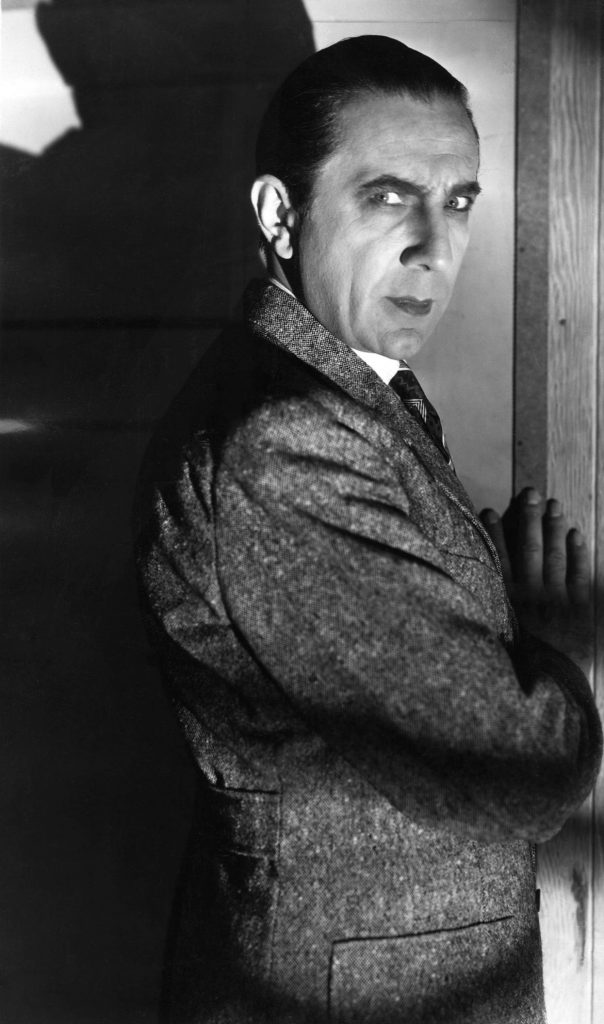
I think the Bela Lugosi filmography should also be approached this way. Anyone with even a cursory knowledge of classic horror films will be well aware of the sad arc of Lugosi’s career in Hollywood – his triumph as Dracula in Universal’s 1931 film quickly overshadowed by Boris Karloff’s greater triumph in Frankenstein, doomed to live in Karloff’s shadow and finding himself in steadily less impressive films until he died more or less in obscurity.
The obvious transition point between the high of Dracula and the low of Plan 9 from Outer Space was Lugosi’s professional relationship with Sam Katzman, proprietor of Monogram, which, along with small-fry studios like Republic and Victory, constituted what is popularly known as Hollywood’s poverty row. Pre-booking their films and keeping close tabs on cost to all but guarantee profit, the Monogram films almost always played on the bottom half of double bills and favoured the lowest common denominator. You had your cut-rate thrillers (including the later Charlie Chan films), your slapstick comedies (especially the Bowery Boys), and, of course, your horror pictures.
Anyone viewing the Lugosi Monograms must obviously keep in mind the impoverished circumstances under which they were made and understand the niche they filled in the grand scheme of cinema. Much of their fascination comes from our knowledge of Lugosi’s tragic life, well aware that we are witnessing a career slowly but surely self-destructing. But what really struck me upon revisiting the films was how little Lugosi himself appears. He is always much discussed by other characters, is guaranteed to evoke certain emotions within the audience based on our prior understanding of his screen persona, and he so dominates the few scenes that he is in that he really becomes his own films’ biggest structured absence.
How did the star of Universal’s biggest moneymaker of 1931 end up at Monogram? The rivalry with Karloff is usually blamed for Lugosi’s fall from the A-list, but I think the real turning point came in 1937, when the British board of film censors banned horror films and dramatically stalled Lugosi’s career. While Karloff – always a more chameleonic actor and under contract at Universal and Warner Brothers – continued his film career more or less unabated, Lugosi appeared in only one serial in 1937 and no films in 1938, turning to stage work when offers dried up. “What’s happened to Bela Lugosi, who used to do a lot of swell acting around town?” asked Jimmy Starr in his Los Angeles Herald Express column, 24 November 1937. Once the ban was lifted, a work-hungry Lugosi naturally became even less choosy about film roles.
There is also the matter of Lugosi’s notoriously poor business sense. Historian Gregory Mank, in his dual biography Karloff and Lugosi, puts some of the credit/blame for Karloff and Lugosi’s disparate careers on their agents. While Karloff’s Leland Hayward/Myron Selznick agency also represented the likes of Gary Cooper, Fred Astaire, Katharine Hepburn, Carole Lombard and Ginger Rogers, the biggest names represented by Lugosi’s agent, Al Kingston, included such megastars as Ward Bond, Berton Churchill, and Henry Wadsworth. (In 1937, Lugosi made the jump to William Merklejohn Inc., whose client list – including Eddie “Rochester” Anderson, Mischa Auer, and Tom Tyler – was not especially better. In 1938, his fellow talent under new agent William Stephens included character actors like Margaret Dumont and J. Carrol Naish.)
Lugosi began his association with Monogram as early as 1935 with The Mysterious Mr. Wong, the same year he made Mark of the Vampire at MGM and The Raven at Universal. Inspired loosely by Fu Manchu and shot in eight days, the film featured Lugosi as a sinister Chinese villain killing one-by-one the possessors of the “Twelve Coins of Confucius,” the reuniting of which is said to inherit great power. Dressed in robes, glasses, pancake make-up and a drooping moustache, the Hungarian Lugosi is, to put it mildly, not the most convincing Chinese man you ever did see.
While not a typical horror film, this suspense melodrama in many ways set the pattern for Lugosi’s future Monogram films. While given top billing, Lugosi has under ten minutes of screen time, his character lingering threateningly over the plot and showing up only occasionally to laugh maniacally or scowl menacingly. There is a generic wisecracking leading man (here played by Wallace Ford), his strong but ultimately rather useless and equally generic love interest (Arline Judge). The musical score is straight from the library, tending to switch abruptly between cues and played at a volume just low enough to sound as if it’s playing independently from the action. There are henchmen, police chiefs, editors, and other stock characters played by barely recognizable stock actors. The film’s depiction of Chinatown is undeniably atmospheric, but more as an evocation of the skid row side of Hollywood so often seen in Monogram features than as, y’know, Chinatown.
(A side note: beginning in 1938, during the brief period when Britain banned all horror films and Hollywood production of the genre resultantly flatlined, Monogram lured Boris Karloff to star in five low-budget mysterious about a wise Oriental detective named Mr. Wong, including a confusingly-titled 1939 entry, The Mystery of Mr. Wong.)
Successful re-releases in 1938 of Dracula and Frankenstein gave Karloff and Lugosi career bumps and helped green light Son of Frankenstein (1939), in which Lugosi gave one of his very best performances as Ygor. 1939 became an active year for Lugosi, in which he managed to appear in both Ninotchka (fourth-billed, despite less than ten minutes of screen time) and Dark Eyes of London, a British Pathe films production distributed in America by Monogram. The film saw Lugosi play the dual role of Dr. Orloff – a slick, brutal insurance agent not averse to killing those who fail to pay up – and the elderly, moustachioed owner of a home for the blind named Dr. Dearborn. The revelation that Orloff and Dearborn are the same person is not terribly shocking.

Lugosi’s relationship with Monogram really began with The Invisible Ghost (1941), in which he played somewhat against type as a kindly widower who, periodically goes into a hypnotic (?) trance, in which he sees his dead wife and then goes on a murderous rampage. Compared to Lugosi’s Universal films (or, heck, even most of his Monograms) the mansion-set film feels rather low-frills, and several of the plot developments strain credulity more than a bit. Still, the direction by Joseph H. Lewis is surprisingly imaginative (one shot is framed from the point-of-view of within a fireplace, with the action taking place behind the flaming logs), and Lugosi’s subtle performance and abundant screen time make his character sympathetic. Also, the film is notable for the surprisingly sympathetic depiction of its African American character (Lugosi’s intelligent butler, played by Clarence Muse). This is arguably the best of the Lugosi Monograms.
Spooks Run Wild (1941), however, is the biggest guilty pleasure. A vehicle for the East Side Kids/Bowery Boys, who by this time had become a Monogram staple, Spooks Run Wild is such a half-assed little trifle that it pushes the theory of structured absences to its extreme. The East Side Kids, led as always by the suspiciously old Leo Gorcey and Huntz Hall, are given not even the slightest character development, with the film assuming instead that we are already familiar with their particular brand of shenanigans from previous series entries. Lugosi, playing the mysterious and seemingly supernatural magician Nardo, is likewise undeveloped, with his cape, affinity for coffins, and generally spooky manner explicitly reminding us of Dracula and pretty much expecting us to fill in the blanks.
The 65-minute film can be described in one sentence: Bela Lugosi scares the East Side Kids. Statically directed by Phil Rosen, much of the comedy takes place in medium and long shots with paper-thin, overlapping dialogue that unintentionally brings Altman to mind. Terrible as it is, I kind of love this film for its charmingly dime-store evocation of the typical Universal atmosphere, complete with cobwebbed house, secret passageways, and candle after candle after candle.
So successful was the Lugosi/East Side Kids team-up that everyone was back in 1943 for Ghosts on the Loose, directed by the tireless old schlockmeister William “One-Take” Beaudine. Despite the title, there is not a single supernatural element to be found. Instead, the eternally talentless East Side Kids find themselves being generally intimidated in another old, dark house by Nazi spies, led by Bela Lugosi. Lugosi barely even appears, showing up now and then to scowl and bark orders. The romantic leads are useless and arbitrary even by Monogram standards, although if you’ve ever had a hankering to see Leo Gorcey share a scene with Ava Gardner, here’s your chance.
At Universal Lugosi had a bit part in The Wolf Man (1941), returned as Ygor in The Ghost of Frankenstein (1943), and turned in an embarrassing performance as the monster in Frankenstein Meets the Wolf Man (1943), but Monogram was clearly his new home. Monogram entered the WWII propaganda fray with Black Dragons (1942), a creaky suspense picture starring Lugosi as a Nazi plastic surgeon who turned Japanese spies into Anglo Saxons. This rather dull film has some mild interest as a historical curio.

The Corpse Vanishes (1942) returned Lugosi to horror territory, with our hero playing a scientist who kidnapped newlywed brides, stealing material from their glands to keep his own wife youthful. “A gruesome offering aimed at out-horroring all horror pictures,” claimed The Motion Picture Herald in a bit of hyperbole that has aged perhaps even worse than the film itself. The Corpse Vanishes was roasted in the first season of Mystery Science Theater 3000, and today can be found on seemingly thousands of cut-rate DVDs. Despite being dreadful, it has most of what you’d want in a dreadful Lugosi film, from the beaker-filled lab set to Lugosi’s usual outsized, aristocratic performance, right down to the casting of dwarf actor and Monogram fixture Angelo Rossitto as Lugosi’s henchman.
For similar hilarity, take a look at Voodoo Man, the most unintentionally funny of the Lugosi Monograms, with Lugosi giving his usual intense performance as Dr. Marlowe, who uses voodoo in an attempt to revive his wife (what is it with Lugosi and his wives?). Another mad scientist film, the ridiculously macabre settings make this one especially fun. Many Lugosi biographers point out the uncommon depth to his character in Voodoo Man, and he is indeed more than just a snarling cutout. But while Lugosi turns in good work, I recommend seeing the film just on the basis of the hilarious performance by John Carradine as a mentally challenged henchman.
In The Psychotronic Encyclopedia of Film, Michael J. Weldon observed that nobody really seems to be able to follow the plot of Bowery at Midnight (1942). I must once again bring up the structured absences theory to suggest that the filmmakers were confident enough that audiences would be able to understand each of the stock characters based on prior experience with similar characters in similar movies (i.e. Dave O’Brien as the romantic lead; Lugosi as the seemingly kindly but secretly criminal university professor; the various short, tough-looking hoods in fedoras and cheap suits who prone to hiding behind walls and slowly drawing small pistols out of their jackets) that any further elaboration would be unnecessary. As the title implies, much of the film is set in a dank, tough urban area, and even if the plot is practically unintelligible, that sleazy, oppressively black-and-white Monogram city remains oddly compelling.

Lugosi’s career at Monogram neared its close with the notorious William Beaudine-directed The Ape Man (1943) in which Lugosi played a mad scientist who was transformed into, yes, a half-man half-ape during a freak experiment. Seeing Lugosi amble around the lab with ape-like posture and thick, conjoined hair and beard, it is unavoidable to reflect that this was the man who turned down the Frankenstein monster in 1931 for not meshing with his sexy image. In a piece of postmodernism that will never be considered Brechtian, the film ends with the minor character Zippo (Ralph Littlefield) smugly telling the character that he was the screenwriter. “Screwy idea, wasn’t it?” (I find the war bonds ad that follows immediately on most prints more interesting.) The film was successful enough to merit an in-name-only sequel, and Lugosi’s Monogram career limped to a close playing a quite human mad scientist in Return of the Ape Man (1944).
In 1946, Monogram opened the Allied Artists Productions unit, which, in an attempt to free the studio of the stigma of the Monogram name, would focus on costlier and more prestigious films (“B-plus” pictures, according to producer Walter Mirisch). The Monogram name was dropped for good in 1953, and the company survived until 1979, sometimes attracting big-name directors like William Wyler and Billy Wilder and also finding time to produce a whole lotta crap (Joe Don Baker’s Mitchell was one of theirs). No less than Jean-Luc Godard dedicated his film Breathless to the studio, influenced by their films’ lurid sensationalism and schlocky vitality.
As for Lugosi, the story of his subsequent decline has become so legendary that it hardly needs repeating. What strikes me most about the Lugosi Monograms is Lugosi’s commitment. No matter how poor the film or how thankless the role you’ll never catch him slumming (no, not even as the Ape Man). Part of the power of his performances comes from his naturally commanding physical presence and his forceful line readings, but I’d suggest that a lot of it also comes from a key structured absence: the inescapable ghost of Dracula that lingers over every single one of his performances. “No, Dracula never ends,” said Lugosi in an interview in the early 1950s. “I don’t know whether to call it a fortune or a curse, but it never ends.”
Originally published in Volume #1, Issue #22, “Cheap Horror Movies And Why We Love Them”.
Will Sloan

Will Sloan first encountered ESR at Word on the Street circa 2004 (age: 15) and started contributing not long after. He is now a fully-grown writer and raconteur, and hosts two film-related podcasts: The Important Cinema Club and Michael & Us. You can follow him @WillSloanEsq on Twitter and at willsloanesq.wordpress.com.