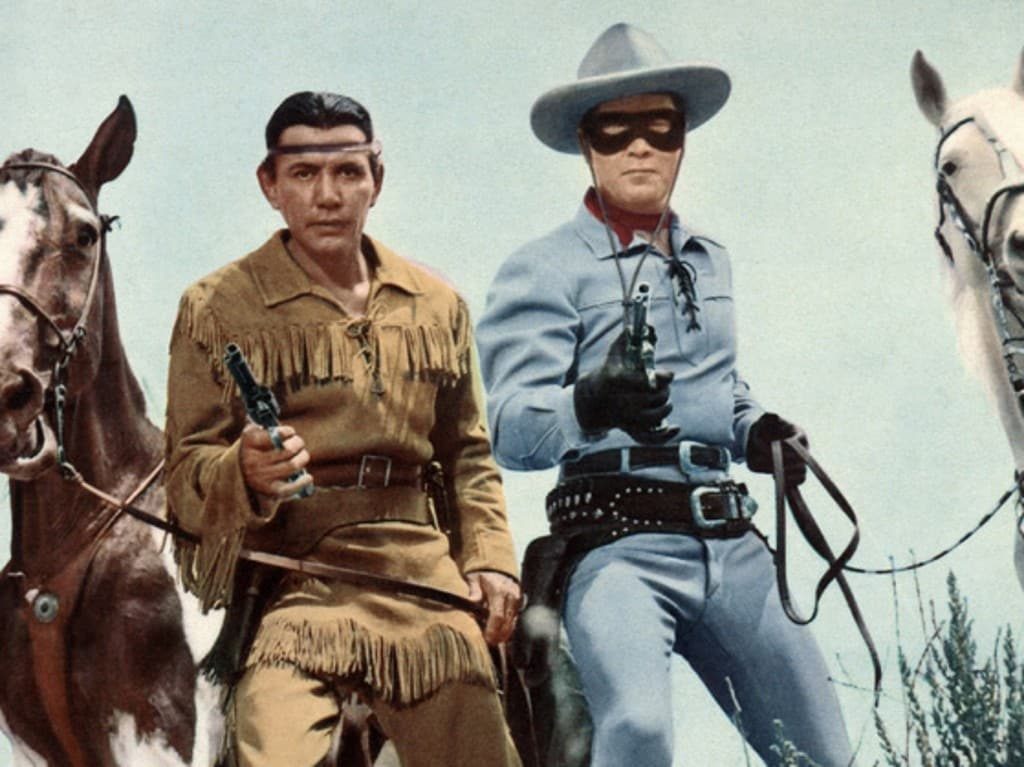
The Lone Ranger (USA, 1956) 86 min color DIR: Stuart Heisler. PROD: Willis Goldbeck, Jack Wrather. SCR: Herb Meadows. MUSIC: David Buttolph. DOP: Edward DuPar. CAST: Clayton Moore, Jay Silverheels, Lyle Bettger, Bonita Granville, Perry Lopez, Robert Wilke, John Pickard, Beverly Washburn, Michael Ansara, Frank deKova. (Warner Brothers)
Since Hollywood’s latest adaptation of the iconic radio and TV western hero The Lone Ranger opens this week, I felt it opportune to have a look at this 1950s feature film, in which Clayton Moore and Jay Silverheels (respectively) continue their characterizations of The Lone Ranger and his native companion Tonto from the long-running TV series that originally aired in that same decade.
Although this first of the two features is generically titled, it is (thankfully) not an origin story. This was likely made for fans of the TV series, who therefore already knew how the character of The Lone Ranger came into being. (In fact, a so-called 1952 feature, The Legend of the Lone Ranger, had already illustrated this, as it was merely a compilation of the series’ first three episodes.) The second film, The Lone Ranger and the Lost City of Gold, does however retell the origin story in a brisk, pre-credits sequence.
Because this was likely made for the fans, the film has little departure from the TV series in scope. It is in colour, like the last season of the television show, and is a modestly-budgeted programmer that resembles a feature-length episode of the program, with its tidy, low-key presentation, and procession of familiar faces instead of stars, not to deter from those high on the saddle.
Admittedly, I haven’t watched the program since WICU’s Saturday afternoon reruns in the early 1980s, so I don’t remember if the show explictly discussed frontier race relations. If it had, such allusions would’ve been lost on this adolescent anyway. This feature wins a few points for its theme of racism disguised in the plot, as The Lone Ranger and Tonto are recruited by the governor to investigate alleged Indian raids on white settlers. Our heroes instantly detect that something is fishy because the marauders have saddles; it turns out these attacks are merely just a ploy by the rancher Kilgore (Lyle Bettger) and his hot-headed henchman Cassidy (Robert Wilke, one of the outlaws who menaced Gary Cooper in High Noon) to incite violence against the natives, so that they can move in on the silver deposits found in the sacred ground of Spirit Mountain.
The Lone Ranger continues in the lineage of the countless B-western programmers made from the 1930s to the 1950s, in which there is little complexity among its stock characters, and that the good guys are unerringly noble, without any shades of antiheroism. Because of The Lone Ranger’s outlaw mask, and Tonto’s native heritage, these squeaky clean do-gooders however face much stigma in those thrilling days of yesteryear. If there is any negative shading to their characters, it is because of how they are perceived, not for what they do.
But save for this interesting undercurrent, the film is otherwise rather routine- its plentiful action scenes are flatly directed. It is as undemanding and forgettable as many B-budgeted oaters produced in its time, or for that matter, as any of the countless western television programs that would eventually replace the B-movie. There are some amusing moments where The Lone Ranger goes undercover as a crotchety old prospector to eavesdrop on the bad guys incognito, but he spends a little too long in this characterization, when we want more of The Masked Man’s. Aside from our charismatic leads, the highlights in the cast include Michael Ansara as a hot-blooded Native warrior who battles The Lone Ranger, and former child star Bonita Granville as the rancher’s wife.
Ms. Granville would soon marry producer Jack Wrather, and remain together until his death in 1984, a few years after his disastrous court order to prevent Clayton Moore from appearing in public as the character. It is commonly believed that the public’s outrage against his treatment of Moore resulted in the poor box-office returns of his 1981 reboot, The Legend of the Lone Ranger, featuring Klinton Spilsbury (in his one and only role) as The Masked Man. Wrather perhaps learned the hard way that to the fans, there was only one Lone Ranger, and that was Clayton Moore. With his rich baritone baritone voice and imposing screen presence, the actor proved that he was born for the role: a fact not lost even in this generic little movie.
Greg Woods

Greg Woods has been a film enthusiast since his teens, and began his writing "career" at the same time- prolific in capsule reviews of everything he had watched, first on index cards, then those hardcover dollar store black journals, then an old Mac IIsi. He founded The Eclectic Screening Room in 2001, as a portal to share his film love with the world, and find some like-minded enthusiasts along the way. In addition to having worked in the film industry for over two decades, he has been a co-programmer of films at Trash Palace, and a programmer/co-founder of the Toronto Film Noir Syndicate. He has also written for Broken Pencil, CU-Confidential, Micro-Film, and is currently working on his first novel. His secret desire is for someone to interview him for a podcast or a DVD extra.