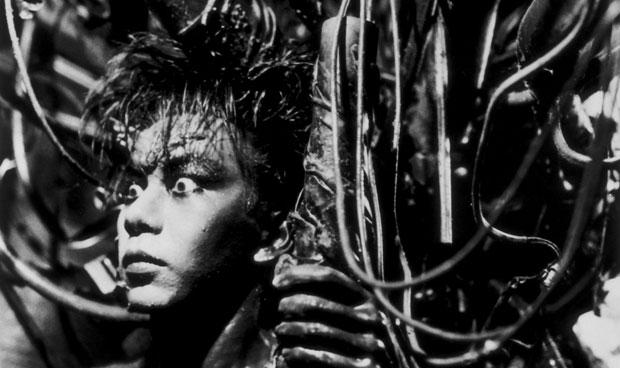
Tetsuo: The Iron Man (Japan, 1989) 67 min B&W DIR-PROD-SCR-EDIT: Shinya Tsukamoto. MUSIC: Chu Ishikawa. DOP: Kei Fujiwara, Shinya Tsukamoto. CAST: Tomorowo Taguchi, Kei Fujiwara, Shinya Tsukamoto. (Kaijyu Theatres)
Besides being a great song by Kraftwerk, the man/machine – man/vs. machine, theme is really as old as cinema itself–though having little in common with this film, even Dziga Vertov’s Man with a Movie Camera explores Man and his relationship to his technologies. Released in 1989, Tetsuo: The Ironman is the film that most fans of Shiya Tsukamoto’s work have seen first. And although it seems to be a highly original piece…it is almost a remake of his first film-a colour super 8mm short called Futsu Saizu No Kaijin (1986) or, “The Phantom of Regular Size”. Many of the same characters appear in both films, though the plot is expanded for Tetsuo.
Tsukamoto himself has acted in over 20 Japanese films including various titles by fellow cult Japanese director Takeshi Miike. He is also typical of many contemporary Japanese directors, including Beat Takeshi, who often wear the actor/ director cap in their own projects.
From the outset, we are subjected to images both industrial and grotesque. A lone man known only in the credits as The Metal Fetishist (played by Tsukamoto) walks through an abandoned industrial park somewhere in Shibuya, as sort of sub-city in the vast metropolis of Tokyo. He enters one of the buildings and into a sort of wiry techno nest made of scraps of metal and wire. He sits and grabs a large steel rod, cuts an incision in his leg, and begins to insert (quite graphically) the rod into the meaty exposed flesh until it is so sunk it, that it could easily be mistaken for a bone. Cut with title cards, the next shot is the Fetishist removing a bandage, only to discover the “surgery” has failed and the wound is infested with maggots. He runs, headlong into a speeding car- as we find out later, driven by a character named in the credits as “man”. Cut to black.
We then see the Man in his bathroom mirror, a piece of metal sticking out of his cheek. He bandages it. It is nearly immediately after this that all hells breaks loose, not merely in a narrative sense, but in an aesthetic one as well. For the remainder of the film, we are subjected to rapid cuts, time lapse photography, frenetic hand held camera work, shots of televisions with refresh bars flickering…much seems almost stroboscopic. Slowly more metal begins to sprout from the man’s face, limbs ,etc., but not before he is chased by a woman who has somehow been taken over by the “spirit” of the Metal Fetishist, having parasitic cybernetic limbs protruding from her. He narrowly escapes-only to have strange rockets emerge from the back of his ankles, which propel him through the suburban streets.
This scene, which I called the jet-rocket scenes (for lack of anything better), is the first of many such sequences in the film. Using still-frame animation, Tsukamoto manipulates the image so it looks as if the Man is zooming through the landscape without moving his legs. This kind of exacting work is a testament to his dedication to a frenetic style that I truthfully have never seen before. It brings the fantastic shots seen in Japanese anime films into the live action film world, far before the radical special effects revolution that came almost 10 years later.
After returning home the Man makes love to his girlfriend, and shares a meal with her. All seems well, as if all of the fantastic scenes we had just seen were just an elaborate hallucination…that is until we see that his feet are bandaged and pieces of metal are jutting out of the bandages. He tries to remove the bandage on his face, only to discover that there is more metal clinging to his face, which ignites his anger and somehow becomes a catalyst for further transformation. Soon he is convulsing on the floor, and screaming in agony as a giant mechanical drill-like phallus rises from his groin. Madness takes over, and it ends in the eventual death of his girlfriend, having impaled and drilled her with his new mechanical member…rage takes over the Man and more metal sprouts from his body- long black tubes from his back, and scraps from his arms.
In most films that relate in the man/ machine dichotomy, usually it is the natural that is chaotic, and uncontrollable, whereas the machine side would be ordered, clean, controlled. In Tetsuo however, the machine materials that emerge from the Man’s body are chaotic, random, seemingly serving no purpose at all, and only growing in moments of rage and frustration. Then we are given the rest of the pieces of the puzzle. The Man hears a voice, it is the voice of the Metal Fetishist- he is the one responsible for the Man’s condition, and it is his rage that is fuelling the man’s rage, and causing the transformation. Then the TV in the man’s house comes to life and we are given the rest of the story that has been missing up until this point in the film. It seems that after hitting the Fetishist with his car, both the Man and his girlfriend emerge from the car, adjusting their clothes, indicating that they were just having intercourse while driving. They take his body and dump it in the woods, then once again have sex while the Fetishist (near death) watches. They leave him there to die. He wants revenge. And he has been and continues to take it.
To say that the super powers of the Metal Fetishist has are bizarre is sort of an understatement. He controls metal- rusted, twisted metal… much like the X-men’s Magneto but far, far more macabre. After the death of the Man’s wife, his madness takes over and he seeks out the Fetishist in his warehouse, where we find the Fetishist losing control of his powers. It seems that the rust is causing him, and the metal around him to decay. Enter the Man, now nearly completely covered in metal with the exception of his face- it steams and pulses, it is fuelled by his rage.
Thus begins the showdown with the Fetishist, whose arm transforms into a cannon, all the while the Man attracts more and more metal. They jet foot it around the city, until in the final moments, the two adversaries merge into one vast heap of metal and flesh, both parties vying for control of whatever it is they are becoming. And what they become is this weird giant tank thing with two heads that rolls down the street at dawn…and together they agree that they will turn the world to metal. The End.

All apologies for the lengthy plot outline, but with a film as wild and crazy as Tetsuo, it’s just so I can make sense of it all. The film really is frenetic, with a rapid, jarring editing style that is more in league with contemporary music videos than with contemporary film styles. Its animated sequences are jarring to say the least, most likely due to dropping frames in the editing process.
Many cinephiles have compared this film to Lynch’s Eraserhead, and in spite of the different pacing (where Tetsuo is hyper fast, Eraserhead is slow and droning), there is much these two films have in common. Both films are cultish in their own way- they are also the first notable works by their directors. But more than that, much in terms of location and composition are comparable as well. The landscapes are both these kind of post-industrial wastelands- areas where burgeoning industry must’ve closed long ago, leaving vacant warehouses, factories and industrial decay in its wake. Both films open and set the stage in these decaying landscapes, inhabited by characters, whose lives are arguably stuck in states of decay. In the end, both films degenerate into a kind of relative madness. In the case of Tetsuo, the Man gives in to the madness of the Metal Fetishist, unable to fight him and his madness by the end of the film.
The Man’s story is a story of descent, from (presumably) a normal and functioning life (although we are given an indication of his dark side through flashbacks), to one of complete and total disarray. Contrary to the usual technology as an ordering mechanism (as we see in many science fiction films-such as something like The Terminator where efficient killing machines have decided to destroy man)—Tsukamoto’s technology is the exact opposite. From the opening shots of the industrial wasteland, we are presented with a constant depiction of technology gone awry. Not once in the entire film do we see technology as we have been told it is….ordering, constructive, purposed. But in Tetsuo, this technology seems to have lost its purpose somewhere along the way. The Metal Fetishist embodies this, living in the wasteland where industry has left its mark and gone, its original function ceased. There is excess, a vast landscape of forgotten pipes and tubing, discarded machinery, all rusted and decaying… as if to say that the promise of prosperity and progress of industry was nothing more than a lie. All that is left is the Fetishist, compulsively placing bits of scrap from his environment into his body. The purpose of the landscape; its necessity is lost, now all that is left is the Fetishist’s want for technology, a want that becomes all consuming, a disease which he spreads to the Man, and eventually will spread to the rest of the world if he has his way.
Tsukamoto’s decay/ descent motif finds its first articulation in Tetsuo, it is a theme that runs through most of Tsukamoto’s work. In Tetsuo II: Body Hammer, it is much the same as we see it here, with a few narrative variations, and it was shot 35mm in colour. In later films such as Tokyo Fist, we see a different kind of descent, as a young businessman is manipulated into becoming a boxer by his violence-obsessed girlfriend. He falls into a world of corruption, violence and greed. All of Tsukamoto’s films that I have seen are dark, and not with a liberating moment at the end. They start in dark places, and end in dark places– none of that cinematic optimism that we are all too familiar with on this side of the ocean. Nevertheless beginning with Tetsuo, Tsukamoto has placed himself within the pantheon of cult, becoming, much like the work of Takeshi Miike, a filmmaker who deserves his rightful place in the canon of Contemporary Japanese Cinema.
Originally published in Vol. #1, Issue #15.
Skot Deeming

Skot Deeming is a pop culture commentator and enthusiast, who has written about media and culture in various fields; including film, television, new media art, video games and art toys. His artwork has been exhibited internationally and his writing has appeared in academic, mainstream and independent publications. Currently, he’s living in Montreal, working on his PhD centered on the cultural economies of character licensing, appropriation art, and toy cultures. Find him at: Instagram (@yoyodynetoydivision)