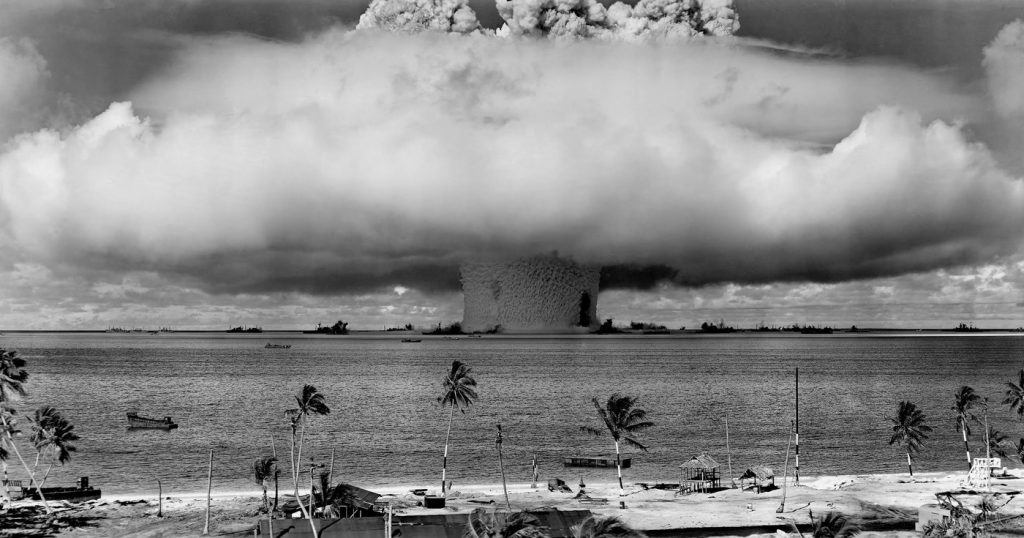
If during the Cold War, America learned to stop worrying and love the bomb, well then Bruce Conner fetishized it.
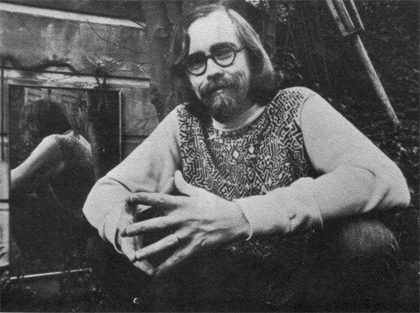
Bruce Conner’s collage films A Movie (1958) and Cosmic Ray (1961), mostly assembled from found footage, remain the among the most durable and audience-friendly experimental films from the fruitful period of New American Cinema (circa 1943 to 1966). Their playful cutting, and ironic juxtapositions make for very entertaining movies. Yet once you see these works as part of a bigger whole, as I recently did in a retrospective, these titles and others emerge as complex films that are important documents of the radically changing world during the Cold War.
Like many experimental filmmakers, Bruce Conner created art in other mediums than celluloid. One could say that his work in sculptural assemblages is identical to his cinematic output. Each discipline shows the artist creating abstract collages created by found materials. During his best-remembered period of filmmaking, he also created such assemblages as “Child” (1959), “Bride” (1961) and “Looking Glass” (1964), with humanoid figures covered in wax or nylon.
A Movie (1958; 12 minutes) was originally made to be a part of one of his installations. The film’s selections of images are ordered in a way that the movie would appear to have no logical beginning or end, especially not when looped to run perpetually in his installation. (I am reminded of Chris Marker’s installation here in 1997 featuring five screens in which decoupages of images seem to run in endless combinations). Even seen on its own, A Movie has that strange illusion that if you left it alone, it would continue to unspool without coalescing to any kind of distinguishable pattern. (In fact, Conner considered his visual art to be “unfinished”, in that they became living things that took on existences of their own.)
A Movie begins with the title “Bruce Conner”, shown onscreen for what feels like minutes, followed by leader, then the classic shot of the naked girl that projectionists would use to ensure the film was in focus, followed by more leader. Shots of cowboys and Indians appear. This western montage gently gives itself over to racing footage, then stampeding elephants, followed by shots of tanks. These fast action sequences seem to blend together seamlessly. This busy decoupage is suddenly hushed with the title “End”. Then we witness a person performing a tightrope act. Title: A Movie.
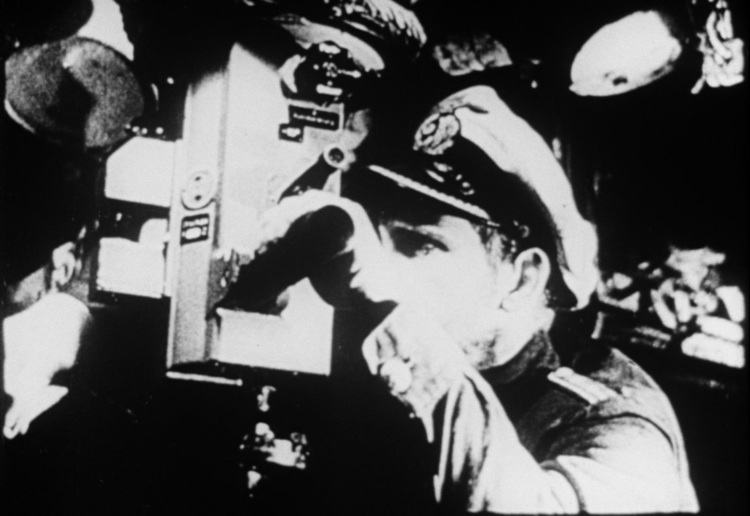
This is followed by the perhaps the film’s most memorable scene. A man in a submarine looks into his periscope. Cut to a shot of a sunbathing girl. Cut to the submarine shooting a missile, followed by the inevitable shot of the mushroom cloud. This sequence is the ultimate expression of sexual longing in the atomic age. Keeping with the theme of water, we next see some surfers, intercut with some natives in kayaks and water skiing.
A bicycle sequence then blends into aerial footage. Shots of a collapsing bridge. More planes. A blimp. Go kart racing. Parachuting. The Hindenburg explodes. Mankind is going out of control. Suddenly, pastoral shots of deer and swans fill the screen. This is filled with a violent image taken on a bridge during an earthquake. The Hindenburg is aflame. A ship sinks. People hang upside down. Footage of war casualties. A mushroom cloud. A dead elephant. The Hindenburg collapses. People search through wreckage. End of film.
The title “Bruce Conner” at the opening suggests than we’re seeing the end first (as experimentalists often put their name at the end of their pictures). Thus, if we looped the film as such, what we see at the “real” ending of A Movie seems like a logical conclusion, as the tone and tempo of the piece mounts to a crescendo of chaos. The film is ordered by sequences with harmonious images pertaining to a consistent tone: the machismo of mankind with warlike tendencies (cowboys, tanks); the ultimate expression of mankind’s machismo in the atomic age (missile=phallus; atomic cloud=orgasm); mankind’s inventions out of control thusly bringing the destruction of all living things- human or animal.
Cosmic Ray (1961; 4 minutes) runs one-third the length of A Movie, and is even more adventurous in its montage. The screen is often filled with layered images of a naked dancing girl, film leader, fireworks, and of course, the bomb. The title refers to Ray Charles, who is singing a live track of his classic “What I Say” on the soundtrack. The music is the catalyst for the montage- the editing becomes more intense as the tempo of the song increases. The leader we have seen endless times which counts down from 10 to 1, is actually part of the montage of Cosmic Ray, a celluloid fabric behind (or in front of?) footage of a topless dancer. It also becomes of the film’s strobe effect, as it gets more psychedelic with streaking street lights and fireworks. Shots of a native and a tiger, and an Indian chief comment on the wild, animal instincts of humans. Shots of war accentuates humankind’s savagery in these supposedly sophisticated times. Fireworks become a pun as they are matted onto an image of a woman disrobing. The decoupage becomes even more furious as the music progresses. Footage of the flag being raised on Iwo Jima. Mickey Mouse fires a cannon. Our knack for destruction is apparent even in juvenile escapism. A skull is held between a woman’s legs. The taboo attitude towards sex in the white picket fence age. Still shots of the nude dancer are pixilated. More shots of flags. More leader. The end. The screen is black while the crowd applauds on the soundtrack.

One ambitious reviewer called Cosmic Ray an X-ray view of a teenage boy’s mind. That isn’t a bad metaphor, but for a film of such brevity, there is much more being illustrated here. More than being the subconscious mind of a horny teenager, the film is a vivid portrait of a time that exercised Victorian prudery yet seemed to topple on the verge of oblivion. In lily white America, R&B music was still taboo in most white households. While the most obvious progenitor of rhythm and blues, rock and roll, was met with rancour only a few years earlier- that form of the devil’s music had been castrated by that time, ever since Elvis joined the army and the new teen idols were unthreatening white kids like Paul Anka or Fabian. But rhythm and blues still exuded that sexuality which threatened many American suburbs. The recurrent image of the topless dancer is less a figure of desire than a reminder of the conservatism in the age of Ward and June Cleaver. Thus, Cosmic Ray is filled with sounds and visuals of forbidden imagery circa 1961. Sex is a natural animal instinct, yet this one is tolerated far less than mankind’s other animal behaviour– the act of killing. Is that to say that sex equals death? If we remember the image of the skull being held between a woman’s legs, the answer is yes. Watching this film is like watching a melodrama of two young lovers who debate on whether or not to forgo their puritan upbringing and fulfill their sexual curiosity with each other before the bomb drops in five minutes.
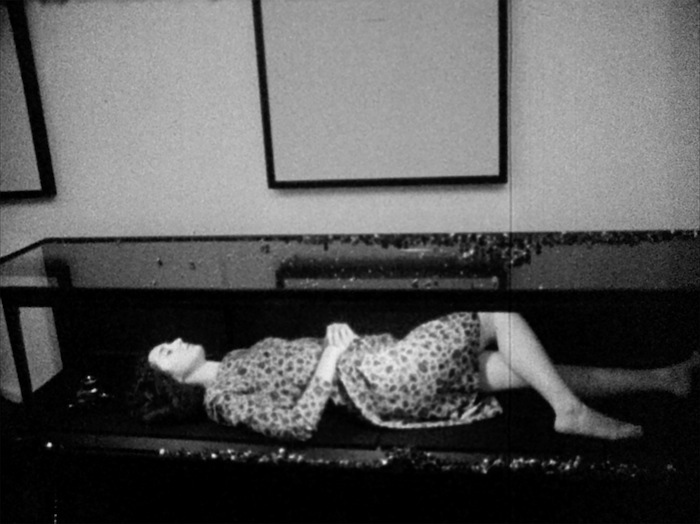
If Cosmic Ray is a testament of repression and fear during the Cold War, then Vivian (1965; 3 minutes) is a testament of 1960’s pop art chic, especially in terms of how it idealized the modern woman. This film at first feels like a playful pop culture piece, with its frame-by-frame pixillation, negative imagery, shots of The Beatles and Bob Dylan. That, plus its setting in a modern art museum make it a testament of its time. The agitated filming style definitely captures the tempo of the times, so much so, that we may initially miss the disturbing subtext that exists underneath. Vivian Kurz is the woman onscreen, who gradually fits her agile body beneath a glass coffin in an art exhibition (actually, it is an exhibit of Conner’s own work). In a way, this film gives people a chance to see an excerpt of Conner’s other life as a visual artist, and thusly it is a preservation of same. On the soundtrack, we hear Conway Twitty’s version of “Mona Lisa”. The song, which deifies a woman to a timeless piece of art, is aptly chosen, but in a film that after all puts a woman in a box, it takes on a whole new meaning. In other words, the film becomes a testament of how society often views female beauty to be an object more than a personality. Thus, having Vivian in a transparent coffin not only keeps the object of beauty always in view, like a trophy, but at the same time is also trapped, controlled.
Some lyrics: “Cold and lonely / Work of art…”
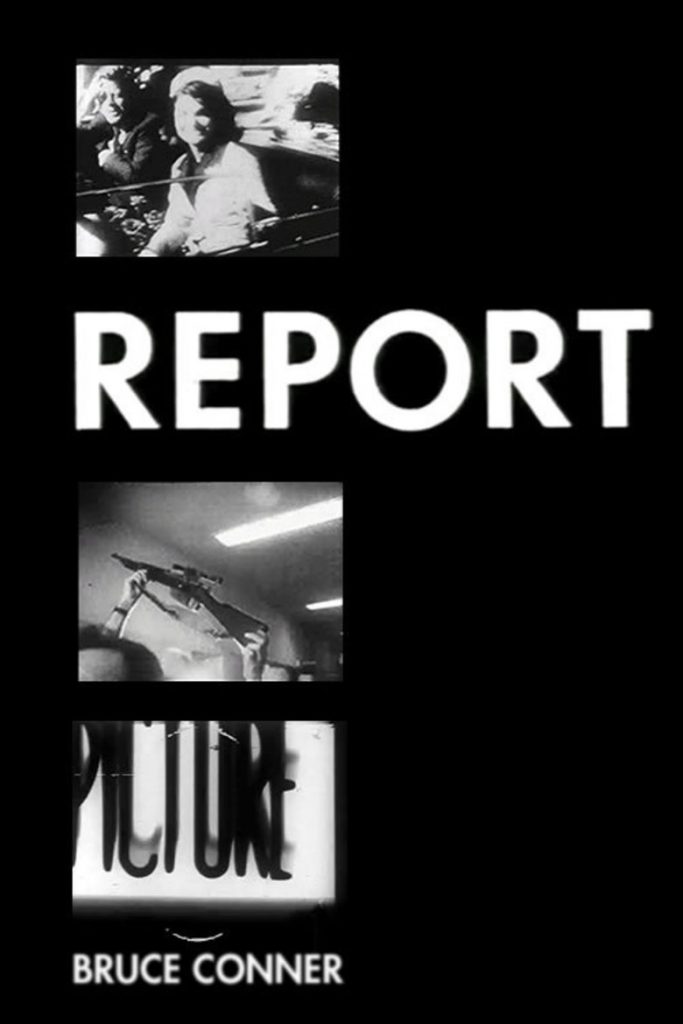
The assassination of JFK is the pivotal moment in Cold War-era America- the end of the innocence. Therefore it is no wonder that Bruce Conner would choose to make a movie about that topic. The filmmaker actually intended to make a lengthy movie about that fateful November 1963 day, but because he faced enormous difficulty in acquiring footage (due to red tape and finances), he was forced to make a much smaller film by comparison, and even then, he had to find other images that would deliver the same point. His liabilities actually became great virtues, as the resultant film, Report (1967; 13 minutes), emerges as a very demanding yet literate piece that results in becoming an ironic commentary on America during the time of Camelot. Of the titles discussed in this article, perhaps this is his masterpiece.
In the opening, we see the image of JFK’s car running through the frame looped repeatedly while on the soundtrack an announcer mentions that “something has happened”. As the announcer continues with his Report, the screen fills with white leader, and then the image strobes, and the rhythm increases until the screen goes dark.
Cut to footage of a man holding the assassination rifle. Cut to people milling about an ambulance. Then a shot of JFK in the limo is repeated continuously. A two shot of JFK and Jackie is also repeated and repeated. The back of the car passes by the frame, and is repeated continuously. Throughout, on the soundtrack, witnesses talk about from where they heard the gunshots. Film leader counts down from 10 to 3, again and again. The announcer finally says that JFK is dead. The numbers in the leader became larger and larger.
Then the film becomes more subjective as we see images of bullfighters, the presidential plane landing one day before, and commercials of new Frigidaires. On the soundtrack, we hear an announcer talking during JFK’s arrival in Dallas the day before. The bullfighter is gored while the announcer states that upon JFK’s arrival in Dallas, “every possible precaution” has been taken for his safety. A two-shot of JFK and Jackie is repeated continuously. A shot of a mushroom cloud. A shot of the flag-draped casket. Still of Lee Harvey Oswald. Stock footage of a bullet in slow motion going through a light bulb. (The magic bullet? The fateful bullet that changed the white picket fence optimism of America?) The Frankenstein monster appears as the announcer continues to talk of the secret service. Cut to a product shot of an “SOS” pad. Announcer: “When the president stops moving, that’s when we’re concerned.”
The bull is slain in the bullfight. Explosions and lightning appear onscreen. Stock footage of a battlefield offers more mayhem. The announcer talks of touring down Love Field as we see the JFK funeral procession. Cut to shots of “space age office equipment”. Cut to close up of cashier’s finger hitting the “Sell” button. The end.
Report is a marvel of invention, perhaps because Conner had to work harder to be creative with less material than he had hoped to work with. The use of strobes during the announcer talking of the shooting is effective, as the blank images suggest visuals that people in Space Age America couldn’t possibly have imagined. The cutting away to images of destruction, be they on a small scale with the bullfight or on a much larger level with the bomb, illustrates man’s casualness about violence. The constant cutaways to TV commercials of the day show “the great promise” and new modern, comfortable living that was offered to postwar America. This dance between visuals of death and those of consumerism shows how these two different personalities of human nature clash in one fateful moment. Death reigns supreme and suddenly the age of innocence is lost.
As early as 1961, Bruce Conner was convinced that the atom bomb was going to drop, and at that particular time, he had fled to a retreat with Timothy Leary. As tempestuous as the 1960s were, culturally they were a melting pot in which artists, big or small, of every persuasion would form a community. Because Bruce Conner’s collage films had become so popular, even among those in the commercial film world, it is unsurprising that Hollywood sought him out. In fact, Conner was close friends with Dennis Hopper (and the former’s influence can be found in the editing techniques of Easy Rider and The Last Movie), and for a time he helped out behind the scenes on projects by the Tinseltown counterculture (Hopper, Peter Fonda, Warren Oates, et al.), but he soon fled the Hollywood scene because he didn’t share everyone else’s penchant for excess and self destruction. Instead, it seemed that Conner was still interested in destruction on a much greater level.
Crossroads (1976; 36 minutes) is perhaps Bruce Conner’s ultimate study of the terrible beauty of destruction. The footage was taken entirely from Operation Crossroads, in which an atom bomb was detonated at Bikini Atoll in 1946. The film opens with two very dry titles: “BIKINI ATOLL”; “JULY 25, 1946”, so matter-of-fact, showing how the world changed on this day. The first shot is a long single take, where we see the cloud erupt into the sky, the stem of the cloud having a diameter of roughly five ships. We see the explosion before we hear the sound. Then we cut to another shot of the explosion as the sound continues. An extreme-closeup of the stem of the cloud reveals a spiky kind of texture, much like the stem of a plant. Next is an overhead shot where we see the explosion out the side window of a plane. Then there is a shot from sea level, as the bomb erupts from near the bottom of the screen. Then there is a similar shot, albeit from further back where we see the tree line in the bottom. If these descriptions of the shots are becoming redundant, or that they feel like they were taken from a director’s shot list on a typical day of shooting, then you have an idea of just how thorough this film is in its visual recording of Operation Crossroads. The explosion is repeated countless times from every conceivable angle. Not only does it tell us just how much money the government spent on multiple camera set ups to record that single moment, all of this footage thus becomes a way for Conner (and thereby, us) to explore this destruction in new ways.
Just when we feel, “Okay we get the point. We’re seeing how awesomely destructive the bomb is by being shown this again and again”, the film changes, largely because of the inclusion of a music track by Patrick Gleeson and Terry Riley. With the inclusion of their electronic score, with long singular notes, suddenly the movie becomes rather dreamlike, especially now that the visuals predominately become very intimate close-ups of the mushroom cloud.
The cloud of destruction is seen to blend with the clouds of nature in the atmosphere (an interesting metaphor- is it man’s “nature” to destroy?). The extreme close-ups of the stem erupting from the sea and eventually engulfing the ships nearby is now seen with a strangely seductive feel. Once the frame is engulfed with debris, day suddenly becomes night. This is synonymous of the bizarre extremes that are made to be harmonious in the latter half of this piece.
The second sequence of Crossroads is reminiscent in feel of Koyaanisqatsi with its dreamlike soundtrack and the strange way in which the horrible is made to look beautiful. In Conner’s film, this marriage makes sense, as giving an aura of beauty and allure to mass destruction only brings to light our species’ attraction to disaster.
This decoupage is perhaps more serene than the frenetic works of Bruce Conner than we have seen previously. Yet at the same time, it seems that all of the prior films add up to this ultimate exclamation point. All of his ironic collages build to a crescendo in which we recognize the savagery inherent in his works of beauty. Finally, we see a Conner film which is somehow a beautiful tableau about the ultimate act of savagery. Throughout his work, we see a man who is terrified of his society going out of control. Crossroads is an epitaph, in which he comes to realize his and our repulsion-attraction to mankind’s flirtation with self-destruction.
Originally published in Vol. #1, Issue #16.
Greg Woods

Greg Woods has been a film enthusiast since his teens, and began his writing "career" at the same time- prolific in capsule reviews of everything he had watched, first on index cards, then those hardcover dollar store black journals, then an old Mac IIsi. He founded The Eclectic Screening Room in 2001, as a portal to share his film love with the world, and find some like-minded enthusiasts along the way. In addition to having worked in the film industry for over two decades, he has been a co-programmer of films at Trash Palace, and a programmer/co-founder of the Toronto Film Noir Syndicate. He has also written for Broken Pencil, CU-Confidential, Micro-Film, and is currently working on his first novel. His secret desire is for someone to interview him for a podcast or a DVD extra.