“It’s okay if you get frustrated or fall asleep in parts. That’s just like what happens during a real trip, and then something really interesting happens.”
The above paraphrases a statement made by director Peter Mettler, who participated in a surprise Q&A session at a recent screening of Gambling, Gods and LSD (2002) at The Bloor Cinema. It is a humble notion from a charmingly humble man, who has nonetheless made some of Canada’s most individual, challenging, and admittedly, demanding, films in the last 20 years. His most recent film, cited above, may be his breakthrough picture- its critical and box-office success (two oxymorons for 99% of Canadian cinema) may get some people to check out his eclectic back catalogue. To some, his earlier work may be tough-going, but in truth, his previous work perfectly compliments his recent success. Gambling, Gods and LSD is fascinating, frustrating, mesmerizing, boring, enchanting and disappointing. But, he is still making his pictures the same way… his.
Peter Mettler absolutely defies categorization. He is either Canada’s most avant-garde storyteller, or he is the Canadian avant garde’s most mainstream director. The fact that his films get recognition at all within his own country is an accomplishment unto itself. That they get recognition in Canada while still being highly personal and uncompromising, is an epiphany. His narrative films (loose though they are) become shaggy-dog jokes. His non-linear pictures are frustrated from being visual escapism with sudden distancing devices.
Gambling, Gods and LSD has understandably, though inaccurately, incited comparison to films like Baraka. Yes, Mettler makes travelogue kind of films, and he certainly takes one to an undiscovered place (or at least, state of mind). But he is not interested in making the larger-than-life, out-of-body cinematic experience that Baraka or Koyaanisqatsi provides. His latest work is a three-hour odyssey of the ways in which people in the Western and Eastern Hemispheres seek fulfillment- be it through spiritual, chemical or sexual means. People would naturally assume that the Western world seeks more superficial and hedonistic ways, whereas the Eastern world (or if you will, “the old world”) seeks a traditional spiritual path. Rather, the two cultures interestingly blur, under Mettler’s non-judgmental eye, where the film is edited to be the least manipulative as possible.
We open in the West, on a surprisingly low-key, underlit scene in which Mettler’s camera follows a man on a night time stroll, talking of his drug experiences. As with what follows, Mettler avoids having the visual power of cinema take over the proceedings. Despite such indulgences as a time-lapse scene in the desert, this film about the getting of sensory pleasure doesn’t try to provide one for the audience.
We see some unusual ways in which Western Culture seeks enlightenment. Some like the sex shop sequence (as a model demonstrates a device resembling an exercise machine, with a huge phallic object in the middle), are obvious in the fulfillment they provide. Others, who for instance travel around to blow up abandoned buildings, seek enlightenment of a far more complex (or obscure) level. The secular pleasure of sex or drugs is contrasted with an interesting, long unbroken take at a religious wake at a Toronto convention hall, in which hundreds of people are praying (or just checking things out); some even go into trance-like states.
Things are equally obscure in the East. In one matter-of-fact interview with a couple discussing their drug use, the woman describes her dangerous, drug-addled path to enlightenment. Her story is not the typical “drug survivor” biography that one sees on Star TV. If anything, this dangerous substance did provide her an enhanced enlightenment. Interestingly, Mettler later told the audience that he deliberately cut out any reference to the male being HIV positive, to avoid getting a stereotypical response from the viewer.

Most pictorially beautiful of course, is the exotic footage of the Middle East, when we see some native ritual customs. Yet, he views these paths to enlightenment in the same third-person quality as the first half of the film: non-judgmental, though curious.
Upon learning that this three-hour film is edited down from 55 hours of usable footage, one is reminded of what Mettler has alluded to in interviews. The passing of film through the camera is his “drug”, if you will: that is his journey to enlightenment. It is a sometimes frustrating path that becomes worth it for the special moment that gets recorded. Gambling Gods And LSD is a metaphor of the tribulations one goes through to satisfy that unconscious region.
Similarly, all of his pictures are about a voyage to some kind of enlightenment: wisdom, state of being or even an object of desire. The frustrations which are encountered along the way become equally integral to the voyage.

His first feature, Scissere (1982), is the genesis of the film style and ideas which he still practices 20 years later. Certainly, Gambling and Scissere bookend his filmography, as both works document the chemical way to enlightenment. Its weird melange of mock-up documentary filmmaking can be appreciated in context with his later work, through its similar attempt to convey its chief protagonist’s state of conscious.
There are three main characters: a young mother, a doctor, and a former psychiatric patient who abuses drugs. The film tries to capture the various states of reality, even with the filmmaking process itself. (After all, what is filmmaking but altering reality?) There are some weird, mock-up moments, as when a woman’s is purse stolen on a bus. It is filmed in such a long shot, that we’re not sure if this is an unscripted accident. (Only in the credits do you realize it is fictional.) Therefore, Mettler forces the viewer to question the validity of what is onscreen. If you will, the image is the audience’s drug which distorts reality.
But still, there is really no narrative thread in the work. It operates as a stream-of-conscious piece, that slips back and forth in time and states of consciousness, as the mind does. At the same time, Mettler clinically explores why people behave the way they do. For instance, the young man’s ritual of tying the tourniquet around his arm to shoot up may or may not be played up for the camera, but Mettler films it with the same kind of documentary approach as Warhol’s depictions of his hapless underground actors. (This scene is so personal that I am reminded of a line I read in a book: “Watching someone shoot up is like watching someone masturbate.”)
Scissere (whose title is named after a fellow patient that Mettler once knew in a psychiatric ward) is a prize-winning feature that Mettler made during his tenure at Ryerson Polytechnical Institute. For a first feature, it is incredibly ambitious. While not completely satisfying, it is the seed to his later work. His unique approaches to narrative, documentary, and ethereal states of mind will be expanded to greater capacity in the future.

His 1985 featurette, Eastern Avenue, remains one of his most satisfying works. This travelogue of his visit to various European countries was filmed on a whim without any regard to cohesion, and then edited with in similarly subjective fashion. And then music was also subjectively added in spots. Therefore, there is no discerning pattern, or any kind of sequencing, in its collage of natural images (water is a favourite), discotheques and landmarks. Because the entire film is shot, edited and sound mixed entirely to chance, the lack of structure is the structure, and works wonderfully. One is constantly surprised by the unknown directions the film takes within its hour. Different images splash about, similar ones are repeated, without any sequence, and the random music becomes congruous, because its incongruity is the point.
The one travelogue he made the most “straight up”, if you will, is 1997’s Balifilm, comprised of film shot in Bali, Indonesia and other Southeast Asian countries in the early 1990s. This is his sole “ethereal” film, which remains a completely escapist experience without any disruption of rhythm. Even then, the journey is somewhat compromised. One is never given a sense of place; the sepia-toned visuals appear as if one walked into an unknown custom in an unknown environment. Balifilm becomes a mini movie on dance, as the natives perform their customary song and dance; the often obliquely framed images play out in slower motion than the music track, putting the mystery back into the proceedings, pushing the work to the edges of unreality.

In addition to shooting his own films, Mettler also acted as cinematographer for others, especially Family Viewing for his friend Atom Egoyan. Mettler’s 1989 commercial feature The Top of His Head may actually remind one of Egoyan, in its fragmented narrative structure, and the film’s pristine, monochrome look. However, the similarities end there. If Egoyan’s pictures bring the threads into a neat bow, Top of His Head leaves them untied, as in Kafka or Blowup.
The story is about a satellite dish salesman named Gus, who becomes attracted to a beautiful, mysterious woman. Because he is being questioned about her by unknown people, he starts to uncover more about the mystery lady, to see why these people are after her. If Mettler chose to stay in fictional narrative, Top of His Head is a good indication of how unique that vocation would be.
It’s a thriller with quirky comedy, and builds up a narrative only to pull the rug from under it. The film gets even more confusing as it goes along, as fittingly does Gus. When Gus gets a car and offers a lift to a stranger, the deceptively intricate plot goes out the window. This long dialogue scene changes the movie. Similarly, later on there is a bizarre scene when Gus tracks the woman down to a warehouse to free her from some bad guys, and then the two engage in some bizarre dance number! Just like the lead character in Blowup, Gus’s buttoned-down lifestyle is blown wide open. That the movie ends up making no sense is the point.
The film, although shot in Toronto, has a strangely futuristic feel. Its unusual locations, and attention to chrome and steel give this a slightly unreal feeling, accenting the audience’s unease with the narrative. The Top of His Head explodes your mind with possibilities. It is a shaggy dog of a movie, but one worth visiting again.

Subjective narrative is explored further in Tectonic Plates (1992), adapted from Robert LePage’s theater piece. Mettler marries both theatrical and filmic looks, adding another level to this complex story of lost loves. The film’s present takes place in this stagy classroom setting. Its deliberately artificial, PBS shot-on-video style, contrasts with the scenes in the film’s past (such as in Venice) that are shot on film. The contrasting looks break up the different pieces of time, and stages of consciousness. Since the Venice footage is in the past, it therefore only exists in the person’s mind! Also interesting is the use of water right on the stage. The metaphor of the picture (and the title) is that people float in and out of each other’s lives, just like continental drift- a perfect metaphor of these globetrotting characters.
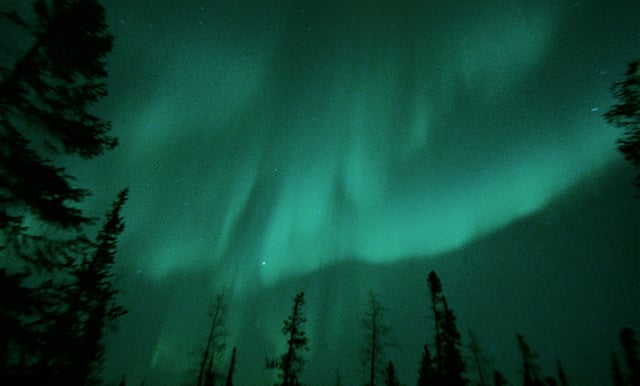
On the surface, 1994’s Picture of Light is a documentary about the Northern Lights. However, the film’s real story is the stodgy drama about the toils taken to film them. Mettler refuses to turn the film into an ethereal “trip” movie a la Baraka. Instead, it is a subtly self-mocking documentary about the movie people were expecting to see.
If you want to lose yourself in the time-lapse footage of The Northern Lights, you’ll have to patiently wait to see it, just like the filmmakers did. This film breaks down the process to record those moments, and evokes the incredibly stifling feeling echoed by its frustrated filmmakers, as this project operates in fits and starts.
This subtle “making of…” diary depicts the bizarre ways in which people pass their time when the production grinds to a halt due to bad weather. There is also footage of the filmmakers trudging outside in the deep snow just to see what they have to do to prepare for the filming of nature’s great light show. Mettler’s voiceover comments on time, boredom, and even the process to shoot the lights (one frame exposed every three seconds, just so it would even register on the film emulsion).
As always, Peter Mettler is taking you to a place you may not have seen before. This is the key to all of his pictures, whether he explores narrative or documentary conventions. His journey to capture beautiful moments on film is accented by the visceral experience he underwent to record them.
Gambling, Gods and LSD is assuredly the breakthrough picture where his singular style has reached to his largest audience to date. It will be interesting to see where his unique quests will take him next, but no doubt audience will have work to do too. Whether he is on the quest for inner peace, a great shot, or some mental stimulation, one can be sure the voyage will be equally demanding and rewarding.
This article was originally published in slightly different form in Vol. #1, Issue #9. To date, Peter Mettler has directed three more films, and acted as cinematographer on a few others.
Greg Woods

Greg Woods has been a film enthusiast since his teens, and began his writing "career" at the same time- prolific in capsule reviews of everything he had watched, first on index cards, then those hardcover dollar store black journals, then an old Mac IIsi. He founded The Eclectic Screening Room in 2001, as a portal to share his film love with the world, and find some like-minded enthusiasts along the way. In addition to having worked in the film industry for over two decades, he has been a co-programmer of films at Trash Palace, and a programmer/co-founder of the Toronto Film Noir Syndicate. He has also written for Broken Pencil, CU-Confidential, Micro-Film, and is currently working on his first novel. His secret desire is for someone to interview him for a podcast or a DVD extra.