Note: in case you visited this page from another link, this is the conclusion to an article on a weekend-long retrospective of Jonas Mekas’ films. Here is the link to start at Page 1
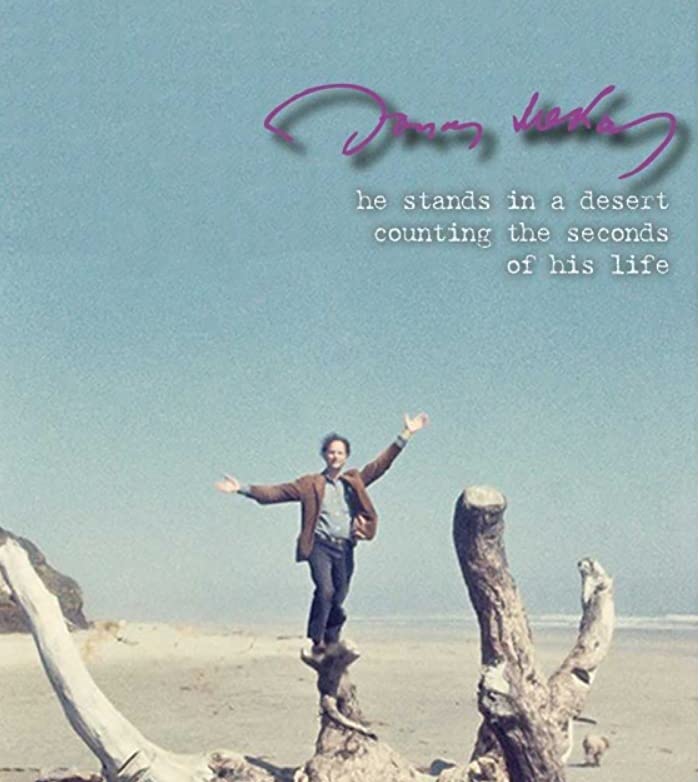
He Stands in the Desert Counting the Seconds of His Life (1985) is a wonderful collection of Mekas’ life from 1968 to 1984. This two-and-a-half hour film is a classic example of Mekas’ subjective approach to filmmaking. (“I like to edit by myself until about 2 or 3AM, when the mind is gone.”) The 160 sequences within are not shown chronologically. However, they were ordered up by pulling numbers out of a hat, and then a minor number of sequences were shuffled further so that they “wouldn’t be boring” (which I highly doubt would be the case, anyway). Further testament to his unconscious filmmaking, he still doesn’t know what the film’s title means. One viewer made an interesting point about how the desert analogy could refer to the fact that this film is void and mysterious, even though Mekas is less cryptic in this film than others. For instance, this work is much more generous with intertitles. That acute observation really applies to all of Mekas’ work.
This omnibus of memories features many faces who will feel like old friends to anyone with even a partial knowledge of the 1970s arts scene, or of Mekas’ contemporaries in the underground. (Where else will you find Miles Davis and John Lennon playing basketball?) There is much vitality in these images, whereas those of Lost Lost Lost and Reminisces are comparatively spare. Mekas’ filming style is very energetic; the camera is slightly agitated, time moves somewhat faster. The energy is exuberant, the tone is giddy. The intimacy of Mekas’ images give the illusion that this footage is now. I caught myself twice smiling back at these faces, thinking they were speaking to me directly.
Yet there is also a profound sadness to this piece, perhaps inevitably, as most of these people are now gone. In fact, He Stands has a funeral near the end. One is reminded of the exciting things which happened in pop culture and media at the time, and of the extraordinary chance that Mekas knew and preserved its people involved.
And true to Mekas’ form in subconsciously ordering these passages, it opens with one of the least representative segments of this film: “Fire on 7th and 23rd” (1970). “Workers Leaving Steel Factory” (1973) is a simple shot of just that. Mekas was in a bar thinking of Lumière, and he saw the workers across the street and shot the sequel 78 years later.
Simple, non-synced, representational sounds abound throughout the picture. “Cavalcanti at Amherst” (1973) is filled with music, “Pleasures of New Hampshire” (1973) with water sounds, “We Buy a Christmas Tree” (1976) a thumb piano, “An Evening With Old Friends” (1979) ambient noise, and “John and Anthony” (1972) the “Bojangles” song.
One becomes dazed by Mekas’ obsession of documenting everything. It seems that no stroll in the park or visit to the country goes unrecorded. “Pleasures at Montauk” (1972) is followed by the title: “Certain words gone by now”. (an admission that only the image reminds us that this moment occurred at all?) “A Visit to LaCiotat” (1974), “One Sunday In Front of Metropath” (1972)… more casual examples of that fact.
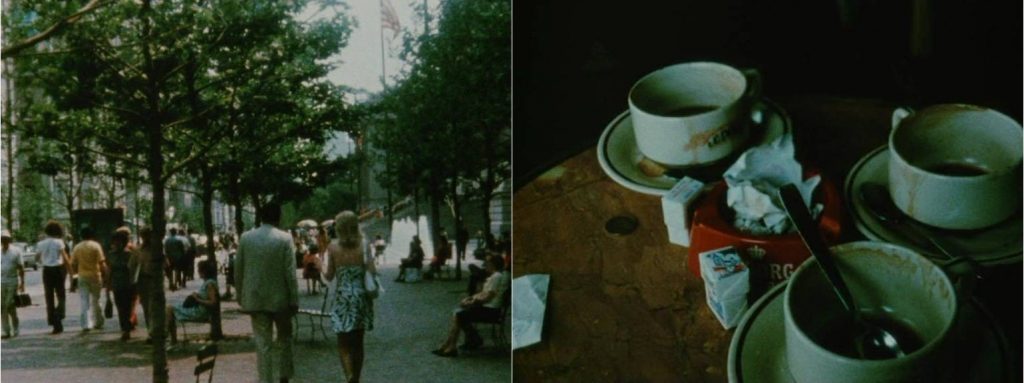
Essentially this feature works on four levels, often at once.
SEASONS
The circle of life matters so much to Mekas’ work. (“Ah, the winters” is a very early title card in the film.) In addition to the human events recorded, but the change of seasons are appropriately featured. Is there another New York filmmaker who shoots so often in the countryside?
“Adolfo and Javier Wake Up and Are Amazed to See the Snow” (1975) features a shot out the window to see snow-covered buildings. (“Do You Know the Way to San Jose” is on the soundtrack!) “Later that day”, we see some skating footage. Another sequence of the country (“Oona Visits Her Cousin Sean”, 1979) featuring kids in the meadow, rolling in the leaves, is interrupted by a title of a Kafka quote (which translates as “Writing is a form of praying”). “It’s not lost yet.” is perhaps an ironic counterpoint to Lost Lost Lost? Or the innocence of youth is not lost.
The film’s final sequence is “Sebastian and Oona in Central Park” with a double exposure of sledding, and the title: “Ah, the winters.”
THE DESERT
Each scene is equivalent to one line of verse of a long deeply personal tonal poem. Sometimes these moments remain mysterious. Often, the images oppose their title cards.
“Warhol At Whitney” (1971) shows a pan of paintings (this scene is extrapolated in Scenes from the Life of Andy Warhol). “Warhol Revisited” (1971) slyly rips off Warhol’s own Empire, followed by a double-exposure featuring waves and people in a boat. “Marcel Hanoun’s Wedding” (1971) shows subway footage. A bizarre representational image, but one nonetheless which will help Mekas remember it.
“Richard Foreman Calls From Paris” (1972) features strange street performers and bewildered onlookers. “Pope John Paul II Passes Broadway” (1979), yet all one gets is street noise and a long-shot of the crowd. The Pope is not seen. “Accident on Broadway and Nintu” (1972) instead features Bressonian cutaways to fruit. “Bruce Baillie Seminar” (1976) only features the horseplay on the train on the way to it. “Biking in Central Park” (1973) features no bikes! Sometimes it seems that Mekas is more interested than showing us the moments leading up to the payoff than the climax itself. “Nisi’s Birthday” (1974) features a birthday party on a street. How is this function happening?
SELF-REFERENTIAL
Mekas mentioned that his films are not real because he is editing (manipulating) what ends up on screen. Throughout He Stands in the Desert are title cards which describe his filmmaking process, remind you that you’re watching a movie, and continuously challenge the viewer’s expectation of his work.
Very early in the film, the title card appears: “This is not a documentary film.” “Amy with a loaf of Lithuanian bread” is interrupted by “This is not a personal film.” “Picnic in Provence” (1974)– “This bottle of wine came from this vineyard”. Snippets of old friends are interspersed with the titles: “Fragments of an unfinished biography”, “You keep a diary and it will keep you.” After “Klein Party” (1971), “Unity? Yes, there is a unity– my film is spliced together.” “Ken & Flo’s Wedding Anniversary” (1980) is “more real than the reality, gone now…”
“Kyoko’s Seventh Birthday” has footage of children playing musical chairs with a double exposure that makes it as dreamlike as the pillow fight sequence in Zero de conduite (1933). “Francene’s 30th Birthday” (1980) features the camera excitedly jumping around (almost treating the live guests as stop motion animation). Finally, Mekas continuously turns the camera onto himself. For the audience, these moments remind one that this is a movie. For Mekas, this is a way of immersing himself into these memories.
CANDID CAMERA
Because Mekas had a lot of famous friends, it is always surprising to see who will appear in his features. Also, these celebrities put a lot of trust in Mekas’ camera, as he sometimes is allowed to record some private moments.
“Ginsberg’s New School” (1972) is a joy to see for the legendary Beat poet wearing a “Vote McGovern” T-shirt!! “By the Seine” (1971) fittingly segues into a collection of snippets on French expatriate Henri Langlois, that must have ordered up in the second go-round. “Langlois At the Dome” (1974), followed by “Langlois At Work” (1971) in blue-tinged footage, culminating in “Breakfast With Langlois” (1973) with a distorted soundtrack in an attempt to discourage one from thinking this is a theatrical home movie.
“Co-op Party at Breer’s” (1972) features the avant-garde playing croquet. “A Visit to Framptons” (1979) features a get-together with Hollis Frampton, who hilariously recounts on the soundtrack a story about someone thinking he was homosexual. “Sally, Hollis and Kenneth” (1973) features a cafe patio with Kenneth Anger.
There is another collection of bits that Mekas must have ordered properly, as they all feature George Maciunas: “George Before the Wedding”, “Bride Prepared”, “George’s Wedding” (1978). Then, after a curious bit of “Spring in Central Park”, we see “A Visit to George in the Hospital” (1978), in which the ailing man waves to the camera. This takes a lot of nerve, but Mekas succeeds in making this a moving portrait of a friend, and his dying subject apparently complies.
With attention paid to nature and seasons, it is fitting that Mekas features the life cycle of people. Therefore, it doesn’t seem intrusive that he is filming his friend on his deathbed, or for that matter, Hollis Frampton’s funeral – “Hollis Frampton Buried” (1984). This reminded me of an e-mail I read earlier in the week about whether anyone was going to film Stan Brakhage’s funeral.
++++++
It is fitting that this post-Brakhage-mortem weekend had a moment of sorrow. On the Saturday night, after the Q&A session following He Stands in the Desert, the evening ended with a surprise screening of a video which Mekas had made on 9/11. The career of this New York diarist would be incomplete without some recollection of that fateful day. Those horrific images have been replayed on television so many times, but Mekas’ simple portrait is quite moving: a small project about one of the most universal images of the past century. Yet somehow, he still turns this into something deeply personal, something old world.
We open with an iris effect surrounding a sepia-tinted photo of a child. The soundtrack has the single sounds of an accordion, with Mekas singing: “Listen my child / Listen my child / It was a horrible story / A horrible story / One that I shall never forget…”
Then we cut to an unbroken shot of the twin towers on fire. Offscreen a woman jokes (it is partially indecipherable) about how there will be a sale or something now. Then the first tower falls. The woman offscreen begins sobbing uncontrollably. Mekas is heard from behind his video camera: “I-yi-yi-yi… I hope they managed to get some people out before…”. The camera pans randomly around some surrounding buildings, then resumes the original full shot of the two towers (now of course only one is in view), and for another moment we watch the second tower smoulder.
Cut back to the iris affect around the photo of the child. The accordion resumes. Once again the stanza is heard: “Listen my child / Listen my child / It was a horrible story / A horrible story / One I shall never forget”.
No applause was heard as the lights came up in the theatre. We thought of our American friends who died that day, while we filed out of the cinema. Chatter was minimal, haphazard. I remembered shots of Hollis Frampton’s funeral. Imagined visuals of Brakhage’s funeral (which occurred that day) popped up in my mind. An interior movie of ghosts of the past unspooled in our minds, engineered by Jonas Mekas, who had long since left the room.
Greg Woods

Greg Woods has been a film enthusiast since his teens, and began his writing "career" at the same time- prolific in capsule reviews of everything he had watched, first on index cards, then those hardcover dollar store black journals, then an old Mac IIsi. He founded The Eclectic Screening Room in 2001, as a portal to share his film love with the world, and find some like-minded enthusiasts along the way. In addition to having worked in the film industry for over two decades, he has been a co-programmer of films at Trash Palace, and a programmer/co-founder of the Toronto Film Noir Syndicate. He has also written for Broken Pencil, CU-Confidential, Micro-Film, and is currently working on his first novel. His secret desire is for someone to interview him for a podcast or a DVD extra.