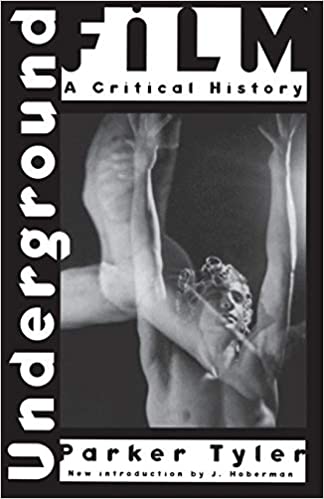
Underground Film: A Critical History
Parker Tyler
1995, DaCapo Press (originally published in 1969)
The world of experimental cinema (or New American Cinema, Underground Cinema, etc.) which proliferated in America circa 1943 to 1966, has a few definitive texts. This is often cited as one of them, alongside P. Adams Sitney’s Visionary Film, and any issue of Film Culture.
Parker Tyler’s book is unique in that it one of the few to actually question what exactly Underground Cinema means. Plus, he does a good job in illustrating the dichotomy within the movement. For instance, these films are often technically crude, but is this due to aesthetic choices, or just simply incompetence at the hands of the filmmakers? Another amusing dichotomy explored in this book while discussing the trends of American experimental cinema is how something that purports to be independent is jumping on a bandwagon.
Tyler does examine the history of avant-garde film, but in a peripheral way. Rather than chronologically examine the progression that the movement has made in a quarter-century, his narrative is rather fragmented. He crosses back and forth in history to show the various aspects which influenced the movement. Most tellingly, for the theorists, he does not cite Cocteau’s Blood of a Poet as the model for American avant-garde cinema (which was Sitney’s choice). Instead, he travels back further, to The Cabinet of Dr. Caligari, with the black-clad somnambulist Cesare walking around in a labyrinthine dream world (an early model for the “trance” film, which was common in the 1940s, best remembered in the films of Maya Deren and Alexander Hammid). And he even cites Caligari‘s film’s origins in Feuillade’s Les Vampires. Dadaist and Surrealist films too are cited as important models for what would later evolve in American Cinema.
Because this is a “critical history”, those expecting an overview of key films within the movement will probably be disappointed. In fact, the closest this comes to being an all-inclusive history is with the handy list of key avant-garde films in the back of the book! Rather, Parker Tyler only encapsulates works which are relevant to the trends and the theories he is discussing. Secondly, because this is a “critical history”, Tyler’s book is naturally a bit biased. Most tellingly, he shows great disdain for then-current works in avant-garde cinema. A commonly used term is the “pad” film, which encompasses personal works filmed in a loft or something, with the filmmaker’s friends’ camping out. Also, there is frequent mention of the newer films being made strictly to stimulate one’s drug-induced state. Now, it is fine to criticize, but it seems that he is approaching the history of avant-garde cinema with his own criteria. Perhaps he is also aware of this irony, thus furthering the dichotomies which abound in Underground Film. Tyler frequently alludes to what he would rather Underground Film be like– and in a movement where people can just do their own thing, why should it be? Curiously, he often cites the works of Charles Boultenhouse as models for what avant-garde film should be like. After all, Boultenhouse was his longtime companion.
Parker Tyler is the André Bazin of the underground. Where Bazin and his “auteur theory” illuminated the importance of the director in Hollywood who still managed to make works with their own distinctive personality, Tyler certainly gave a lot of recognition to the avant-garde filmmakers, by illustrating the psychological and philosophical aspects which pervade their works. And unfortunately, Tyler’s prose has a falsely grandiose nature to it. Tyler’s flighty, paragraph-long sentences attempt to be elite with numerous references to psychology and Greek mythology, in apparent defences of the underground film. This is a dangerous approach, as one could be reading something in a picture which its maker simply did not intend. Secondly, these paragraph-long sentences meander so much that one forgets what the point was in the first place.
But still, Underground Film is a valuable resource for avant-garde cinema. No other book so couples the history of the medium with its dichotomy. The book itself is part of both.
Originally published in Vol. #1, Issue #8.
Greg Woods

Greg Woods has been a film enthusiast since his teens, and began his writing "career" at the same time- prolific in capsule reviews of everything he had watched, first on index cards, then those hardcover dollar store black journals, then an old Mac IIsi. He founded The Eclectic Screening Room in 2001, as a portal to share his film love with the world, and find some like-minded enthusiasts along the way. In addition to having worked in the film industry for over two decades, he has been a co-programmer of films at Trash Palace, and a programmer/co-founder of the Toronto Film Noir Syndicate. He has also written for Broken Pencil, CU-Confidential, Micro-Film, and is currently working on his first novel. His secret desire is for someone to interview him for a podcast or a DVD extra.