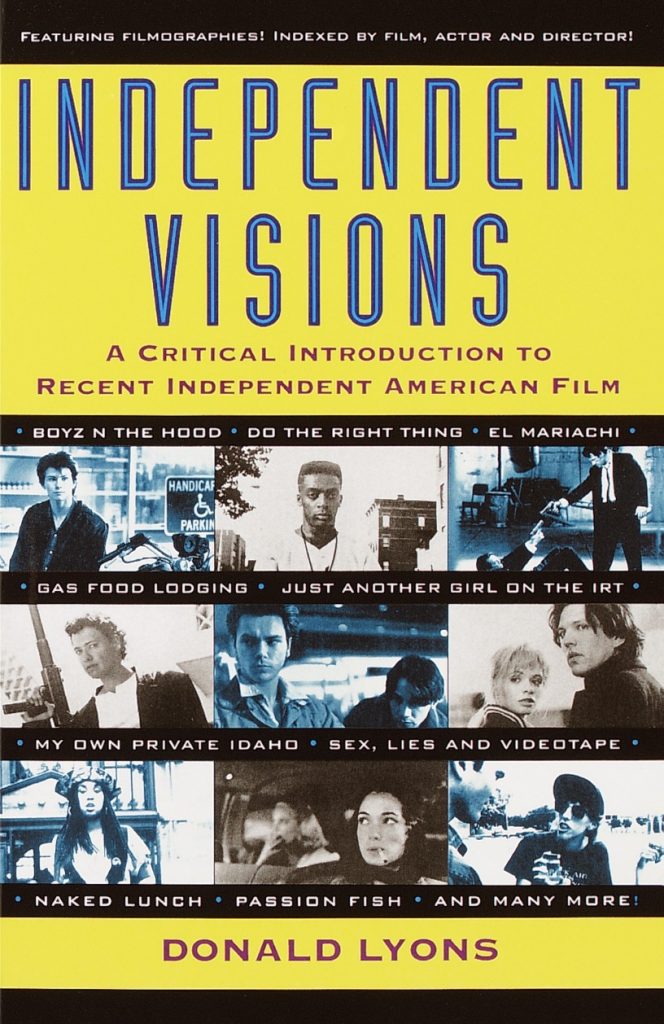
Independent Visions: A Critical Introduction to Recent American Independent Film
Donald Lyons
1994; Ballantine
The greatest criticism one could make of Donald Lyons’ thoughtful, highly readable exploration of the “Independent” boom in American cinema, from the mid-1980s to the early 1990s, was that it was released too early. This book was published prior to 1994’s Pulp Fiction, which itself started another “Indie” boom. Since the movement was still happening while it was published, it is therefore exempted as a comprehensive history. Even so, Mr. Lyons indicates right at the start that this book is not meant to be an all-inclusive overview. This would explain why someone like Rob Nilsson is ignored entirely.
Admittedly, I use the term “Independent Film” a lot more liberally than others. Its colloquial usage is to describe independently produced narrative films, omitting avant-garde, experimental cinema. (One can scarcely get more independent than the hand-to-mouth lifestyles, and grassroots approach to creating and promoting work than did many people who made non-narrative films.) Also, there is the dichotomy of so-called independent films produced by smaller companies that are often subsidiaries of a larger studio, and with commercial aspirations. This book ignores such arguments, but suffice it to say, the films included are of independent narrative cinema.
As such, for those who are interested in the the “indie boom” of the period, this is a worthwhile introduction. Mr. Lyons divides the book into regions, (New York, California, etc.) and then discusses the independent filmmakers pertinent to those areas, with detailed reviews of their works (admittedly, more synopses than critiques).
This book covers more of the obvious choices (like the works of Spike Lee, John Sayles and Hal Hartley), and he even includes Canadian directors David Cronenberg and Atom Egoyan (specifically Naked Lunch and The Adjuster, respectively, as they are of the time period examined in the book). Some obvious subject choices are surprisingly short: Joel Coen’s oeuvre as a whole is given less time than the analysis of Carl Franklin’s One False Move! This book is valuable for the coverage of other lesser-known works like Leslie Harris’ Just Another Girl On The I.R.T., and Nancy Savoca’s True Love. And for these efforts, this book is recommended, but I wish more time was spent on exploring Independent Cinema really means.
Originally published in slightly different form in Vol. #1, Issue #8.
Greg Woods

Greg Woods has been a film enthusiast since his teens, and began his writing "career" at the same time- prolific in capsule reviews of everything he had watched, first on index cards, then those hardcover dollar store black journals, then an old Mac IIsi. He founded The Eclectic Screening Room in 2001, as a portal to share his film love with the world, and find some like-minded enthusiasts along the way. In addition to having worked in the film industry for over two decades, he has been a co-programmer of films at Trash Palace, and a programmer/co-founder of the Toronto Film Noir Syndicate. He has also written for Broken Pencil, CU-Confidential, Micro-Film, and is currently working on his first novel. His secret desire is for someone to interview him for a podcast or a DVD extra.