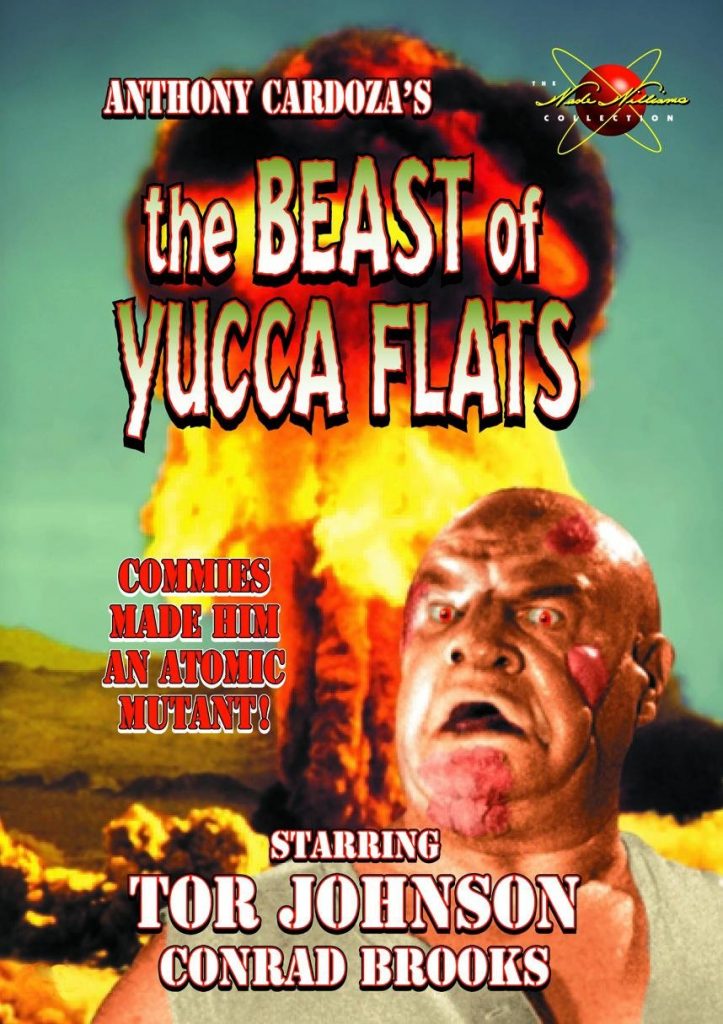
Many directors started out as actors who were fed up starring in other people’s claptrap and sought to share their unique visions from the directors’ chair. Not always, but sometimes, these people with such independent visions make films not easily digested by the mainstream. This anomaly includes such people as Stroheim, Welles, Cassavetes, and… Coleman Francis. Wait. Did I just reference Coleman Francis in the same sentence as Erich von Stroheim and Orson Welles? Well, yes, like any work by those men, there is a distinct authorship in Francis’s films as a director.
In his lifetime, Coleman Francis was better known as a bit player, who starred in such B films as T-Bird Gang and The Jailbreakers. Like Cassavetes or Stroheim, he is better known posthumously as a director of a handful of films that in the grand tradition of Erich von, snub their nose at Hollywood conventions, and commit their peculiar visions to celluloid either within or without the system- mainstream acceptance be damned. Between 1961 and 1965, Francis wrote and directed a trio of grimy, washed-out Grade Z genre pictures, with Anthony Cardoza as producer: Beast of Yucca Flats, The Skydivers and Night Train to Mundo Fine (now better known as Red Zone Cuba). Beast has been lauded as an all-time bad movie for quite some time, but the latter two films have gained a new audience thanks to their inclusion in the Mystery Science Theatre 3000 sweepstakes. Although it too had the MST3K treatment, and it was recently released on DVD, Beast was nonetheless hard to see, thus making its notoriety almost legendary (if it’s hard to find, it must be for damn good reason). My copy, for instance, was acquired from a collector.
With the ways in which video distributors try to wrap releases around numbers, I’m surprised no one has put out Beast of Yucca Flats with the slug: “40th Anniversary Edition”. Why not? They put out It’s a Wonderful Life and Citizen Kane with similar monikers. And why should we be putting such a banner on this film, you ask? Whereas Stroheim, Welles and Cassavetes advanced the film language, Francis set it back about forty years. Therefore, everything bad you may have read about Beast of Yucca Flats is true. It really is one of the worst films ever made… or, are we missing the point? Surely no one would aspire to make something this terrible, or is this film an intentional gob of spit in the face of Tinseltown?
Right from the opening scene, all properties of cinema are reduced to their crudest forms. We are given a teaser of an introduction, as a cute brunette (who is briefly seen nude) gets ready for bed, and then is strangled to death by a slightly offscreen brute. Then we are given the opening credits sequence, displaying all those responsible for this film. The next scene shows a plane touching down, and exit Dr. Joseph Javorski, played by none other than Grade Z legend, wrestler Tor Johnson. As luck would have it, suddenly standard-issue hired guns show up to waste him and his associates. After a lame car chase, the doctor runs away on foot as his pals try to draw the fire of the enemy agents. Somehow, no one is able to aim at the 400-pound doctor or at least be able to run after him.
Alas, none of that matters, as an A-bomb goes off. Due to the radiation, the good doctor is now reduced to the basest form of existence, namely hulking around and strangling people. Just in these few scenes, you are introduced to the modus operandi of this film, which is to invert and pervert all that one holds dear to cinema. As the beast is humanity at its most primal state, the movie is the basest form of filmmaking. This work’s most distinctive property is the absence of a soundtrack. Even in the first scene, it is glaringly obvious; the strangulation sequence has the sole sound of a clock ticking. As much as this film devolves cinema, it is also ahead of its time.
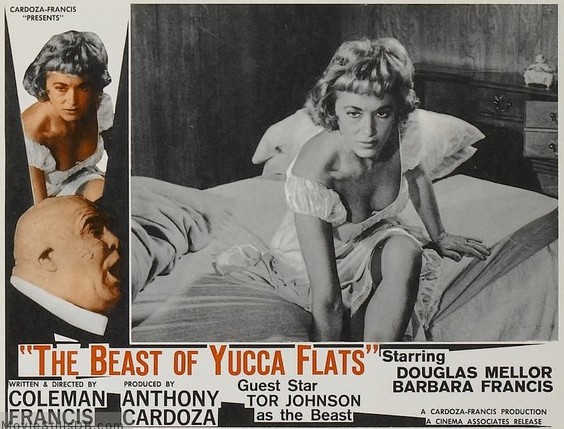
Although we do not realize it at first, the opening scene is out of the time frame of the rest of the film, which unfolds in standard A to B narrative. Was this scene included much later in the filmmaking process as a little teaser (especially because nudity was still rare in 1961 non-raincoat cinema), or is it much more than that? We are watching something that hasn’t happened yet (never mind that this segment is never referred to again); the man is not yet a beast. This interruption of temporal logic was rare in 1961, especially in American cinema. The most peculiar thing, of course, is the film’s (lack of) soundtrack. It predates the Creeping Terror school of filmmaking if someone lost it, but Beast almost seems to have been shot without dialogue. The only “onscreen” dialogue is present during long shots or overlong cutaways- in fact, voiceover is more correct. The “you are there” feeling of the standard Z movie small towns and grassy knolls is sabotaged by the crude canned sound.
The rest of the film’s soundtrack, if not limited to spare sound effects, is filled with a tired narrator reciting the most absurd psychobabble, which has nothing to do with whatever is onscreen. During the early chase scene, the deep-thinking voice utters: “A flag on the moon, how did it get there?” It gets better. A gas pump attendant is taking an afternoon nap to the soundtrack of “Nothing bothers some people; not even flying saucers.” (?!?) The two hard-working cops separately are introduced as men “caught in the wheels of progress”. A rare sound bite that kind of makes sense is the footage of The Beast carrying away a body while the lamenting narrator mourns: “Joseph Javorski; noted scientist- dedicated his life to the betterment of mankind.”
In someone’s warped mind, however, all of this could have a point. One may assume that this film’s narration babbles on to oblivion to make up for a missing soundtrack. Yet, we are also missing shots that would give an indication that dialogue scenes were actually shot in most cases. When Officer Joe Dobson “caught in the wheels of progress” picks up his partner Jim Archer, “another man caught in the wheels of progress”, the scene’s decoupage is not with two-shots of the men greeting one another, which would at least give the soundtrack relevance. Instead we get a long shot of Joe going in, cut to an extended single take of Jim’s angry wife slumping around in a nightie (surely another law was soon to have been broken?), cut to a long shot of Joe and Jim leaving. Also, when Dr. Javorski gets off the plane and starts talking to someone, we don’t hear any of the dialogue. Here, Francis may have sabotaged the one natural performance in the film… and it is from Tor Johnson, for God’s sake! He of course devotes the rest of his performance to lumbering around with what looks like a fried egg on his face- just like in Ed Wood’s Night of the Ghouls. (Were they shot the same weekend?) However, he is really the only person in the film who gives anything resembling a performance, as anyone else’s chances to emote are instead replaced by gratuitous cutaways.
But given all the narrative psychobabble about people caught in the wheels of progress and about the good doctor being reduced to a savage beast, perhaps this film is less some cheap-jack exploitation than a disturbing exploration of de-humanization. Not only is the doctor reduced to something less than human, but so are all the other “characters”, caught in the “wheels of progress”. Perhaps all of humankind is nothing but a machine- acting out the most basic of actions, without compassion, without pity. What better way to accomplish this than to rob the film of anything that might communicate warmth: performance, gesture, voice? Plus, Beast has a troubling message about the way humans treat one another. A manmade device reduces Javorski to savagery, and another stops his reign of killing. There is no standard Universal 1934 cliché here of the beast being felled by someone who cannot bring oneself to stop the monster because of the great human being it once was. Instead, the beast is hunted down like an animal by another unfeeling animal… mankind from above in a helicopter (a recurring motif in all of Francis’s oeuvre).
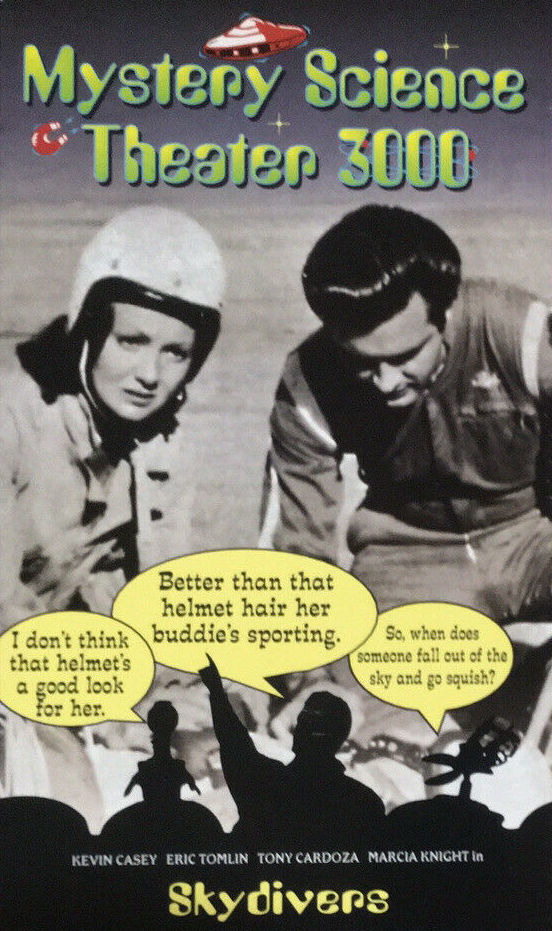
After such a revisionist debut as a filmmaker, what could anyone do for a follow-up but something more mainstream, digestible… better? The Skydivers is a straightforward tale of jealousy and betrayal taken to unfortunate degrees. Harry and Beth (Kevin Casey) are a married couple who run a skydiving school. He however is running around with Suzy (Marcia Knight), a graduate of the Yvette Vickers School of the Other Woman for Potboilers. She, on the other hand is also fooling around with Frankie (Titus Moede- an alumnus of Ray Dennis Steckler pictures), whom Harry recently fired. Harry dumps Suzy, and she metes out her revenge with grave consequences for the skydiving center. Hell hath no fury like a woman scorned, or an embittered bit player making a movie about the basest forms of humanity. While watching this film, especially right after Beast of Yucca Flats like I did, one is actually surprised by the competence of the direction… in relative terms. Never mind that there are long melodramatic scenes that don’t go anywhere, that the stock skydiving footage features people that bear no resemblance to the principal cast (whose canned studio echo voices are simultaneously heard on the soundtrack), or that there are continuity errors galore. It’s much more digestible- that is, it isn’t such an uncompromising subversion of cinematic technique.
Taken in light with his other two pictures, however, Skydivers is another of Francis’ sour depictions of the awful things humans do. Everyone in this film is betraying someone for another who ends up doing them wrong anyway. As usual, this film is shot in grimy low contrast, washed out greys, which in hindsight properly enhances the seedy human behaviour. Once again the film climaxes with Francis’ favourite operative, the helicopter chasing down the villain. At the fade-out, the message is clear: Francis is creating an oeuvre in which bad behaviour begets more of the same, and it just keeps on continuing.
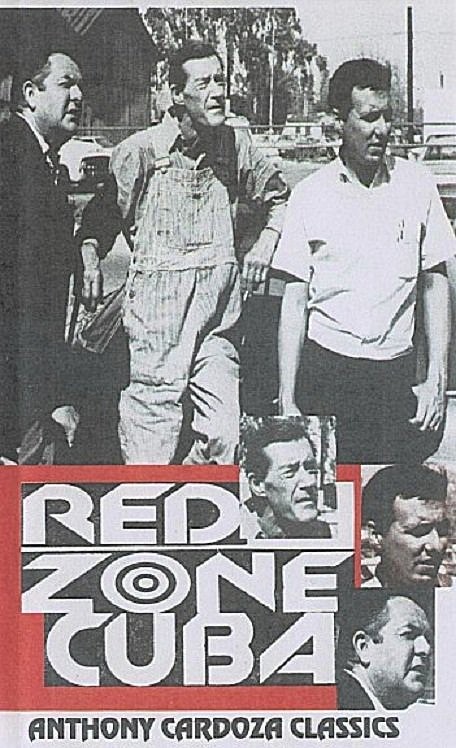
The final film in Coleman Francis’ trilogy is his tour de force: Red Zone Cuba (originally entitled Night Train to Mundo Fine). The maverick writer-director also takes a principal role. Where Beast of Yucca Flats spared nothing in form, Skydivers was uncompromising in theme, Red Zone Cuba is challenging in its structure. Because the plot is constantly being frustrated, the film is then forcing us to study the irrationality of human nature. Right from the start, the storyline is going spastic. John Carradine is an engineer in a desolate train depot, who is interviewed by a reporter about some criminals who hopped his train four years earlier, in 1961. As with Beast, Francis bewilders us with an opening scene. After this brief introduction, and the opening credits (over which Carradine sings the title song- sounding a lot like Vaughn Monroe), we are back into the past.
Francis plays Griffin, an escaped convict on the lam who meets two ex-cons, Landis (producer Anthony Cardoza) and Cook (Harold Saunders). Rather than make a fast buck by turning him in, they decide to accompany Griffin in the inane idea of joining a ragamuffin group of mercenaries who are going to storm Cuba and overthrow Castro. The operation of course backfires and our original trio is incarcerated in a prison that looks like an outdoor hot dog stand. They escape, and then plot to prospect at the mountain that their platoon leader Chastain (Tom Hanson) has said is loaded.
Somehow they end up at a roadside diner, kill the owner and make off with his car, ditch it and get on the train. A ha! Finally, we get to see the locomotive that warranted so much attention that it was mentioned in the prologue to the movie! And what happens on the train? Absolutely nothing! About ten seconds after getting on, they get off.
Griffin then hocks Landis’ ring to buy another car. They meet Chastain’s wife at his home, and then plan to take the mountain. But somehow the climax is doubled by the inexplicable arrival of Chastain, the law quick on their heels, and, this being Francis-esque, are hunted down by authorities in helicopters. Whew!
Let’s go back to the opening. As we see, Carradine’s character buys absolutely nothing. We never see this old engineer again, even in the actual train sequence (such as it is). The opening scenes of Francis’s films operate on a figurative level. They are indicators that some property of filmmaking is to be subverted. In other words, once we learn that the “night train” is a nothing role, we understand the syntax of this haywire “plot”. With very little difficulty, the Cuba subplot could actually have been written out of the film completely. It only exists as a set piece for the trio to acquire information on this mountain they intend to plunder. Given that, they could have saved a lot of dough on grainy day for night combat sequences, and they could have eschewed the shaggy Castro lookalike (also producer Cardoza).
The only true motivation in this story is killing for greed. This is the only operative in the cruel world that Francis portrays. Once again, we are given a film with an unending string of depravity. The vignettes are actually secondary to this motivation. Like Cassavetes, Francis purposely up-ends the story and forces us to study the unpredictability of the characters; thus, they are as inconsistent as real people. This film is a lot like life: a series of seemingly unrelated events nonetheless strung together. This unsparing depiction of the inhuman condition and human irrationality is how Francis completed his odyssey as a filmmaker.
It should be said that visionaries do not act alone. They also have inseparable companions who are on hand to aid them in realizing that vision. In the films of Coleman Francis, Anthony Cardoza is an important ingredient. Not only did he produce all three of Francis’ pieces, he also acted in prominent roles in the last two. He saw it fit to literally immerse himself in his director’s unique morality plays. In Skydivers, he is Harry, whose infidelity meets a stern retribution. In Red Zone, he plays one of the ex-cons who travel with Griffin in an impressionistic journey of plunder. Did Cardoza cast himself in order to save money? Perhaps the two filmmakers were so close to the project that they decided to play two of these horrible human beings as the absolute filth they envisioned them to be.
In the twilight of Coleman Francis’ life, his efforts as a filmmaker were forgotten. Once again, he was making a meager living in small roles in films B to Z. He was a fixture in films of Russ Meyer and Ray Dennis Steckler. In Motorpsycho, Meyer gave him a prominent role as Haji’s husband (yeah right!), who could be a lecherous cousin of Bert Remsen’s character in Nashville. It is a well-known story in the annals of Grade Z-dom that Steckler had just wrapped Body Fever, but when he saw Francis in the gutter, he suddenly created a scene which showcased the hungry actor, and his off-the-cuff scenes actually would add weight to the plot! In an interview, Steckler had lamented that Hollywood had given Francis the cold shoulder because of his alcohol problem. It is sadly ironic that one of his last (and tiny) roles was in Meyer’s Beyond the Valley of the Dolls… as a drunk.
Thanks to the Mystery Science Theater crowd, Francis is better known today as a director. And despite the foreground heckling of the animated silhouettes, it is also because of this MST3K treatment that Francis’ films are arguably better known today than ever before. Finally, after decades of neglect, even after Francis lies buried, his uncompromising trio of films is back in the public eye. They are a durable portrait of a justifiably bitter man- one that was ignored by the system and then retaliated by creating work which challenged our conditioned responses to cinema, and which gave us stark, bleak portraits of inhumanity.
Originally presented in Vol. #1, Issue #2, “The First Annual Summer Drive-In Issue”.
Greg Woods

Greg Woods has been a film enthusiast since his teens, and began his writing "career" at the same time- prolific in capsule reviews of everything he had watched, first on index cards, then those hardcover dollar store black journals, then an old Mac IIsi. He founded The Eclectic Screening Room in 2001, as a portal to share his film love with the world, and find some like-minded enthusiasts along the way. In addition to having worked in the film industry for over two decades, he has been a co-programmer of films at Trash Palace, and a programmer/co-founder of the Toronto Film Noir Syndicate. He has also written for Broken Pencil, CU-Confidential, Micro-Film, and is currently working on his first novel. His secret desire is for someone to interview him for a podcast or a DVD extra.