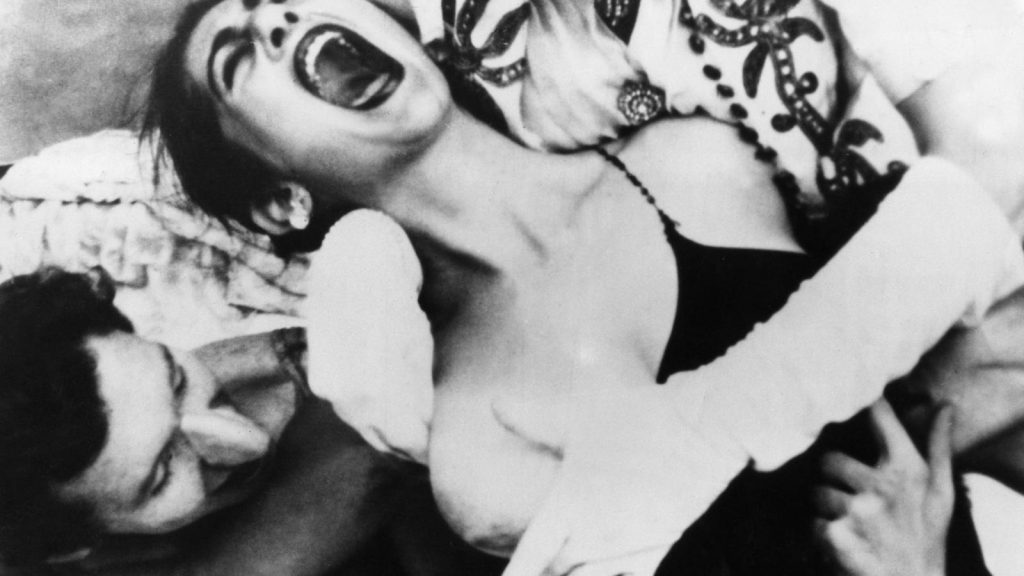
Flaming Creatures (USA, 1963) 40 min B&W DIR: Jack Smith. SOUND: Tony Conrad. CAST: Piero Heliczer, Frances Francine, Sheila Bick, Joel Markman, Mario Montez, Arnold Rockwood, Judith Malina, Marian Zazeela.
Technically, Jack Smith’s once-notorious film, Flaming Creatures, has never been lifted from its ban. However, if you view it via unauthorized streaming online, or perhaps at a college or cinematheque screening, the police likely won’t be breaking down your doors. At the time of this review, the taboos challenged in Flaming Creatures had been distilled to the masses. On a typical Friday night, one could turn to the Showcase Revue to see the onscreen fellatio of Marco Bellocchio’s Devil in the Flesh, or flip to TVO’s Film International for two men going at it in the opening of Derek Jarman’s Edward II.
However, in its 1963 original release, Flaming Creatures understandably raised a furor over its depiction of bare breasts and exposed phalluses (however flaccid, both in physiology and presentation). The most notorious film from the career of filmmaker-performance artist Jack Smith (at the time of his death in 1989 at the age of 57, much of his work remained uncompleted or in tatters as he’d present excerpts of his films in his performance pieces), this forty-minute romp, shot on a rooftop one Sunday afternoon, is an assault on sexual and cinematic mores, as heavily made-up queens (ambiguous in gender and sexual preference) camp out and act out their hidden lusts.
The washed-out visuals (due to being shot on outdated military film stock) accentuate the cloud of ambiguity, and (intentionally or not) have a gauzy dreaminess which recalls the very papier-mâché artifice of those 1940s exotic costume vehicles, specifically those of Smith’s muse, actress Maria Montez. The film’s otherworldliness from the non-acting, drag costumes (when worn at all) and grubby compositions is upheld by rubbery, post-sync sound, and scratchy, tinny music from 78 RPM records. Flaming Creatures has an operatic flow: a middle diminuendo bookended by crescendoes of desire carried out to sometimes dangerous degrees, as pain replaces (or at least copulates with) pleasure.
Much has been written about this film: Stephen Dwoskin’s Film Is candidly observes its making and premiere showing (it travels back to the days when underground filmmaking really was underground, and one had to settle for screenings in flooded basements); P. Adams Sitney’s marvel of a book Visionary Film devotes an entire chapter to it (less on its subversive qualities than on exploring Smith’s adoration for the tinny camp cinema of yore he is recreating). A more recent text, On Jack Smith’s Flaming Creatures: and Other Secret-flix of Cinemaroc by J. Hoberman (who has spent a career championing this film) was published in 2001. Most famous is Susan Sontag’s 1964 essay, “Notes on Camp”, which discusses the sexual content and how the film’s form compliments it.
In fact, for years, Flaming Creatures could only just “be” read about, as it was so difficult to see. Filmmaker and archivist extraordinaire Jonas Mekas risked arrest to defend its existence; it debuted in Toronto as late as 1990 (fittingly enough, presented by Hoberman). In 2001, much to my amazement, one of my favourite video stores carried a bootleg VHS (from some outfit called Exclusive Media), which was the source for this original review. But, I have to be honest. Flaming Creatures is much more interesting to read about than to sit through.
Even at 40 minutes, it is unbearably tedious. It is truly difficult to pay attention to what transpires onscreen largely due to the sloppy compositions and washed-out visuals, but all the more infuriating that it was likely made for the sole purpose of frustration. History records that Jack Smith “liked to leave messes”. That is to say, he relished in presenting work that was uncompromising, or at least inconsistent, unfinished.
To date, Flaming Creatures and his subsequent feature Normal Love can be seen in unofficial bootlegs. But his tattered legacy, and battles over his estate, presage that there won’t be a Criterion box set of his work anytime soon. Despite how difficult it is to view his work (in either sense of the term), Jack Smith himself is an endless source of fascination. On and off camera, he truly was as “larger than life” like the movie stars he idolized. His work even predated the Warhol factory’s “superstars”- he had his own in Mario Montez. Smith would resent how Warhol popularized the underground cinema, and lived most of his life in poverty while being true to his art. In that sense he was “underground cinema” personified.
A different version of this review was originally published in Volume #1, Issue #1, 2001. Some of the context has been left in, if to show people in the pre-internet age how we had to resort to bootleg VHS tapes to see commercially unavailable films. In 2012, Lightbox presented a one-off showing of Flaming Creatures on film! After having only seen it in multi-generational bootlegs, I attended the screening to see in all fairness if I would change my mind about the film after seeing it properly. Sorry, but the answer is a resounding “nope”.
Greg Woods

Greg Woods has been a film enthusiast since his teens, and began his writing "career" at the same time- prolific in capsule reviews of everything he had watched, first on index cards, then those hardcover dollar store black journals, then an old Mac IIsi. He founded The Eclectic Screening Room in 2001, as a portal to share his film love with the world, and find some like-minded enthusiasts along the way. In addition to having worked in the film industry for over two decades, he has been a co-programmer of films at Trash Palace, and a programmer/co-founder of the Toronto Film Noir Syndicate. He has also written for Broken Pencil, CU-Confidential, Micro-Film, and is currently working on his first novel. His secret desire is for someone to interview him for a podcast or a DVD extra.