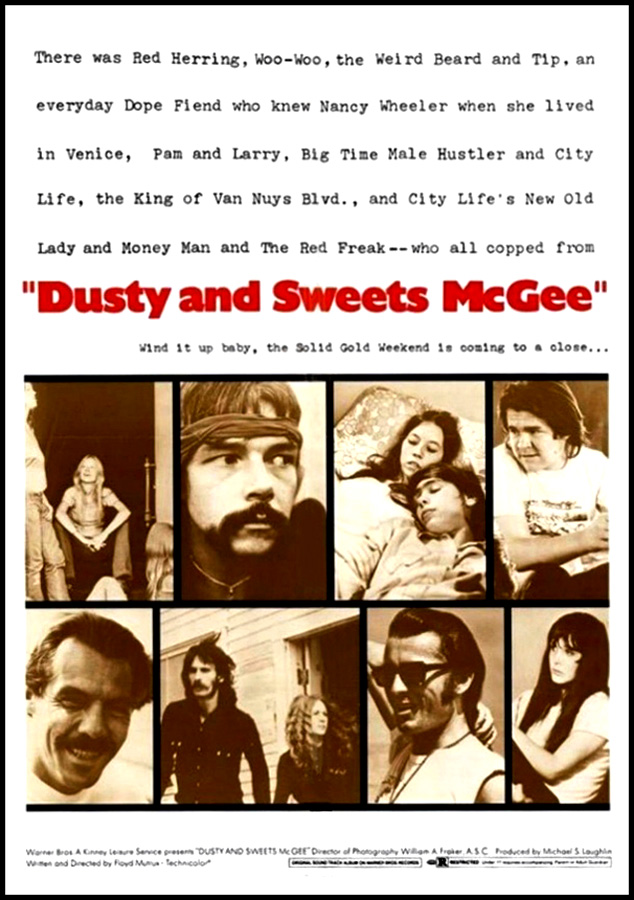
Dusty and Sweets McGee (USA, 1971) 92 min color DIR-SCR: Floyd Mutrux. PROD: Michael Laughlin. DOP: William A. Fraker. CAST: Clifton Tip Fredell, Kit Ryder, Billy Gray, Bob Graham, Nancy Wheeler, Russ Knight (Warner Brothers)
In 1971, Warner Brothers barely released a pseudo-documentary counterculture film, Dusty and Sweets McGee, written and directed by Floyd Mutrux. This uncompromising depiction of drug addiction was soon overshadowed by Fox’s release of Panic in Needle Park, and Warners thusly put the film back in the vault, only occasionally reviving it for sporadic screenings. In fact, the most attention this picture has received in recent years is when actor Billy Gray (from TV’s Father Knows Best) sued movie critic Leonard Maltin for inferring (in his annual movie review guide, TV Movies) that Gray was a real-life drug addict. The actor maintained that he was merely playing a role for the film. (Since then, mentions of Billy Gray have vanished from newer editions of Maltin’s book.)
Even so, that bizarre footnote of legal history is rather pertinent to the film. It is indicative of Dusty’s strange wavering between fact and fiction. Apparently, the addicts in the picture played themselves, whereas the pushers were played by actors (can’t imagine why). The entire film has a candid nature about it, from very loose scenes in which we see our subjects going through their everyday lives (mostly trying to score), to curious “talking head” moments where they confess to the viewer about their experiences with dope. Thus, Dusty and Sweets McGee is a very important picture for its look at hippie dreamland gone to hell due to hard drugs (and as such, remains one of the least dated counterculture films). It is also a sample of those short years in which studios were willing to back projects which took on risky subject matter, or at the very least, attempted to experiment with film form. Try imagining a Hollywood studio funding pictures like Myra Breckinridge, Pound or Zabriskie Point today. Further, Dusty is perhaps the finest film of writer-director Floyd Mutrux, one of the 1970s’ most important and unjustly neglected filmmakers. For all these reasons and more, Dusty and Sweets McGee is an unsung masterpiece that is inexplicably collecting dust in Warner’s vaults.
Those familiar with the work of Floyd Mutrux likely think of his penchant for nostalgia- American Hot Wax and The Hollywood Knights were (respectively) valentines to the 1950s and 60s, and Aloha, Bobby and Rose became a time capsule of mid-1970s aimlessness. Yet, there is a profound sadness in many of his films. Behind the brilliant neon photography and the soundtracks of wall-to-wall oldies, we see the unfortunate traps that his protagonists blindly walk into and cannot exit. Thus, the old rock n roll music (coming from a solid gold weekend of an omnipresent radio) provides an ironic counterpoint to the tragedy onscreen.
As sad a picture that Dusty and Sweets McGee is, it is also surprisingly funny, and thrilling; yet it is far less digestible than any of his other tonal poems. Not only is this a demanding picture in its look at addiction, this impressionistic, near-plotless film weaves a surprisingly dense narrative, as it chronicles the adventures of a group of addicts over one weekend. It finds and retains the perfect balance between reality and fiction (we’re never exactly sure if what we’re seeing is genuine or scripted), and its elliptical, choppy structure further makes us uneasy.
Although we see these people do such personal things as shoot heroin, argue and confess their sins to the camera, we come away not knowing much more about them then when we started. This makes perfect sense actually, as how much can one person really find out about another over a weekend? Mutrux’s style further adds to the mystery of these characters. The viewer is always a voyeur, not necessarily a participant.
Dusty and Sweets McGee are played by two actors simply credited as Beverly and Mitch. Throughout the film, we see this pair do little else but drive around in their VW bug, and pick up dope in phone booths left there by their connection, City Life. As with all of the other people in this film, drugs are their life, so much that the conversation seldom deviates from this topic. Yet one scene, in an anonymous hotel room, we get a glimpse of this couple falling apart. As the woman (not sure if she is Dusty or Sweets) says. “There’s one reason why we’re together- dope”. Yet she is getting tired of him sponging from her all the time. There is one however brief moment of tenderness when we do see these people in a park, and we realize these two need each other after all.
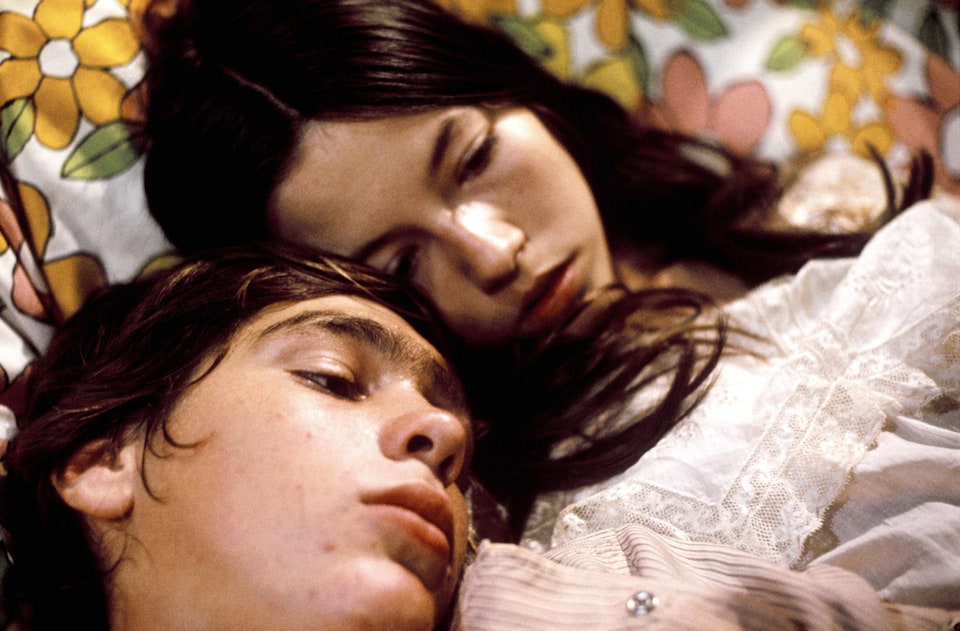
Perhaps Dusty and Sweets are more animated than another young couple, simply identified in the credits as Boy and Girl (played by Larry and Pam), who do little else but lie in bed after cooking heroin. One young lady (Nancy Wheeler) confesses to the camera her experience where she forgot she had already taken some dope, took some more, and overdosed. We see little else of her in the narrative sense, but for such a small moment as when she is walking along the beach. Wandering seems to be a key to this film as much as the director’s next film, Aloha, Bobby and Rose.
In fact, one recurrent image we see throughout this solid gold weekend is the male hustler (Kit Ryder) wandering down the middle of the street at dawn, no doubt coming home from turning tricks for dope. (In one interesting moment, we see that one of his johns is one of the old gangster types bringing the dope to the streets- this may be narrative convenience, but it makes sense- this underground is small enough, that naturally people would know one another.) In the hustler’s confession to the camera, he talks about his trade with no apologies.
And Tip (playing a character called Everyday Dope Fiend) is so unapologetic about his lifestyle that he jokes about it. His interview to camera is right outside the prison where he served time for drugs, and he laughs at the irony of it. In one long take, Tip shows us from a pickup truck driving through a neighbourhood, all the places where he got stoned. While Tip is hardly someone you’d want to have drinks with, he brings much levity to the movie with his boisterousness and serio-comic scenes, especially those with his crime partner (both men wear ruddy moustaches and white T-shirts: they could be twins). We see the duo at work when one feigns a seizure in a supermarket to divert attention so the other can steal food. Then in one hilarious moment, the two go into a public washroom to share some dope, and one accidentally flushes their stash down the sink!
Interestingly, and perhaps fittingly, the only character seen having anything resembling a normal life (that is, drugs doesn’t permeate every single conversation) is City Life, the dealer (played by Billy Gray). He is viewed in such idyllic moments as looking for a tape deck to put in his car, or relaxing under a tree with Sidekick (played by Little Billy Graham).
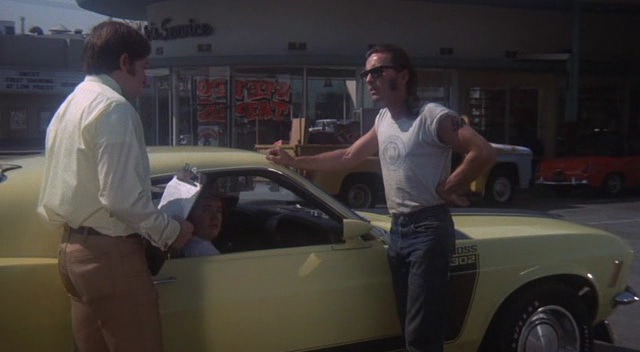
And so, Dusty and Sweets McGee ends (perhaps not ends, but stops) with an arrest, and an overdose as its other assorted characters still wander on to the next fix, another day. Smartly, not everyone has a great dramatic climax in this solid gold weekend. Some stories end, some continue. And some of the characters remain an enigma to us. To rely on any other kind of narrative convenience is for “a movie”.
This film comes back to haunt you for days later, just like Aloha, Bobby and Rose, especially those with popular music on the soundtrack. Like Aloha’s idyllic drive scored to Junior Walker or the journey through the desert and oblivion to Elton John’s “Tiny Dancer”, Dusty too creeps up to you with its impeccable use of songs. Today such a thing would be used to mainly sell a soundtrack album, but Mutrux’s use of music perfectly balances the tones of whatever is going on in the movie. “Duke of Earl” and “Hey Baby” bring the sinful thrills of the night life in the abstract opening, shot in overexposure by William Fraker, so that the neon screams at you. Larry and Pam cook eggs and heroin to the stoned out haze of “Ride Captain Ride”. Nancy walks along a beach in the morning as Nilsson moans “Don’t Leave Me Baby”, capturing the waste and abandon. Dusty and Sweets shoot up in yet another anonymous hotel room to Van Morrison’s “Into the Mystic.” Many films make the mistake of having popular music overpower the visuals, yet the way in which Mutrux blends sound and image is perfect: the narrative (such as it is) becomes a sad, beautiful poetry.
After the movie officially ends, we are then treated to a series of stills featuring the cast members in lighter moods (not necessarily from moments we have seen in the film), while on the soundtrack we hear Jake Holmes’ “So Close”: this marriage of his mournful ballad to these photographs is too moving for words. We are never made to judge the acts of these people (even though the documentary style of the movie doesn’t glamourize them in any way). Yet, after seeing 90 minutes of their self-abuse and squalor, this conclusion reminds us that Dusty, Sweets and all the rest are people after all. Few counterculture films treat their subjects with such dignity. Mutrux’s career is likewise infused with dignity. While he was a very successful screenwriter and producer, his pursuits as a director only happened in fits and starts, after such a promising beginning. So close.
Originally published in Vol. #1, Issue #14 (“Back to the 70s”). This film was made available for viewing thanks to, ahem, “a collector”. Since then, Warners has released this film, if only on MOD through its Warner Archives label. Still, it’s good that it’s out there for those who want it. So close.
Greg Woods

Greg Woods has been a film enthusiast since his teens, and began his writing "career" at the same time- prolific in capsule reviews of everything he had watched, first on index cards, then those hardcover dollar store black journals, then an old Mac IIsi. He founded The Eclectic Screening Room in 2001, as a portal to share his film love with the world, and find some like-minded enthusiasts along the way. In addition to having worked in the film industry for over two decades, he has been a co-programmer of films at Trash Palace, and a programmer/co-founder of the Toronto Film Noir Syndicate. He has also written for Broken Pencil, CU-Confidential, Micro-Film, and is currently working on his first novel. His secret desire is for someone to interview him for a podcast or a DVD extra.