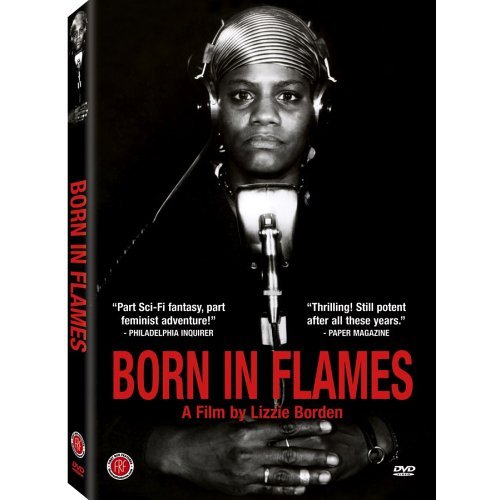
Born In Flames (USA, 1983) 79 min color DIR-SCR: Lizzie Borden. STY: ED Bowes. DOP: Ed Bowes, Al Santana. CAST: Honey, Adele Bertei, Jean Satterfield, Florynce Kennedy, Kathryn Bigelow. (First Run Features)
In an age when the term “independent film” can mean the most innocuous, sophomoric, and disposable anything shot on a palmcorder and posted on YouTube, or even a film whose nonetheless low budget is backed by a subsidiary studio and still has commercial elements, what a relief then, to encounter Born in Flames on DVD. This 1983 feature, directed by Lizzie Borden, made available for viewing by First Run Features, is a breath of fresh air. This movie is loud, angry, confrontational, and thought provoking, as the radical spirit of independent films should be, but it is also surprisingly quirky in its “movie within a movie” approach.
This futuristic tale, set 10 years after the War of Liberation, in which women had won their fight for equality, finds that things are reverting to the old ways, as the male population is attempting to reclaim its dominant role. Although director Lizzie (nee Linda) Borden has said that the movie is only science fiction in its setting, this movie is timeless. Born in Flames, thusly, like all good SF, could be present day, with all of its racial and sexual politics, and setting in the ghettos and industrial areas of New York.
If this film was made today, it would be no less relevant. However, its 1983 release perfectly coincides with much of what was in the air in the days of Ronald Reagan and Margaret Thatcher. As the year 1984 was approaching, there was a renewed interest in George Orwell’s novel of the same name, and its depiction of a totalitarian society. And because this picture was made at the twilight of the Cold War, Born in Flames perfectly captures the era’s anxiety over Armageddon with two superpowers in the nuclear arms race. At the same time, there is a punk, “Do-It-Yourself” aesthetic throughout- the music compliments the nihilistic tone of the picture. (In fact, this multi-layered narrative film can be compared with Rick Schmidt’s Emerald Cities, released the same year; another Orwellian, Reagan-era apocalyptic nightmare interspersed with nihilistic punk overtures. However Born in Flames is much more humourless and political.)
Ms. Borden’s film is also evocative of the time’s New York’s Downtown Cinema. While Born in Flames is certainly not as extreme as the Cinema Of Transgression also borne out of that movement, it shares the similar concerns of living in a police state that has gone out of control, and has a gritty authenticity not found in most commercial films of the day. The “Do-It-Yourself” manifesto is also evident with its use of non-actors (who further blur the fiction of the narrative by using their real names for their characters’): and even if some of these stars are obviously unschooled actors, I think any attempt at classical Hollywood filmmaking would have ruined the fascinating docu-drama approach.
In an interview, for the November 1983 issue of The Independent Film and Video Monthly, Ms. Borden mused that some of the scenes ended on the cutting room floor because they were “too beautiful”. The gritty look enhances the oppressed society it depicts, and the film has an excellent “you are there” feel, especially in some scenes where the viewer feels like a fly on the wall, with two-character scenes rife with overlapping dialogue. This is indicative of how the movie feels so alive, and the documentary approach makes this allegorical tale all the more real.
One early scene features a Spanish girl who is accosted by Latino men on the street corner, and before the interlude turns into a sexual assault, the men are besieged by women on bicycles, blowing whistles, embarrassing the men into leaving. The documentary feel is further enhanced as many scenes are filmed as television reports, shot from screens. This device blurs with the Orwellian aspect of the film, as the constant motifs of seeing footage on monitors, and hearing voiceovers from white men, give the constant feeling that everyone is being watched, as the white male quotient soon uses totalitarian methods to combat the female dissidents.
In an interview collected in the second volume of A Critical Cinema, Ms. Borden had expressed regret about making the movie without a classical story structure, especially because the feminist themes drew an audience that had not exposed to such an experimental narrative. Because it was shot over a few years, whenever she had money, and with whatever actors where available at the time, this is why the movie has such a fragmented structure. Yet this is precisely what I like about it. It is for the most part an impressionistic look at this society, told on a huge canvas.
Through the dense narrative, a handful of characters take precedence: Isabel (Adele Bertei), the brush cut host of Radio Regatta, who expounds on the oppressed female in between the confrontational strains of punk songs; Honey (played by Honey), on the Phoenix radio station who similarly expresses social concerns on the air; and Adelaide Norris (Jean Satterfield), the founder of the Women’s Army. All of the prominent characters, except for Isabel, are African-American women. And for its time, no other feature film better examines the limited prospects of working-classic females of visible ethnicity. Despite the so-called futuristic setting, all of the excellent “on-the-street” interviews with women talking about their crises make these themes just as timely.
Similarly, there is documentary footage of women doing dishes, preparing food, and putting fast food in bags, among other subservient low-wage, no-skill jobs. Just how much have the roles changed? Are we seeing shots of women before or after the revolution? In either event, not much has changed—and we ponder how much this has changed in real life.
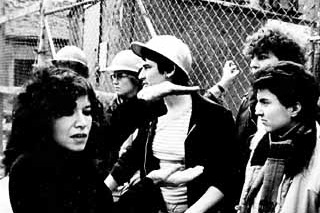
When Adelaide loses her job on the construction site, she incites a call to action, and soon, women are picketing in the streets, obstructing men from going to work. Her arrest, and suspicious death while in police custody, sets off a chain of events. Of all the characters, Honey becomes the most militant. She recruits a small group of radicals who take over a TV station and play a videotape to incite women’s revolution.
The film doesn’t so much end as stop, but this narrative ends chillingly with the radicals detonating a bomb on the roof of the World Trade Centre. In a post-9/11 world, this moment is obviously uncomfortable to watch, and unintentionally makes the film all the more real. However logically this moment makes sense, as the World Trade Centre is the dominant symbol for the male-run capitalist- imperialist society, and, if you think about it, the ultimate phallic symbol that the radicals would want to destroy.
Lizzie Borden would venture on to make the more popular 1986 independent film Working Girls (and with a more conventional structure), and the Hollywood feature Love Crimes (1992). Yet, Born in Flames is arguably her masterpiece. Like all great works of art, it is seems as timely now as the time of its creation. It is no crowd pleaser, because it does not offer pat solutions to a broad social crisis (and how could it?), but it is a daring piece of work, not just for the themes it explores, but for the fascinating approach that blurs narrative fiction with documentary aesthetics. Despite the futuristic Orwellian setting, this doesn’t feel like a “movie” at all in its “you are there” realism. For its social studies and fascinating use of film form, Born in Flames remains a challenging and invigorating piece of work.
Originally published in Vol. #1, Issue #20, “Independent Voices”.
Greg Woods

Greg Woods has been a film enthusiast since his teens, and began his writing "career" at the same time- prolific in capsule reviews of everything he had watched, first on index cards, then those hardcover dollar store black journals, then an old Mac IIsi. He founded The Eclectic Screening Room in 2001, as a portal to share his film love with the world, and find some like-minded enthusiasts along the way. In addition to having worked in the film industry for over two decades, he has been a co-programmer of films at Trash Palace, and a programmer/co-founder of the Toronto Film Noir Syndicate. He has also written for Broken Pencil, CU-Confidential, Micro-Film, and is currently working on his first novel. His secret desire is for someone to interview him for a podcast or a DVD extra.