We all carry pieces of pop culture around with us. Some people however, hang on to their adulation of choice by writing about it, collecting it or even publicly performing it. In movies, such people are usually portrayed as social outcasts and hermitic misfits who barely know how to carry on a conversation past one sentence. For a famous example of this, one need look no further than Vinyl (2000), Allan Zweig’s alternately hilarious and depressing look at compulsive record collecting. Since most of the interview subjects are such curmudgeons who rarely leave their apartments except to hoard more junk, the film is amiss over the joy of collecting, and instead offers an upsetting look at people’s obsessive behavioural sicknesses. What a relief then, to encounter Russ Forster’s two films So Wrong They’re Right (1995), and Tributary (2002), which explore fascinations with certain aspects of our popular culture, and yet present us with people one would actually want to have a drink with.
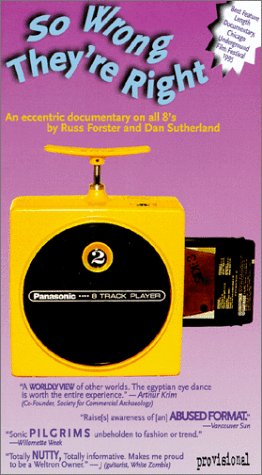
The nostalgic subject matters of So Wrong They’re Right and Tributary, respectively, are about 8-Track tape collectors and rock n roll tribute bands: topics so common to Boomers and Gen-Xers, that we say to ourselves “Why didn’t I think of that for a movie topic?” Each of these films are buoyed with Russ Forster’s own narration or onscreen introduction, not only offering a clever social commentary, but also giving a refreshingly personal touch to these diary-like narratives.
From 1990 to 2000, Russ Forster published the magazine 8-Track Mind, for and about 8-Track enthusiasts. The magazine received a warm response from people validated in their particular fascination, and for the most part, having their own strain of pop culture recognized. His film So Wrong They’re Right is the result of his 10,000 mile, $20,000 cross-country crusade in 1994, to put faces to the names of those enthusiasts who supported his magazine in print, creating a document in film about people with a unique fascination.
At the start, one gets the impression that this assembly of 8-Track collectors has a more socio-political agenda… Gen X Situationism, if you like. The film is introduced as “a statement of active outrage and rebellion from a group of people who have opted out of a disposable consumer culture laid out for them to embrace in the spirit of growth and progress.” Or, these people cling to the 8-Track, “the vanguard of the analog revolution”, out of protest against the “orchestrated demise” of one format, for the conglomerates to sell you back something you already had, however in a new format.
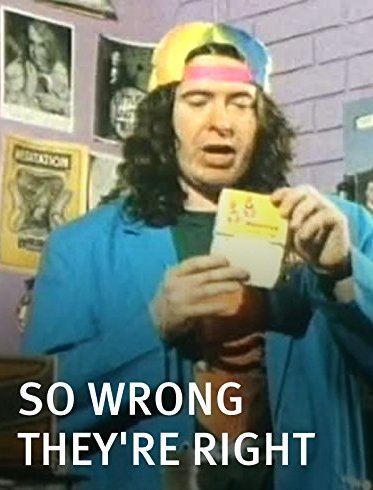
While I partially agree with this, perhaps the statements made by Phil Milstein, who also coined the film’s title, are more telling: referring to 8-Tracks as “the dumbest form of music… totally dumb and that’s what I love about them… big dumb and sweet.” Because the sound quality may or may not be inferior to CD, a KA-CHUNK sound is heard in the middle of long songs as the tape continues to the next track, and people like Jeff Economy wonder “if this is the last time I’ll be able to hear this” before the cassette falls apart. I think the film’s central question is why people will still hang on to obsolete formats.
For instance, let us remember the boom of vinyl nostalgia right at the point in which CDs became more affordable. And despite that DVDs are now more wallet friendly than ever, is it soon to become the next 8-Track tape with BluRay and HD-DVD on the horizon? Meanwhile, there are still those who swear by the LD format of the early 90s, that they are superior to DVDs (which makes sense, because they are a higher bandwidth).
On a personal level, I am a fervent VHS collector, yet I cannot fully explain my behavioural pattern. While I admit that some of the transfers are godawful, why do I make a point of especially amassing anything from the Paragon or Interglobal labels, who proliferated right at the beginning of the home video revolution, notably when the quality of VHS transfers were the worst? Am I too protesting against the machine of commerce by trying to hold onto a format that the new technology wants to obliterate? One remark in So Wrong They’re Right resonates: people falsely believe that the new medium has the definitive catalog of anything ever released. Quick, when did you last see Telly Savalas’ Who Loves Ya, Baby on CD? You may rightly ask, who would want to see it on CD? But uttering that statement is also to play into what is precisely a point of this movie: anything seemingly throwaway is heartfelt by someone. (A similar quandary can be made of some of the titles I have in my two crates of Paragon VHS that have yet to be released digitally.)
But by the same token, a VHS of a fairly recent title for sale in a video store bin is considerably cheaper than even renting the DVD, therefore I am able to stretch my consumer dollars to the max by being able to acquire more films I’m interested in seeing. This trait I share with Tim Hunter of Sparks, Nevada; who could buy a Yoko Ono 8-Track for a quarter, while the sealed LP, which would never be played, sits on the wall with a 60-dollar price tag.

“Swingin’ 8 Track Chick” Abigail Lavine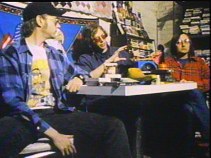
Gumball
But it’s still even more surprising that a marketplace for this format still exists. (Hmmm, maybe I’d better hang on to my pet rock.) We see Tim Hunter on the phone taking an order for Iron Butterfly’s Heavy on 8-Track, and even more elaborately, “Big Bucks’ Burnett in Texas tells us his sale of Never Mind the Bollocks for 100 bucks. W have to admire this entrepreneur’s sensibility: why listen to The Beatles for the fifty millionth time when you can listen to Tiny Tim on 8-Track? It’s cultural snobbery in reverse. When Corey Greenburg wrote something on 8-Tracks in the highbrow publication Stereophile, that further broke the stigma—suddenly it became all right for readers to talk about something as “common” as this medium. But still, they’re not necessarily retro cool, as 8-Track DJs never have to worry about having their tapes stolen.
So Wrong They’re Right would be enjoyable alone for the aspects of people sharing the most offbeat selections in their collections, like the Rudy Ray Moore comedy albums, or Grand Funk’s Shinin’ On (with the 3D cover!) We see how these cassettes work their therapeutic ways into their lives. Jeff Economy listened to Lou Reed’s Berlin one summer while he was depressed. (Lou Reed and The Velvet Underground are staples in people’s collections here, which does make sense, because they’ve always spoken to the fringe dwellers.) One humorous example features the band Gumball emanating the virtues of their great big mountain of 30,000 tapes as inspiration (and they always pack a bunch with them on tour, for spiritual purposes). Perhaps more revealing, one enthusiast drove down the street blaring Reed’s infamous Metal Machine Music (nothing but 80 minutes of feedback)- a more anarchist rebuttal to mainstream consumerism cannot be imagined.
But Russ Forster stretches the parameters even more. Throughout the enthusiastic bubbling about “TNT” shaped tape players, we get little glimpses of how this hobby is representative overall of their lifestyles. This film is perhaps less made for music-collecting enthusiasts, more for people in the fanzine nation, which of course makes sense as many of these subjects contributed to the magazine. The handmade title cards, introducing the next city or speaker, even the rubbery “home movie” kind of sound, and wonky easy listening music (which warbles like a broken cassette) all add to the “Do It Yourself” mantra of the underground publishing world. Indeed, the colourful people in this film mirror those who wander past my table at all these zine fairs.
And for some, these sequences may be over-indulgent. For instance, Doug Von Hoppe’s “8-track delivery boy” sequence is like an educational film gone awry. The scene of librarian-by-day, “ Swingin’ 8 Track Chick” Abigail Lavine, all decked in her go-go boots, calling the Library of Congress to get 8-Track Mind an ISSN number, is shot with all the lurid colour and cheesy lounge music of a late 60s counterculture flick. Yet, they do add an extra, unexpected dimension to the narrative: all representative ways in which people carve out a little corner for themselves in a corporately bland world.
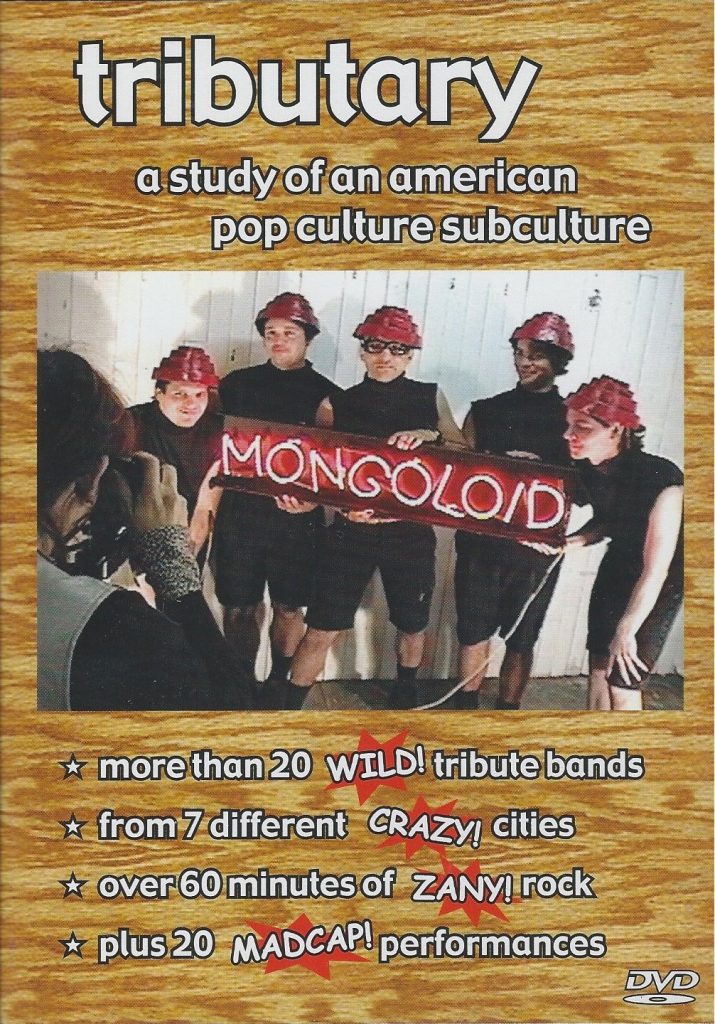
At about the time I had seen Tributary, I was reading Chuck Klosterman’s book, Sex Drugs and Cocoa Puffs. There was an entertaining chapter about musicians who play in rock and roll cover bands. The central conceit of the writing is that these kids are famous for mimicking someone else rather than for their own identity! In other words, if they were doing their own music, they would likely be ignored. (Or at the very least, if the chaps in Sabbacadabra did record their own material, it would sound a lot like Black Sabbath anyway.) But put on a wig and pretend to be Axl Rose, and everyone is thrilled to death. Russ Forster’s documentary, also made from a cross-country exploration, however examines this phenomenon a bit more intricately.
Refuting the oft-held claims of tribute bands being “degenerate offshoots of the real music”, or “a refuge for the unimaginative and untalented”, Tributary instead breaks down the work into sub-categories. The first sequence features “Post Modern Tribute Bands”, that is, self-reflective musicians aware of their mock identities. This group is just here to extend the virtues of the music, not the bombast or ego. Futuristic Dragon (covering Marc Bolan and T. Rex) avoids having a “Bolan” in the group, or even a front man in general, allowing the sound to speak for itself. Brothers E is an Elvis tribute act with the novelty of two people dressed like The King, and although directed at the ladies in the audience, perhaps this band misses the irony of the two singers dressed like Elvis in his cheesy Vegas period, when people perhaps saw Elvis more for the spectacle than the music.
The second group, “Working Tribute Bands”, refers to those who are in it just for the money, even if it is just a weekend thing. Yet, interestingly enough, as much as they love the life of the rock star, they have enough self-awareness to avoid letting it go to their heads. When the Rolling Stones clones Sticky Fingers are asked to sign pictures of Mick and Keef, or when the frontman to Time of Dying (Led Zeppelin) gets called “Robert” at the bar, they know enough to not get lost in their identities.
“Social Tribute Bands” feature artists with an emphasis on community, and perhaps indirectly voices what all of these groups share. If nothing else, these artists are simply trying to keep some part of pop culture alive. (And this is what Tributary shares with So Wrong.) They can play the music of their idols without having to mimic their downward spiral of drugs or being produced by David Geffen. In other words, they’re here to give the people what they want: represent the music and keep the image alive for the fans, when the original group lost their way through lineup changes and different sounds. As British Steel (Judas Priest) proudly shouts: “We’re number two!”
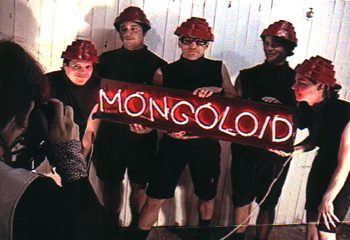
Finally, “True Love Tribute Bands” emulate their idols to the point of mentorship- where they actually feel a kinship with whom they’re imitating. Power Windows members proclaim they wouldn’t want to be musicians were it not for Rush. Giant Bug Village prides itself in being able to turn listeners on to Guided By Voices. Mongoloid represents Devo for the true fan, not just those who jumped on the flavour-of-the-week bandwagon with “Whip It”.
The approach to the material is consistent throughout- interviews mixed with onstage antics. While this style is standard MTV documentary structure, the clever categorization of the material makes this a social commentary above what one would find there. In retrospect, one is more struck by the similarities of these musicians, instead of the differences. They all reduce the iconic status of their idols by playing in small venues or even smaller burgs. (“AC-DC wouldn’t play in Hammond, Louisiana!”, High Voltage exclaims.) As one enthusiastic fan emotes about the Motley Crue clone 2 Fast 4 Love, “they care about me… not their albums or record contracts”. Seeing a Rolling Stones tribute band in a bar instead of a stadium makes their music far more intimate, and thereby makes these ghosts of celebrities seem more like everyday people instead of modern day messiahs. I’m sure all of the performers in this film would exclaim: “It’s all in the music, man!” But despite losing themselves in the identities of their idols, even if someone like Dressed To Kill proclaims “Kiss should be thanking us”, they clearly love the life, and appear to us as funny and engaging people who in some way give their idolatry their own personality by humanizing those they emulate. And if 2 Fast 4 Love wants to pop pills to get on the wavelength of their superstars, and have their groupies show their breasts to the camera, well all right. This is rock and roll, after all. But in Tributary, the wisdom of these performers is not always achieved from the road to excess.
Profound without being heady, and personal without being self-conscious, Russ Forster’s looks at two aspects of our disposable culture are even more remarkable in how they speak very deeply to the viewer. Like the people onscreen whose fascinations are vindicated, the viewer too is somewhat validated by the recognition that even the most arcane piece of popped culture we hang onto is also somewhat important. These films about “those groups” are also about “us”.
So Wrong They’re Right is available on DVD from Other Cinema. Russ Forster also sells copies of this and Tributary on his own website at www.8trackheaven.com
Originally published in slightly different form in Vol. #1, Issue #18, “Discoveries”. Update! I can’t remember now if this came up in my initial research for the article, and if so, I sadly neglected to mention here that Abigail Lavine, an important component of the 8-Track Mind universe (and the engaging “Swingin’ 8 Track Chick” cited above), had sadly passed away from cancer in 1997 at the too-young age of 32.
Greg Woods

Greg Woods has been a film enthusiast since his teens, and began his writing "career" at the same time- prolific in capsule reviews of everything he had watched, first on index cards, then those hardcover dollar store black journals, then an old Mac IIsi. He founded The Eclectic Screening Room in 2001, as a portal to share his film love with the world, and find some like-minded enthusiasts along the way. In addition to having worked in the film industry for over two decades, he has been a co-programmer of films at Trash Palace, and a programmer/co-founder of the Toronto Film Noir Syndicate. He has also written for Broken Pencil, CU-Confidential, Micro-Film, and is currently working on his first novel. His secret desire is for someone to interview him for a podcast or a DVD extra.