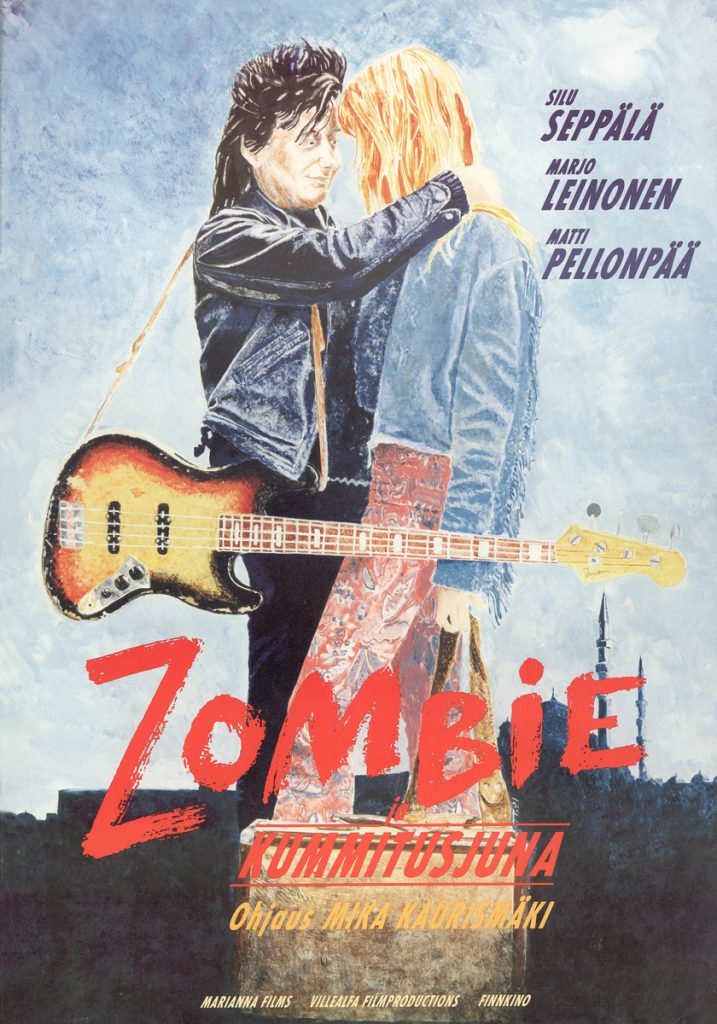
Zombie And The Ghost Train (Finland, 1991) 88 min color DIR-PROD-SCR-EDITOR: Mika Kaurismäki. STY: Sakke Järvenpää, Mika Kaurismäki, Pauli Pentti. MUSIC: Mauri Sumén. DOP: Olli Varja. CAST:Silu Seppälä, Marjo Leinonen, Matti Pellonpää. (Kino Video)
Although director Aki Kaurismäki’s films bear a more signature style which no doubt got him noticed on the international scene, works by his brother Mika (Helsinki Napoli All Night Long; Tigrero: A Film That Was Never Made; L.A. Without A Map) are also recommended. This Finnish comedy-drama succeeds as an early 90s time capsule that can be universally recognized, even on this side of the pond: the heavy metal hair, the economic recession which forced people -once living in 80s excess- to move back into their parents’ basements… it’s all here. This very loose, dark farce concerns a burned out musician and perennial loser named “Zombie” who ambles from one screw-up to another. After getting kicked out of the army for putting turpentine in the soup (yes, you read that right), Zombie finds himself back at home unwillingly. Dad just lost his job, and he’s hardly thrilled to take his son back in. However, old bassists don’t die, they just find another band to play in. He falls in with a punk country band (and they’re something else, believe me) headed by Matti Pellonpää, the droopy moustached actor in many of Aki Kaurismäki’s films. Meanwhile, he reconciles with his old girlfriend, yet the people closest to him still can’t prevent the man from his self-destruction (often brought on by his drinking). While leisurely paced and sometimes rather sloppily directed, this film still has a scruffy charm, and is very funny at times, like the Spinal Tap moment where the bandmates talk about the fates of their former bass players… while “Zombie” is passed out behind them! The least satisfying segment is the weak conclusion set in Istanbul: though not logically wrong, it just belongs in a different movie. The film’s title also refers to a band called “Ghost Train”, which Zombie always aspires to join, but becomes the film’s “Godot”, as his dealings with them are fleeting at best (getting a lift on their tour bus, and being visited by them while unconscious in the hospital). This is a perfect metaphor in a film all about unrealized dreams.
Originally published in Vol. #1, Issue #8.
Greg Woods

Greg Woods has been a film enthusiast since his teens, and began his writing "career" at the same time- prolific in capsule reviews of everything he had watched, first on index cards, then those hardcover dollar store black journals, then an old Mac IIsi. He founded The Eclectic Screening Room in 2001, as a portal to share his film love with the world, and find some like-minded enthusiasts along the way. In addition to having worked in the film industry for over two decades, he has been a co-programmer of films at Trash Palace, and a programmer/co-founder of the Toronto Film Noir Syndicate. He has also written for Broken Pencil, CU-Confidential, Micro-Film, and is currently working on his first novel. His secret desire is for someone to interview him for a podcast or a DVD extra.