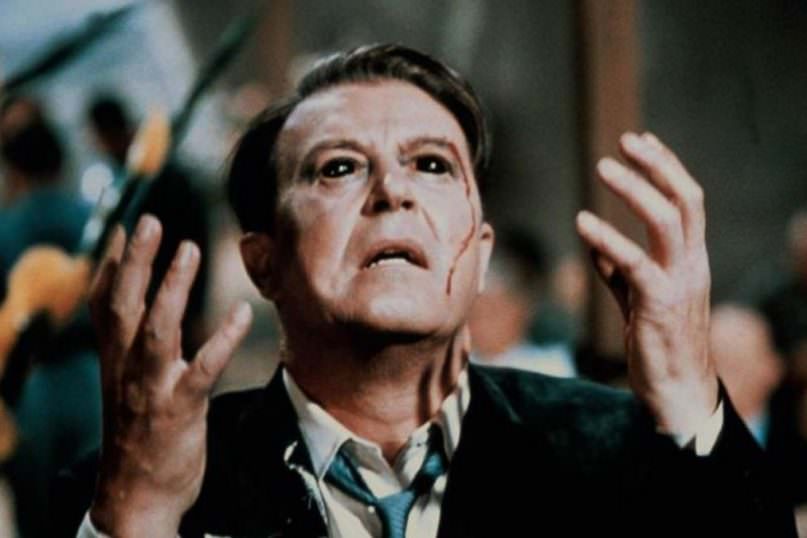
X: The Man with the X-Ray Eyes (USA, 1963) 79 min color DIR-PROD: Roger Corman. SCR: Robert Dillon, Ray Russell. MUSIC: Les Baxter. DOP: Floyd Crosby. CAST: Ray Milland, Diana Van der Vlis, Harold J. Stone, John Hoyt, Don Rickles. (American International Pictures)
By the early 1960s, Roger Corman had really hit his stride as an independent director and producer, and was making more sophisticated films than his quickie genre titles of the previous decade. X: The Man with the X-Ray Eyes hails from this productive, inspired period for Corman, and remains one of his most enduring efforts of the era- an offbeat, well-paced science fiction spectacle with a psychedelic twist. Released four years prior to Corman’s freaky acid film The Trip, “X” covers similar territory: the disturbing experiences of an outsider looking at the world with an altered perception of reality, their senses heightened and unbalanced by a controversial drug. “X” is a relatively conventional narrative, falling into the familiar guise of the “mad scientist” picture, but it is enriched by this druggy undercurrent, and foreshadows Corman’s more overtly counterculture output of the later ’60s, as well as films such as Altered States.
“X” is tailor-made for venerable lead actor Ray Milland, who turns in a memorable performance as the obsessed and ultimately deranged Dr. James Xavier. Following the same dangerous path as the protagonists in The Invisible Man, Dr. Jekyll and Mr. Hyde, and numerous other cautionary sci-fi/horror tales, Dr. Xavier is a visionary scientist delving into unknown realms through his work, with ostensibly noble intentions. At the outset of the film, Xavier is conducting research in an attempt to expand the range of human vision. Through his experiments, designated “X”, Xavier has developed a “compound” which, when applied directly to the eyes, increases the sensitivity of the subject’s vision. In a reckless move, Xavier applies the untested drug to his own eyes, and is soon experiencing the “X effect”: greatly enhanced visual perception, flashes of brightly coloured light, and the ability to see through physical objects (yes, clothing included!). The viewer is treated to some great shots from Xavier’s p.o.v., including some trippy light effects, and a party sequence full of attractive youngsters dancing in the nude! Events soon take an abrupt turn for the worse: Xavier’s research funding is pulled, and in a subsequent fit of anger, he inadvertently pushes a fellow doctor through an upper floor window to his death. Xavier flees, and from this point on becomes an increasingly unstable “mad doctor” on the run from the law.
Xavier continues his downward spiral as an outcast from society, while his “vision” expands exponentially – he regularly administers the drug to his eyes, and the X effect is cumulative. As the storyline unfolds, Xavier first takes refuge as “Mentallo”, a fairground sideshow act, promoted by a sly barker named Crane (played by a young Don Rickles!). Con artist Crane has greater plans for Xavier, however, and soon sets him up in a dingy part of town as a “healer”, summoning locals to have their ailments cured by the enigmatic figure. The brooding, erratic Xavier is eventually pulled away from this dire situation by his former colleague and love interest, Dr. Diane Fairfax (Diana Van der Vlis), and in a desperate attempt to raise some quick cash, the couple drive to Las Vegas. At this point, Xavier’s vision is so intense that he is horrified by what he sees around him – describing “A city unborn, flesh dissolved in an acid of light. A city of the dead.” People appear as skeletons, buildings as frameworks, and everywhere there are strobing coloured lights. Xavier puts his optical powers to work in Vegas, but the casino staff suspects that he is cheating, and he is on the run again. A lively car chase scene ensues, with a disoriented Xavier swerving wildly down a desert highway. After crashing his car, Xavier staggers into a nearby tent, wherein a fervent religious service is being held. His eyes now physically transformed to black, Xavier declares to the preacher that he has seen through to “a light in the centre of the universe, the eye that sees us all!” and in a final abrupt act, pays the terrible price for his cursed vision.
Described by Corman in the director’s commentary as a “low budget Greek tragedy”, “X” is a provocative and enjoyable offering, packed with pulpy thrills and eerie insights into alternate realities. Composer Les Baxter’s uncanny score compliments the film’s otherworldly aspects, accenting the strange imagery with haunting voices and bizarre sounds. And despite the fact that some of the visual effects are quite dated and a bit hokey, they add to the overall 60s-era charm of the picture. Considering that Corman shot “X” in 3 weeks for under $300,000.00, it is a solid achievement, a dose of speculative fiction that retains its impact and sensational appeal four decades on.
Originally published in The Roger Corman Scrapbook.
David Faris

David S. Faris is a Toronto-based writer, musician, DJ, and graphic designer. He has written articles and reviews for music magazines Chart, Exclaim!, and Blue Suede News. He is also a founding member of the Toronto Film Noir Syndicate.