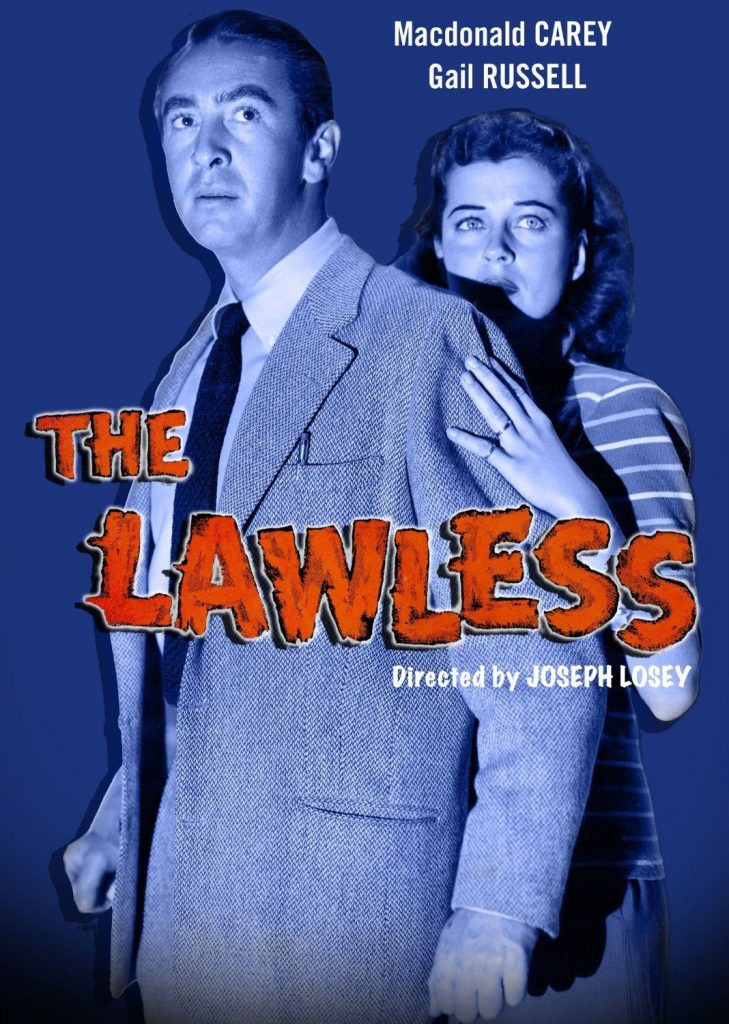
The Lawless (USA, 1950) 83 min B&W DIR: Joseph Losey. PROD: William H. Pine, William C. Thomas. SCR: Daniel Mainwaring, based on his novel, The Voice Of Stephen Wilder. MUSIC: Mahlon Merrick. DOP: J. Roy Hunt. CAST: Macdonald Carey, Gail Russell, Johnny Sands, Lee Patrick, John Hoyt. (Olive Films)
The consistency of Joseph Losey’s work is not so much an identifiable style, but that the iconoclast director always chose unusual material for the screen. The Lawless, his second feature, is among a group of films, coined by critic and filmmaker Thom Anderson as “film gris” (grey film)– certain American films noir (circa 1947 – 1951) that exhibited leftist causes, and where the true villain of the piece is in general, the society that persecutes an individual. It is small wonder that those who made the key films in this niche were blacklisted: Abraham Polonsky (Force of Evil); Cy Endfield (Try and Get Me); John Berry (He Ran All The Way). Joseph Losey’s political leanings would eventually make him unemployable in Hollywood during the McCarthy era. He was subpoenaed by the HUAC, but left the United States instead of testifying, and like many of his fellow travellers -Endfield, Berry and Jules Dassin- Losey had a second career in Europe.
The Lawless isn’t as scabrous as any of the other titles cited above, but it is interesting as the rare Hollywood film of its day to shed light on the plights of migrant workers in the American southwest, and especially on the social injustice served them. (This was still years before the independent feature, Salt of The Earth, which was also made by blacklistees.)
Daniel Mainwaring adapted his own novel, The Voice of Stephen Wilder, for the screen, once again featuring trouble brewing underneath the surface of his favourite milieu, small town California. After a dance hall fight between white and Mexican kids results in a riot, a young Mexican named Paul Rodriguez flees the fracas in a stolen truck, resulting in a police chase that causes death. As in any film noir, fate stacks the deck against Rodriguez while on the run. The media exaggerates his brief encounters with a farmer and a young woman, to make it look like he had attacked them. Once he is finally apprehended, there is a mob-like mentality that prevents him from getting a fair trail.
Macdonald Carey is noble reporter Larry Wilder who fights for his cause. (His paper, appropriately enough, is entitled The Union.) Through this drama he befriends Sunny Garcia (Gail Russell) who runs her own press for the Mexican community. While this film is rather pedestrian, this Paramount quickie is however interesting for its look at the Mexican community; much more interesting in fact, than the bland leads who are the focus of the narrative.
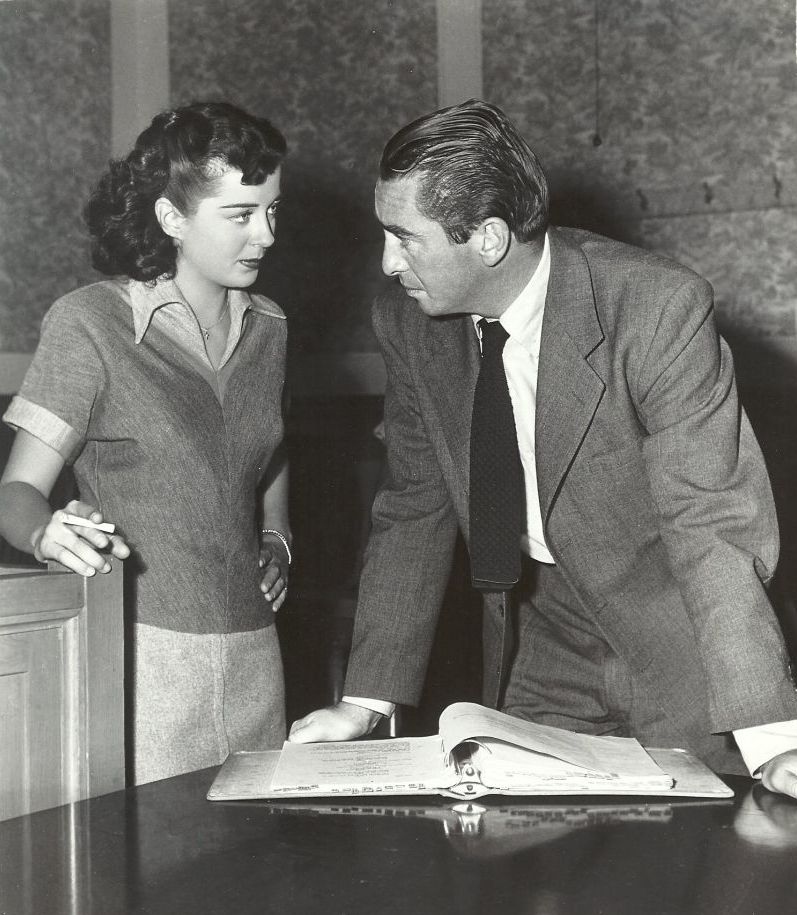
Carey is okay as the representative everyman, but Gail Russell’s character is positively annoying. Sunny Garcia does little but lurk around in her trench coat and mope. She is the voice of the people? The film offers good support from Lee Patrick as a wisecracking dame reporter who also wears her prejudice on her sleeve (“they all look the same to me”), and John Hoyt as the rich liberal father of the white hooligan (Johnny Sands) who started the riot.
While the film slowly builds to a gripping climax, the way it wins our sympathies is a little dishonest, even when viewed in our current age of information distortion. Throughout this narrative, one wonders if the bias towards Rodriquez is really due to the prejudiced townspeople or the exploitative media. In as much time as it takes to get a haircut, it seems that the press has made a frenzy out of this incident, according this kid with the hoopla usually reserved for a mass murderer.
The Lawless isn’t terrible, it just isn’t as trailblazing at it pretends to be. It masquerades as a liberal movie about unjust persecution, but stacks the deck a little too calculatedly. It also pretends to give a voice to a people that are under-presented in Americana (to say nothing of American) cinema, yet they still seem peripheral to the narrative.
Still, I’m glad that it’s on the shelf. Olive Films has resurrected another interesting title from Paramount’s catalog for another generation, in a typically bare bones release with no extras (not even a trailer). However unsatisfying The Lawless may be as a whole, it is well worth a look for film noir buffs, its historical significance, and its intentions of a unique cultural study hidden beneath its exposition.
Originally published in Vol. #1, Issue 25.
Greg Woods

Greg Woods has been a film enthusiast since his teens, and began his writing "career" at the same time- prolific in capsule reviews of everything he had watched, first on index cards, then those hardcover dollar store black journals, then an old Mac IIsi. He founded The Eclectic Screening Room in 2001, as a portal to share his film love with the world, and find some like-minded enthusiasts along the way. In addition to having worked in the film industry for over two decades, he has been a co-programmer of films at Trash Palace, and a programmer/co-founder of the Toronto Film Noir Syndicate. He has also written for Broken Pencil, CU-Confidential, Micro-Film, and is currently working on his first novel. His secret desire is for someone to interview him for a podcast or a DVD extra.