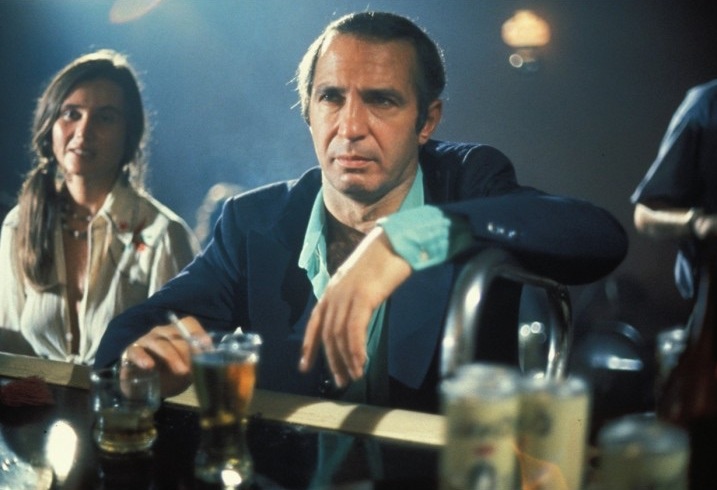
The Killing of a Chinese Bookie (USA, 1976) 108-135 min color DIR-SCR: John Cassavetes. PROD: Al Ruban. MUSIC: Bo Harwood. DOP: Mitchell Breit, Al Ruban, Frederick Elmes. CAST: Ben Gazzara, Timothy Agoglia Carey, Seymour Cassel, Morgan Woodward, Azizi Johari, Val Avery, Haji. (Faces Distribution)
In his forays behind the camera, actor-writer-director John Cassavetes rarely explored genre conventions, instead favouring domestic dramas. The Killing of a Chinese Bookie involves such film noir tropes as club owners, gangsters and dancing girls, and loosely appropriates some thriller conventions in its midsection. But still, because this is a Cassavetes picture, it is more interested in character than genre or plot conventions: in this case, their attraction to the seedy urban underbelly.
Ben Gazzara is Cosmo Vitelli, the owner of a tacky burlesque nightclub who gets himself out of debt with the mob, only to put himself right into hock again by losing a huge sum of money in gambling. Since he can’t make good with the cash, the mob offers to call it square if he performs the murder of, you guessed it, a Chinese bookie.
Although today, many regard The Killing of a Chinese Bookie as one of Cassavetes’ finest films (myself included), this picture was ignored in its day- it was even released twice in different versions, and in either case quickly disappeared from the radar. One of the few who did take notice of it was that perennial crab John Simon, who never had respect for Cassavetes’ films as a director. In his review he scoffed at why Vitelli would suddenly go into debt again just after getting himself out. Simon could never understand anything that wasn’t given away by a hack screenwriter in less than ten minutes (or maybe he spilled scotch on the press book), but his response is typical to how people reacted to the elusive works of Cassavetes. Even though this film subscribes somewhat to the conventions of genre, it is still one of his complex character studies in which we slowly understand Vitelli’s mechanisms- just the way we gradually learn about people in real life.
Although Vitelli is a screw-up and irresponsible, he however devotes his life to his nightclub. Because the club’s burlesque acts seemingly crawled in from the 1930s and the dancers all seem blown in from the 1950s, one wonders why he would want to support a place like this. But this garish place, drenched in red, seems as out of touch with the world as Vitelli. Every seemingly illogical or meandering scene in some way relates to his endeavours to keep this ramshackle enterprise going. Even when Cosmo is en route to perform the killing, Cassavetes purposely frustrates the suspense for the viewer. While Vitelli is driving to the scene in a mob-provided, untraceable automobile, he suddenly abandons the car in the middle of the road and goes to a pay phone to call and see how things are going at the nightclub! This darkly funny moment is classic Cassavetes: surprising, confounding, and yet, oddly enough, we realize this moment is something that his character would do.
If anything, by tossing aside the usual plot conventions, he is giving us far greater insight into what makes these stereotypical characters tick. Through Cosmo Vitelli, we understand the allure of the living life on the edge coupled with the thrill of getting rich quick, even though danger and betrayal are always nearby.
Originally presented in Vol. #1, Issue #14, (“Back to the 70s”), as part of the article, “Neo-Noir”.
Greg Woods

Greg Woods has been a film enthusiast since his teens, and began his writing "career" at the same time- prolific in capsule reviews of everything he had watched, first on index cards, then those hardcover dollar store black journals, then an old Mac IIsi. He founded The Eclectic Screening Room in 2001, as a portal to share his film love with the world, and find some like-minded enthusiasts along the way. In addition to having worked in the film industry for over two decades, he has been a co-programmer of films at Trash Palace, and a programmer/co-founder of the Toronto Film Noir Syndicate. He has also written for Broken Pencil, CU-Confidential, Micro-Film, and is currently working on his first novel. His secret desire is for someone to interview him for a podcast or a DVD extra.