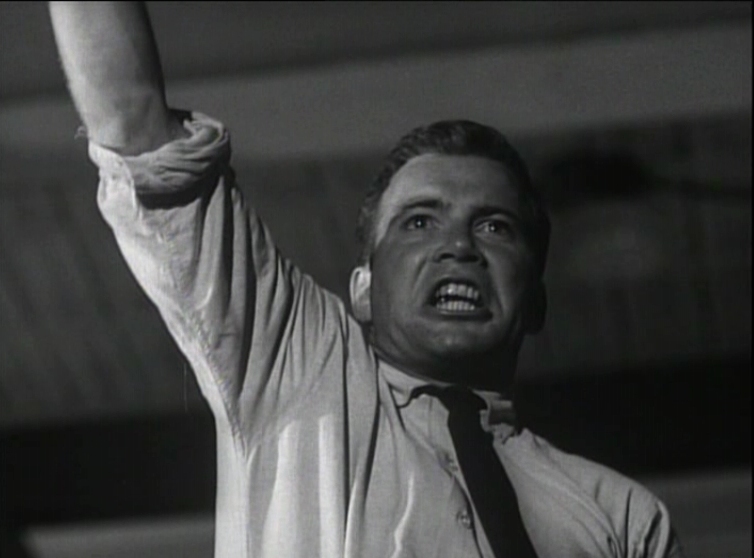
The Intruder (USA, 1961) 84 min B&W DIR: Roger Corman. PROD: Gene Corman, Roger Corman. SCR: Charles Beaumont, based on his own novel. MUSIC: Herman Stein. DOP: Taylor Byars. CAST: William Shatner, Frank Maxwell, Beverly Lunsford, Robert Emhardt, Leo Gordon, Charles Beaumont, Jeanne Cooper, Charles Barnes, William F. Nolan. (Astor Pictures)
While we often call Roger Corman an independent pioneer, as he had been making micro-budget movies outside of Hollywood on his own terms, he had always done them for commercial purposes. The Intruder, however, is a one-of-a-kind movie: and perhaps made in an attempt to convince himself of his own talents as a film artist (as he was always self-deprecating of his own virtues), he made this bold statement against segregation, right in the heart of the American South, facing danger every step of the way. He emerged with a film that even today is a complex picture about racism. It is impossible to imagine a major studio making a picture like this, then or now: and therefore not surprising that this movie was the rare money loser in all of Corman’s filmography. It is so confrontational (as audiences are forced to examine their own prejudices, as do the onscreen characters), but the red-hot subject matter kept people away from the Southern drive-ins, even when released with the more sensational titles, I Hate Your Guts and Shame.
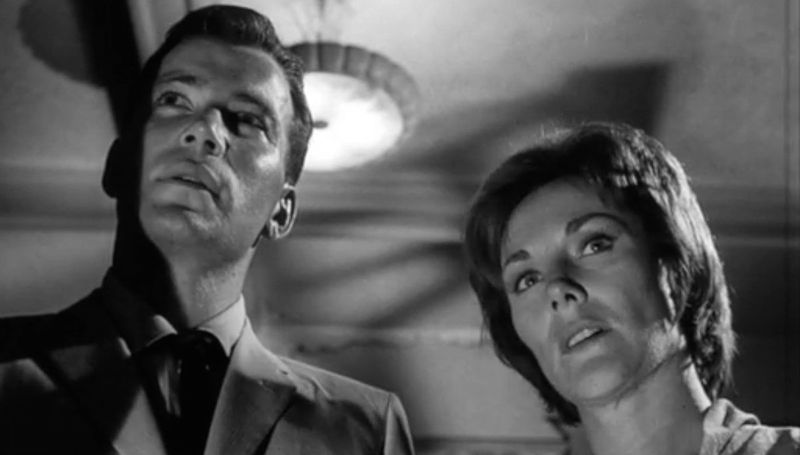
Given the cult status of its lead actor William Shatner, and that his over-acting has lent to self-parody, this picture might have some curiosity value for seeing Shatner as a white supremacist. And to be honest, during many of his speeches, one is reminded of Captain Kirk’s big lectures at the end of any Star Trek episode, informing the week’s alien life form what they’ve been doing wrong. However, that same larger-than-life persona is well-suited to the role of Adam Cramer, who comes to town just at the beginning of integration and incites the townspeople to bring segregation back to the community.
The minute he steps off the bus, he reveals himself to be a devil inside the suit of angelic white. He sleeps with teenager Ella (“They sure grow things fast around here, don’t they?”), and even seduces a married woman down the hall in his hotel. Cramer also seduces the whole town, with his words, to bring out the hatred among that lies just beneath the surface of these God-fearing folk.
The film is often unbearably intense. In the scene where a black family drives through town, and is surrounded by a mob that taunts the father into a fight, one can feel the violence just in the people’s faces. (With all their brush cuts, these all-American boys could easily be mistaken for Aryans.) The climax, where a young black man named Joey Greene (Charles Barnes) is about to be lynched after Cramer convinces Ella (Beverly Lunsford) to say that he raped her in school, is absolutely heart pounding. (Among the familiar faces in this scene are Robert Emhardt and Leo Gordon, whose humourless visages are blood-curdling.)

Charles Beaumont’s script (adapted from his own novel) lets no one off the hook. White-picket fence America is shown to be full of hypocrisy, but the all-American family unit is shot to Hell. Ella’s father Tom McDaniel (Frank Maxwell), also a newspaper columnist, is one of the town’s few pro-integrationists, who does not even get support from his family. (He is beaten up for walking the black students to school, and then his own father even says he would have lynched his son for associating with them!) Ella confesses to the mob that she made up the story of the rape, and apologizes to Joey (who was just moments away from being hanged by a swing in the schoolyard… what a perverse symbol). Joey says nothing to her… and why should he? That response of silence is the most damning. One line mentioned in Tom’s household encapsulates the entire picture: “One thing Adam Cramer has done for us, he’s made us face ourselves.” That truth could also apply to the audience.
The Intruder is a beautifully made film… and begs the question, should it be? A grainy exposé may have suited the material, but one marvels at the meticulous care that Roger Corman (who co-produced with his brother Gene) has given the movie. Portraying small-town Americana in all its bright wholesomeness is to also reveal the hypocrisy beneath the surface. 45 years later, it is shocking to see “sweet old ladies” use the “N” word so casually. Many townspeople (and especially Cramer) are shot from a low angle, so that they represent power, but positioning their bodies against the skies above is to enforce the point that they equate their horrible behaviour to be acts of Godliness. This is also emphasized in the shot where the reflection of a burning cross is in the foreground of the frame, while Cramer is in the background ruminating about how such a thing is a religious crusade. The brothers Corman should be commended for making such a powerful, complex picture, whose images are as thought-provoking as its words.
Originally published in The Roger Corman Scrapbook.
Greg Woods

Greg Woods has been a film enthusiast since his teens, and began his writing "career" at the same time- prolific in capsule reviews of everything he had watched, first on index cards, then those hardcover dollar store black journals, then an old Mac IIsi. He founded The Eclectic Screening Room in 2001, as a portal to share his film love with the world, and find some like-minded enthusiasts along the way. In addition to having worked in the film industry for over two decades, he has been a co-programmer of films at Trash Palace, and a programmer/co-founder of the Toronto Film Noir Syndicate. He has also written for Broken Pencil, CU-Confidential, Micro-Film, and is currently working on his first novel. His secret desire is for someone to interview him for a podcast or a DVD extra.