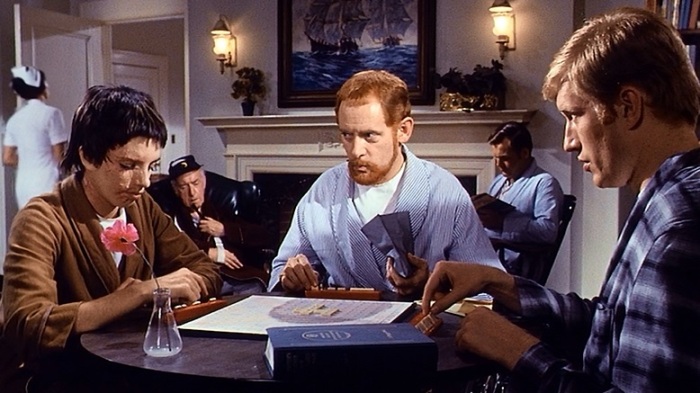
Tell Me That You Love Me, Junie Moon (USA, 1970) 113 min color DIR-PROD: Otto Preminger. SCR: Marjorie Kellogg, based on her novel. MUSIC: Philip Springer. DOP: Boris Kaufman. CAST: Liza Minnelli, Ken Howard, Robert Moore, Fred Williamson, James Coco, Kay Thompson, Pete Seeger. (Paramount Pictures)
Tell Me That You Love Me, Junie Moon (1970) is grotesque, pretentious, tasteless, funny and touching. In other words, it seems like a perfect movie for Otto Preminger! Written by Marjorie Kellogg (based on her own novel), this bizarre comedy-drama chronicles the joys and sorrows of three unique individuals -a facially scarred woman, a schizophrenic and a paraplegic homosexual- societal outcasts all, who decide to share a house after their release from the hospital.
Junie Moon (Liza Minnelli), the group’s den mother, who had her face disfigured by a sexually deviant sicko boyfriend who poured battery acid on her, is understandably hesitant to begin another relationship, despite that her schizophrenic roommate Arthur (Ken Howard of TV’s The White Shadow fame) begins to fall in love with her. The central characters in this film are searching for love in their own ways, and they find it in unusual fashions.
Forty years on, it is uncomfortable to see yet another stereotypical depiction of a homosexual, as Warren is a bitchy queen (though Robert Moore is very good). Further, the film seems to suggest that homosexuality can be cured by a midnight rendezvous with a woman on the beach. Likewise, the movie takes a sledgehammer approach to the complexities of schizophrenia, as Arthur mysteriously dies in the end; still, there is a sequence where Arthur has a hallucination, which gives the director a chance to pull out all the stops and shoot the scene with blue gels and apply zombie makeup to the extras, thus making this nightmarish moment look like a European horror film. (This is Preminger: you were expecting subtlety?)
The movie opens and closes with folk singer Pete Seeger walking through the forest, crooning the theme song, “Old Devil Time”. Having Seeger appear on camera in a sequence that is detached from the narrative actually feels like a smug attempt on part of the filmmakers to look hip with the changing times, by featuring a musician whose work had tapped into the social consciousness of the day.
But still, this character-driven film exemplifies why I love 1970s movies- even the imperfect ones; they continue to surprise the viewer with unexpected relationships, and moments that at once seem free-wheeling, off the cuff, yet completely natural. The “no rules” policy of the decade has resulted in countless films with a freeform approach that nonetheless sacrifices conventional means to achieve beauty.
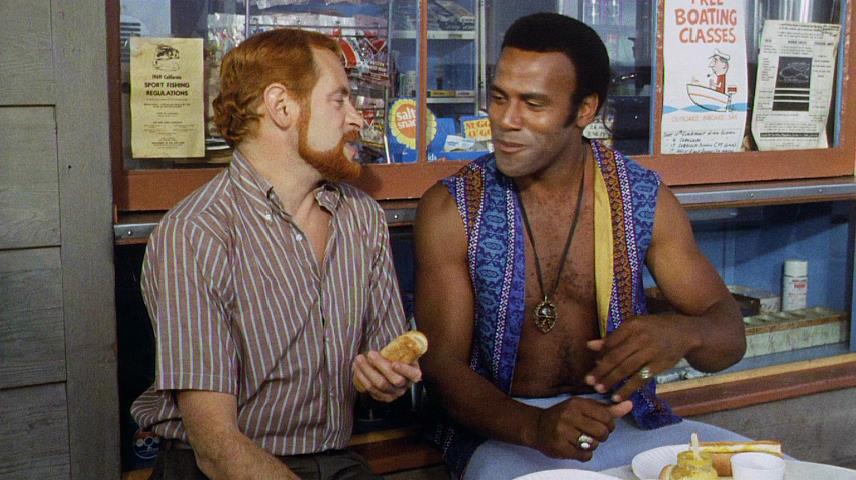
Junie Moon succeeds in that it is a movie about the ugliest forms of human nature (violence, betrayal), and the characters who plunge to those depths, yet it is equally about the beauty beneath hideous exteriors. Thus, the latter half of the film in which friendships do evolve in unexpected ways, is truly wonderful to see. James Coco is the fish market owner Mario, who hires Arthur to work in his shop as a favour to Junie, and he gives the trio a chance to go on a vacation through truly unusual circumstances. On a beach resort, Warren has a kinship with a beach boy who carries him around (literally) everywhere. Future blaxploitation star Fred Williamson, in one of his earliest roles, plays this man, who rather becomes the fourth wheel to the group- and it is a delight today to see one of the all-too-rare instances when the actor was allowed to play a regular human being, full of love, laughter and character.
Junie Moon is not a film for everyone- some won’t want to advance past the ugly first half to get to those warm moments later- as necessary as it is to have one play off the other. It is nonetheless a fine example of the numerous movies made in the decade which succeed in surprising an audience.
Originally published in Vol. #1, Issue #24, excerpted from a larger piece on the late period films of Otto Preminger. This film is now available on DVD via Olive Films, in a typically barebones release.
Greg Woods

Greg Woods has been a film enthusiast since his teens, and began his writing "career" at the same time- prolific in capsule reviews of everything he had watched, first on index cards, then those hardcover dollar store black journals, then an old Mac IIsi. He founded The Eclectic Screening Room in 2001, as a portal to share his film love with the world, and find some like-minded enthusiasts along the way. In addition to having worked in the film industry for over two decades, he has been a co-programmer of films at Trash Palace, and a programmer/co-founder of the Toronto Film Noir Syndicate. He has also written for Broken Pencil, CU-Confidential, Micro-Film, and is currently working on his first novel. His secret desire is for someone to interview him for a podcast or a DVD extra.