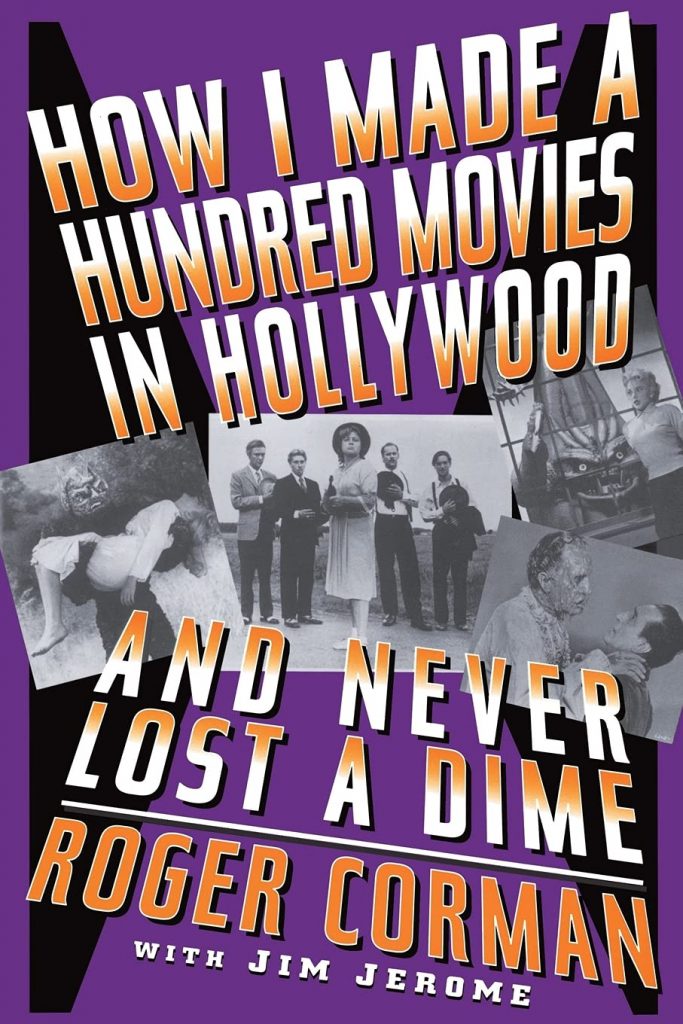
How I Made a Hundred Movies in Hollywood and Never Lost a Dime
Roger Corman (with Jim Jerome)
Delta Books, 1990
Roger Corman can always be relied on for a snappy title, and he usually has the goods to follow it up. How I Made a Hundred Movies in Hollywood and Never Lost a Dime is right up there with some of the more audacious titles in his lengthy film career, and is a fitting header for this light-hearted autobiography. As much a “how-to” book for independent filmmakers as an autobiographical account, How I Made… is an inspired, invigorating read, Corman’s remarkable life story and career unfolding as an unlikely success story outside of the mainstream film world. The book should be required reading for all aspiring film students, outlining as it does Corman’s no-nonsense approach to everything from directing and producing to financing and distribution, all within a tight budget. But this information is all related with Corman’s characteristic wit and charm, intertwined with colourful tales from his heyday as a director of drive-in staples and low-budget genre classics. Indeed, this is one book which I could see actually translating well to the “talking book” format, particularly after hearing some of Corman’s commentary tracks on DVDs reissues of his films – the book reads very much as if Corman is telling the tale directly to the reader. And what a tale there is to tell!
While the emphasis of How I Made… is on moviemaking, rather than Corman’s personal life, the author does provide some insight into his background and motivations. Corman’s story is a real-life testimonial to the concept of the “American Dream”: a young man born in middle America (Detroit), growing up during the Depression era, moves with his family to the “Golden Land” of California (Beverly Hills), enters the film industry as a messenger on the Fox lot, and works his way up to being the head of his own successful independent film studio, New World Pictures. Corman more than paid his dues along the way, and kept a relentless pace throughout the 50s to the 70s, tirelessly churning out low-budget drive-in programmers, many of which would become cult favourites in years to come. It is the first two decades of Corman’s career that are the most interesting, while he was still directing “classics” like It Conquered the World, A Bucket of Blood, Little Shop of Horrors, and the Poe films, and he recalls these years with much fondness and humour. He was always striving to inject some sort of uniqueness and higher artistic standards into the work, and by the 60s was moving on to more ambitious projects. He recalls setting out to adapt James Joyce’s A Portrait of the Artist as a Young Man and Kafka’s The Penal Colony for Columbia, and while neither of these attempts got off the ground, they hint at the sort of material Corman had in mind at the time beyond his standard fare.
The business side of filmmaking is equally important to Corman, as one might guess by the title of the book. He discusses his wildly resourceful money-saving techniques throughout, and stresses the fact that all of his films (except The Intruder) made money, despite their dubious production values. From Monster from the Ocean Floor onwards, Corman was innovative and highly frugal, making films with whatever means were available at the time, and the results paid off handsomely. Combined with distribution and marketing savvy (and a mutually beneficial relationship with burgeoning independent studio AIP), Corman’s colourful career would become a role model for the next generations of filmmakers, many of whom would start their careers working for Corman in some capacity.
By the early 70s, Corman was ready to retire from directing and start his own production and distribution company, New World Pictures, to regain the control he was losing to AIP and the majors. At this point, he becomes more of a behind-the-scenes figure, helping launch the fledgling careers of such directors as Martin Scorsese, Ron Howard, Joe Dante, and Jonathan Demme, and nurturing rising talent through what he refers to as “The Corman School”. One wonders why Corman, with all of his apparent financial success, didn’t invest in larger pictures to allow his talent roster to develop further without having to fly the coop to the major studios, but this never seemed to be on the agenda at New World, and later Concorde Films. Corman seems happy keeping it on the cheap, and envisions his studio as a training ground for new talent. In this capacity, Corman’s track record speaks for itself, although the book is filled with quotes and anecdotes from famous Corman School alumni (from Jack Nicholson and Francis Ford Coppola to Peter Bogdanovich and Allan Arkush), all of them (naturally) grateful for the experience.
Roger Corman is a true independent, and a successful one. The film world has changed dramatically since he first launched his career over 50 years ago, and it’s unlikely we’ll ever see another figure like him emerge any time soon. However, as new frontiers open up on the digital front for low-budget and independent filmmakers, Corman’s principles as outlined in How I Made…will continue to apply and inspire the next wave. No doubt Corman himself will be leading the way.
Originally published in The Roger Corman Scrapbook.
David Faris

David S. Faris is a Toronto-based writer, musician, DJ, and graphic designer. He has written articles and reviews for music magazines Chart, Exclaim!, and Blue Suede News. He is also a founding member of the Toronto Film Noir Syndicate.