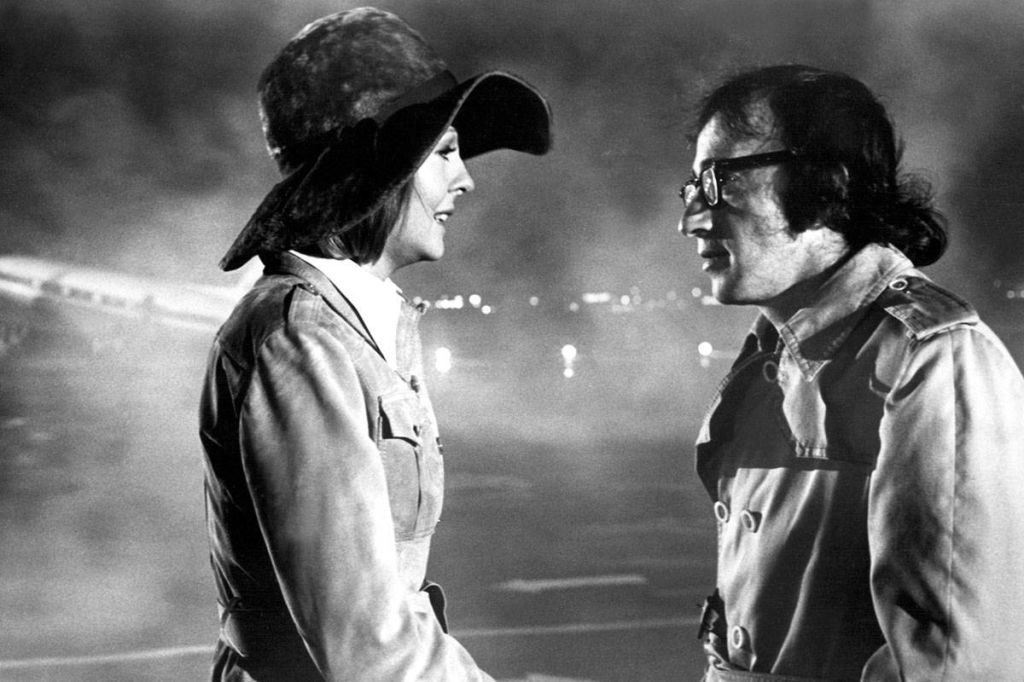
Play It Again Sam (USA, 1972) 85 min color DIR: Herbert Ross. PROD: Arthur P. Jacobs. SCR: Woody Allen. MUSIC: Billy Goldenberg. DOP: Owen Roizman. CAST: Woody Allen, Diane Keaton, Tony Roberts, Jerry Lacy, Susan Anspach, Joy Bang, Jennifer Salt, Viva. (Paramount Pictures)
“I never met a woman that didn’t undershtand a shlap across the faishe, or a shlug with a 45.”
“Yeah, but you’re Bogart!”
Woody Allen’s 1969 stage play is transformed to the screen as a perfect snapshot of the neurotic early 1970s, starring Allen himself, the decade’s poster child of neurosis, as introverted film writer Allan Felix, who is so lost in the movie world (watch his orgasmic close-ups in the beginning while he is viewing a revival screening of Casablanca), that he is out of place in these trying times. His wife Nancy (the adorable Susan Anspach) left him for some adventure in the free-spirited hippie life, and now starved for companionship, he makes hapless attempts at sexual conquests. For advice, he must heed the helpful spirit of Humphrey Bogart (Jerry Lacy). Fantasy sequences further extrapolate Allan’s obsession with cinema (one segment is played like an Italian bedroom farce), as he tries to fit into the modern world. His attempts at meeting women are pitiful: a nymphomaniac spurns his advances, he tries to get a date out of a girl at an art gallery the night before she plans to commit suicide, and one girl who wants to “get stoned and watch the freaks” gets whisked away by a bike gang. At the time, Woody Allen’s own films were broad comedies with many slapstick vignettes (Bananas; Sleeper). Although this does have some laugh-out-loud sight gags, Herbert Ross directs a gentler blend of fantasy and romantic comedy that anticipates Allen’s later Annie Hall. Like that film, this is a spot-on satire of 1970s living. (You can’t get more early 70s than casting Jennifer Salt, Joy Bang and Viva as would-be girlfriends!) With all of the pop psychology, bureaucracy (his best friend Dick is always on the phone- even in bed), new age psychobabble and hippies smoking pot in a cab, is it any wonder why the guy retreats into the movie world? Perhaps Play It Again, Sam explains why there were so many 1970s films that were nostalgic for a previous era. Since the world was going to Hell, people sought the movies for a tonic, as did their parents during the trying times of the Great Depression and World War II. Alas, the ghost of Bogart gives him pointers on seducing the perfect woman— his best friend’s wife Linda (Diane Keaton)! This coupling makes sense in an age when mate-swapping was “a thing”, but also because they are equally neurotic. Finally, the film ends in a brilliant rip-off of Casablanca‘s airport scene, where the love triangle meets, and like Bogart, Allan doesn’t get the girl either. However, he doesn’t even need Bogie anymore, as he now has all the self-confidence he needs to survive the “Me” generation.
Updated from a review originally published in Vol. #1, Issue #10, (“Summer in the 70s”).
Greg Woods

Greg Woods has been a film enthusiast since his teens, and began his writing "career" at the same time- prolific in capsule reviews of everything he had watched, first on index cards, then those hardcover dollar store black journals, then an old Mac IIsi. He founded The Eclectic Screening Room in 2001, as a portal to share his film love with the world, and find some like-minded enthusiasts along the way. In addition to having worked in the film industry for over two decades, he has been a co-programmer of films at Trash Palace, and a programmer/co-founder of the Toronto Film Noir Syndicate. He has also written for Broken Pencil, CU-Confidential, Micro-Film, and is currently working on his first novel. His secret desire is for someone to interview him for a podcast or a DVD extra.