
Phone Call from a Stranger (USA, 1952) 105 min B&W DIR: Jean Negulesco. PROD-SCR: Nunnally Johnson. MUSIC: Franz Waxman. DOP: Milton R. Krasner. CAST: Gary Merrill, Bette Davis, Shelley Winters, Michael Rennie, Keenan Wynn, Evelyn Varden, Warren Stevens, Beatrice Straight, Craig Stevens. (20th Century Fox)
When I was first getting interested in film during my mid-teens, I would often catch Q Classics, broadcast on Erie PA’s PBS affiliate WQLN, which would offer double-bills of golden-age movies every Saturday night and Sunday afternoon. Whatever played on the Saturday program would be repeated on the Sunday afternoon the following weekend. Since much of this existed before VCRs became the norm, this repeat programming was handy: one simply needed to wait eight days if they missed the Saturday night films, or just wanted to see them again.
This lonely kid found surrogate companionship in these shows (which would air anything from classics like The Treasure of the Sierra Madre to B-grade curios like Quiet Please Murder), while dangling from the edge of the bed, constantly twirling the antenna on my little black and white TV to retain the signal from across the lake (this was pre-converter, too). If there is truth to the adage of how much movies are a part of our lives, then surely my time spent while watching WQLN remains an example. To a young misunderstood dreamer, these movies were transmissions from another world that seemed like a better place to be. At the time Q Classics specialized in (but was not limited to) the Fox catalog – it is amusing now to think that many of their Cinemascope productions were squeezed into pan-and-scan prints viewed with a lot of static, but we took our “fixes” however we could get them. Of the many movies I had viewed on WQLN in those days, one that particularly stayed with me was the 1952 melodrama Phone Call from a Stranger.
After a quarter-century, I still recalled that solitary viewing with affection, for its unusual premise and colourful characters who meet over the most peculiar of circumstances. It was only this winter that I had viewed the film again, and likewise under peculiar circumstances, albeit not to the degree of what’s on film, as we will soon see.
In the first of five nights in which filmmaker Guy Maddin presented screenings and lectures at the University of Toronto, he showed clips of various melodramas from cinema’s silent and golden age eras. Primarily, his reason for selecting these clips were to illustrate how the most primitive pieces of art make us more aware of the craft, and thereby more memorable. This point was emphasized with his choice segments of an Italian silent screen diva’s opera-level histrionics, or an overtly heavy-breathing saga of two former lovers shooting it out on the range. At the end of this sequence he made an off-handed comment, which I thought was even more interesting: how much we viewers need melodrama.
Indeed, in this age, everything in retrospect is ironic: we now view classic Hollywood melodramas with a keen awareness of the craft. The alto-to-soprano ranges of the performances heighten the story to a grandiose level; the orchestral music fills in the pockets of the narratives to cue the viewers’ Pavlovian responses to whatever moods the stories should elicit; and the lush mise-en-scène which conveys a supra-natural world much like our own. But this is why, then as now, people went to the movies- to paraphrase André Bazin, audiences go to see a window instead of a mirror. Viewers would pay to see people with problems possibly worse than their own, but they would be comforted by the cinematic tradition that somehow everything was going to work out all right, even though real life dilemmas would not resolve so easily. This is but one example of how movies become necessary parts of our lives: art (and artifice) offers hope to our natural world.
It was for all of this that I was reminded of Phone Call from a Stranger during his dialogue. Upon leaving the lecture hall that evening, I promptly went to the video store, and sat in front of the television later that same night to revisit the film I fondly remembered from all those years ago. How would I respond to the movie a second time after so many years of film theory, and untold bouts of post-modern irony? Happily, I was once again surrendered to the movie. Isn’t that what a good melodrama should have us do?
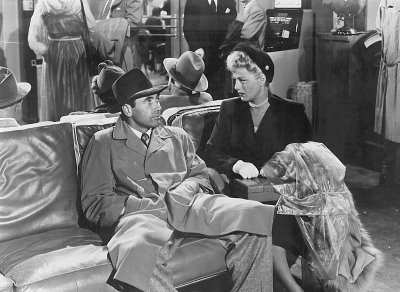
Gary Merrill stars as lawyer David Trask, who learns his wife Jane (Helen Westcott) is unfaithful, and spontaneously takes a plane trip to get away and think things over. While the jet is in stopover, he forms a bond with an unlikely trio of fellow passengers: stripper Binky Gay (first-billed Shelley Winters), doctor Robert Fortness (Michael Rennie) and traveling salesman Eddie Hoke (Keenan Wynn). As the friendship grows between these disparate people, they form a pact to reunite every year- “the four musketeers” as they call themselves. That notion is short-lived however, as the plane crashes, leaving Trask as the sole survivor of this quartet.
Then, he visits the bereaved families of his newfound friends to offer some comfort with stories of the brief times he had spent with each of them before their deaths. It soon becomes apparent that, like Trask, all of these people have crosses to bear.
Despite that she referred to herself as “Mrs. Michael Carr”, Binky has left behind an estranged relationship with her entertainer husband (Craig Stevens) who works at a club with his domineering mother (Evelyn Varden). Dr. Fortness was forever haunted by the lies and guilt surrounding an alcohol-related car crash which killed three people. Eddie, “the life of the party”, is posthumously revealed to be “a tiresome, foolish irritating man” who hides behind the façade of his practical joke props. In the film’s climax, we meet Eddie’s widow Marie (in an astonishing role for Bette Davis, then married to co-star Merrill), whose weekend fling with another man indirectly led to events that left her paralyzed. Now that I’ve told you who plays Eddie’s widow, re-read that “tiresome, foolish” phrase above with her voice in your mind.
Of course, these sordid stories teach Trask how his friends and their loved ones are all haunted by mistakes of the past, which they ultimately learn to forgive in order to move on. Indirectly, with each visit into the bereaved people’s sordid pasts, Trask learns to come to terms with his own.
This 20th Century Fox vehicle is surely Hollywood assembly-line product, but Grade A nonetheless, delivered by experts in the field. Director Jean Negulesco has made a career out of classy studio fare such as Johnny Belinda (1948), Three Came Home (1950), How to Marry a Millionaire (1953) and Three Coins in the Fountain (1954). Nunnally Johnson had a long history with Fox, penning such classics as Jesse James (1939) and The Grapes of Wrath (1940) before returning to the studio to write and produce more fine work, much of it in association with Negulesco. Cinematographer Milton Krasner, (who also worked frequently with this writer-producer-director team) lends the film a dark shadowy world that perfectly compliments the guilt, sins and ghosts of the past that haunt these characters.
Keenan Wynn of course steals the film as prankster Eddie, but all of the performances are remarkable. Shelley Winters, fresh from her Oscar-nominated role in A Place in the Sun (1951), is great fun as the burlesque dancer, who is completely shameless about her profession. Michael Rennie always did more with less, and so his hesitant delivery and taciturn demeanour perfectly enhances the woe-begotten Fortness. Gary Merrill is perfectly cast as Trask: the actor’s haunted expression compliments the man who cannot shake off ghosts.
Someone wisely decided to put the Bette Davis vignette last. The sight of a bedridden Ms. Davis in the final fourth of the movie, needing to grab chains from above in order to move, turns this understated piece into a baroque opera, in which the melodrama reaches its crescendo. Admittedly, her grandiose histrionics (holding her hand to her breast upon thinking of Eddie, while the music swells on cue) are a bit much, but melodrama always has to be larger than life, doesn’t it? However, it is better that the film builds up to this scene, as its inclusion anywhere else in the narrative would have clashed with the naturalistic feel.

Marie: “Good heavens, whose is?…. Is yours?”
There are other previous moments in which Phone Call from a Stranger surely feels of its time. To our jaundiced eyes, where CGI now makes every special effect look too perfect, the miniatures of the plane in flight (and its subsequent crash) now seem hokey. To be sure, the screenplay wears irony on its sleeve, especially in how Winters’ character constantly reminds Trask how terrified she is of flying. People who walk into the movie without any previous knowledge of the story would likely surmise where this narrative is headed.
This movie obeys certain Hollywood conventions, but also succeeds by trying innovative things within those familiar patterns. It has an unusual structure, where Merrill is the only constant character throughout, and in fact the film has so many flashbacks that past and present seem to co-exist: fittingly so, for a film in which all of its characters carry sins of the past with them. When most of the top-billed characters get killed off early in the film (and remember, this was years before Alfred Hitchcock deceived everyone into thinking that Janet Leigh’s ill-fated role in Psycho was the lead), one is excited by the possibility that this film could go anywhere.
The fascinating premise for this movie is potentially morbid, but curiously it is also life-affirming. A feel-good movie about a plane crash? Well, not necessarily. Each of the surviving characters aid their grief in forgiving past sins and being grateful for what one has in their lives. Admittedly, it is a little too pat that every surviving character who is affected by guilt or past regrets subsequently becomes renewed. Real life, as we know, doesn’t always work like that. But then as now, we acknowledge that it’s “only a movie”, and like the characters onscreen, we come away a little renewed ourselves. That’s one reason why people go to the movies, isn’t it?
Originally published in Vol. #1, Issue #23.
Greg Woods

Greg Woods has been a film enthusiast since his teens, and began his writing "career" at the same time- prolific in capsule reviews of everything he had watched, first on index cards, then those hardcover dollar store black journals, then an old Mac IIsi. He founded The Eclectic Screening Room in 2001, as a portal to share his film love with the world, and find some like-minded enthusiasts along the way. In addition to having worked in the film industry for over two decades, he has been a co-programmer of films at Trash Palace, and a programmer/co-founder of the Toronto Film Noir Syndicate. He has also written for Broken Pencil, CU-Confidential, Micro-Film, and is currently working on his first novel. His secret desire is for someone to interview him for a podcast or a DVD extra.