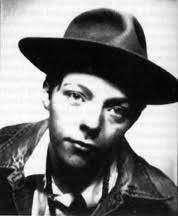
Sadie Benning is a kind of cult figure in the video art world. She began her wonderful low resolution work at age 15 when she was given a Fisher Price PixelVision CameraTM, which delivers one of the most pixilated and strangest images to come from a consumer video camera. Without dwelling too much on this wonderful and now rare piece of esoteric video gear; the camera was designed as a children’s camera, which could record onto audiocassettes. The camera didn’t fare well with the kids, but the art community had found a new toy!
But truth be told, I have never seen work done on PixelVision quite like Sadie Benning’s. It vacillates between representation and abstraction. Her narratives sound like diary entries, yet they are in part elaborate fictions.
Most of Benning’s early work (particularly Jollies, It Wasn’t Love and If Every Girl Had a Diary) is of tales of a young girl coming to terms with her sexuality, from experimentation with boys, to the eventual realization that she is gay. In these films, Benning uses the camera to explore issues pertaining to gender, sexuality and performance. Much like Jack Smith’s Flaming Creatures, we see Benning dressing up as different characters- each one a specific reminder of how gender is by and large a performance.
Benning’s narrative strategy is an specific one: she addresses the camera and tells stories of her exploits, or uses hand drawn text which she shoots with the camera; both appear to be entries in some kind of low-res video diary. She intersperses her “diary entries” with shots of her room, or films or television, many of these images juxtaposed in relation to the part of the narrative she has just shared.
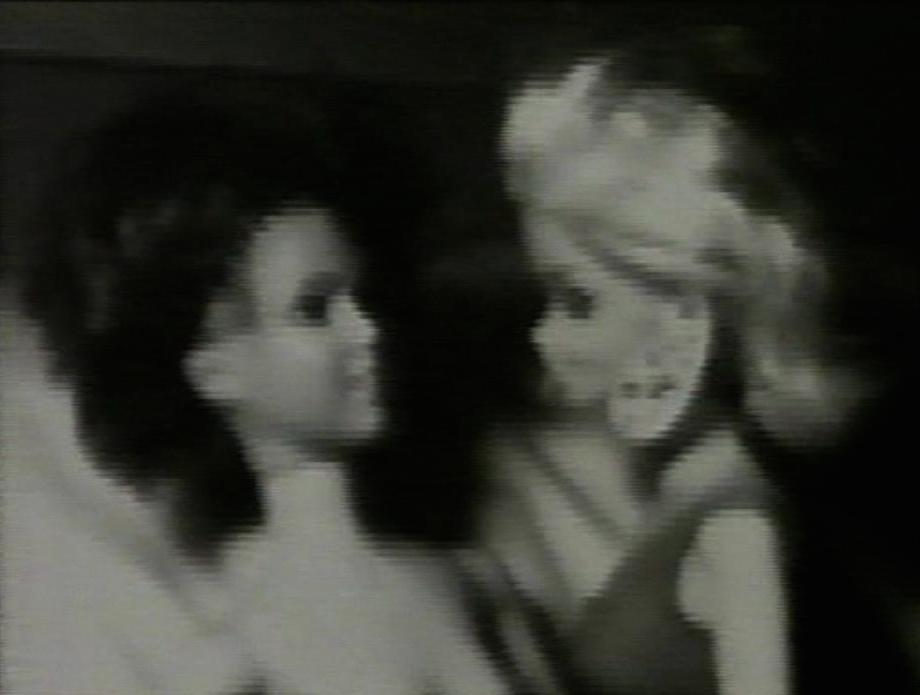
Jollies (1990)
The video begins with what appears to be an innocuous shot of two Barbie dolls. Upon closer inspection it comes to attention that one of them is naked, and the other is leaning over the naked doll. It’s no coincidence that a video which explores sexuality begins with this shot. It is as if we whisked back to Sadie’s childhood when she began to explore gender issues with her dolls. (I myself put Ken and Barbie in some interesting situations.) We then see Benning, in a high contrast extreme close-up as she tells us the story of her first crush, and how she began to explore her sexuality with “boys”. It was during this tale that it became apparent to me how much she understood editing and its processes from a very young age.
It was only recently that I discovered a dialectical editing style very close to Eisenstein’s within this video. When Sadie is telling of her first sexual experience with a young man, she tells us that she “touched his dick”, she then cuts to a close-up shot of her slapping a Louisville Slugger baseball bat into her hand; and when she tells us that he now works in a sushi bar, she cuts to a shot of a goldfish in a fish bowl. It is thesis/antithesis/synthesis with an ironic and satirical bent to it.
Shortly after, she tells us of how she prefers kissing girls to boys, and this is the journey of self-discovery. However, I have heard that many of her stories are actually fictional, so it begs the question- is this autobiographical? If so, how much of it, and if not, why not? The video has the same kind of feel that a video diary would have, but it seems to have more bite and an edge than other video diary work I have seen. Plus there is the inclusion of popular music, all kinds of different genres that seem to be carefully chosen to emphasize a certain moment or theme within the video. It has a weird kind of MTV-influenced aesthetic; pop music, jumpy editing- which leads me to believe that the good ol’ boob tube had a great impact on her before she picked up her video camera.
Many of the devices that Benning uses in this piece become very interesting stylistic signatures in later videos: the pop music, the hand-written text, the strange and abstract shots of her room, and of course the wonderful low-res images of the PixelVision. Somehow, with her first work she found her own cinematic practice and although it may be a little rough around the edges, she managed to fine-tune these techniques in later videos for some rather impacting effects.
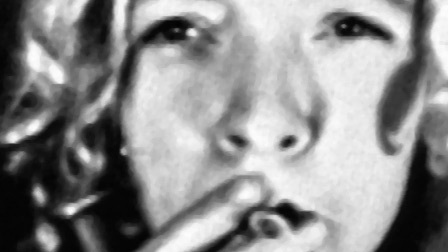
It Wasn’t Love (1992)
This video is much like Jollies, wherein we are told another story of Sadie’s youth. This time she meets a girl in a Pizza Hut parking lot, and they decide to drive to Hollywood together in a stolen car. She tells her story much like in Jollies, with text and direct address. As we are told the tale of the girls’ trip to the west, we see shots of a toy car zooming across her hard wood floor. I find it kind of interesting that all of the materials, and locations are all found within one space- her bedroom. It’s kind of like a Dogme film, everything to make the film is from that specific location (let’s just note that this was three years prior to the Dogme manifesto).
There are a few shining moments in this video that quite nicely illustrate the growth of Benning’s style and devices. In one shot we see an old film (not sure what film it is) where a daughter gently caresses her mother’s face. Innocent enough, until she overdubs Michael Jackson’s “I Wanna Be Your Lover” on top of the footage. The effect is this kind of bizarre homoerotic and incestuous scene. Another is when Benning tells us when the girls pull the car over and fool around. She rapidly cuts to a shot of her dressed as an old crooner (going as far as a fake goatee and old fedora) while lip-synching to “Blueberry Hill”, then cutting to a shot of the ‘crooner’ riding and stroking a large cane.
But perhaps the most notable sign of her growth is in her creation of new transition techniques other than just cutting. Since the PixelVision is a rather low-tech piece of video gear, there are no fancy in-camera transition effects. What is a poor girl to do? If you’re Benning, you use your hands to block the camera in various ways with your hands creating a whole new set of iris style transition effects. They are really quite remarkable with the PixelVision’s grainy resolution.
The story ends with Benning telling us that she didn’t fall in love with the bad girl in the stolen car, and that they never even made it to Hollywood, but that is was just a fling, and that it didn’t matter that they never made it because “we were Hollywood”. All of which lends to the belief that the story is fiction rather than fact, and that the narrative is really just an amalgamation of old teen flicks and road movies blended together with her own narrative flair to paint an interesting self portrait of a rather brilliant young artist.
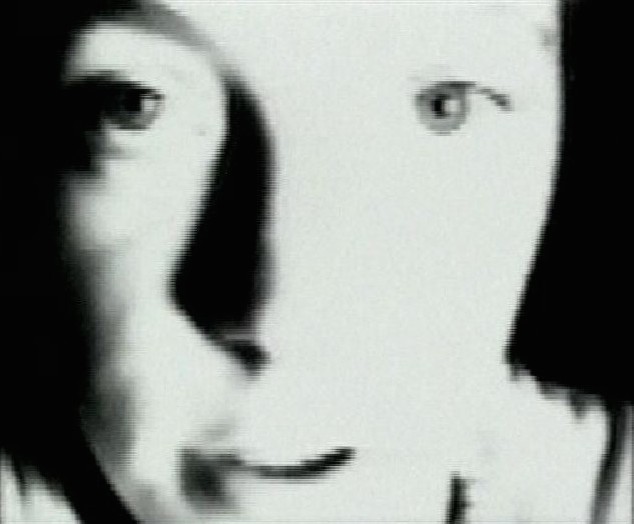
If Every Girl Had A Diary (1992)
In this video, Benning ponders the question of what it would be like to be married, and whether or not it is a possibility in her future. All this to the sounds of James Brown and Marvin Gaye, with images of dancing hula dolls and wedding images. But this video is much edgier than her previous work, and becomes a very strong protest against what marriage can be, how stereotypes operate, and how they can be frustrating and upsetting to a young girl coming to terms with her sexuality.
The strongest indication is the various shots of pornographic images that are in the video, all which depict the woman in a position of subservience to the man, whether it be through camera angle or sexual position. It’s a much shorter piece than the others, but its effect is quite powerful. It marks the entry of a far more explicit political context in her work. Granted that issues of sexuality and gender are prevalent in most of her work, but in this video, they seem to be reaching out beyond Benning’s personal sphere. She engages the issues in a manner that seems a little less playful and a little more edgy.
Here Benning seems to be coming to terms with her lesbianism, and the stereotyping and prejudices that come along with that (there are moments in this piece when she also deals with the disrespect that she is given because of her sexuality). It is a piece that is much angrier than the others, but Benning manages to harness that anger and place it within a context that allows her to explore the issues that matter to her.
Overall I have to say that Benning’s work is quite impressive; it incorporates so many different cinematic styles/genres/practices, becoming self-portrait/political soapbox, and entertainment all at the same time. I don’t know whether it’s the satirical dialectics or the low-res images but these videos have a unique charm all their own, and every time I sit down to watch any of her videos, I can safely say that it delights me, educates me, and makes me wish that I had a PixelVision camera of my own.
In a very short period of time, Sadie Benning became a kind of art star in the queer video art/film theory world, and has managed to amass an impressive body of work since her beginning twelve years ago. She has made numerous shorts, on Super 8mm, video and her PixelVision including Me and Ruby Fruit (1990), Living Inside (1989), A Place Called Lovely (1991), and A New Year (1989). She has also worked on music videos for Julie Ruin (“Aerobicide”-1998), Come (“German Song”-1995) and Bikini Kill (“Girl Power”-1992) she later went on the play in the post-Bikini Kill band Le Tigre under the pseudonym Ghosty Jr, made a featurette called Flat is Beautiful (1998) and did a five part animation series on MTV’s “Ain’t Nothin’ But a She Thing” called The Judy Spots (1995). She has also been the recipient of a Rockefeller arts grant, and has had several retrospectives including one at the Whitney Museum.
SADIE BENNING ON VIDEO:
If you’re interested in checking out any of her work, be forewarned that it can be pretty hard to come by, but check out the Video Data Bank website for more info.
Originally published in Vol. #1, Issue #5.
Skot Deeming

Skot Deeming is a pop culture commentator and enthusiast, who has written about media and culture in various fields; including film, television, new media art, video games and art toys. His artwork has been exhibited internationally and his writing has appeared in academic, mainstream and independent publications. Currently, he’s living in Montreal, working on his PhD centered on the cultural economies of character licensing, appropriation art, and toy cultures. Find him at: Instagram (@yoyodynetoydivision)