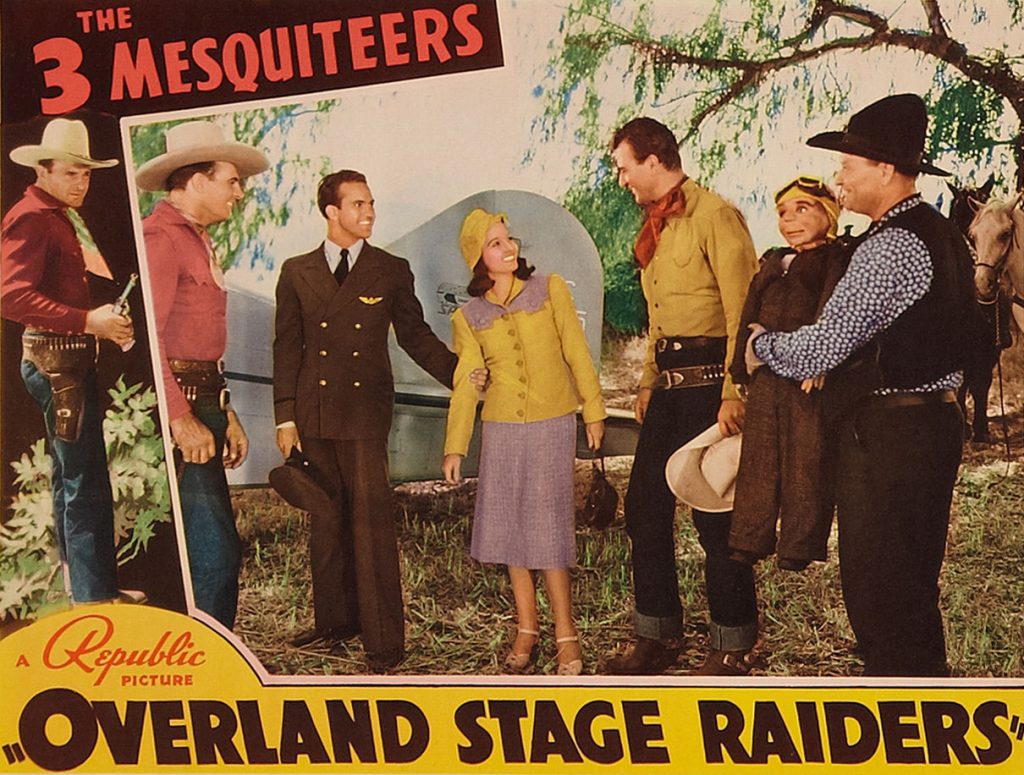
Overland Stage Raiders (USA, 1938) 54 min B&W DIR: George Sherman. PROD: William Berke. SCR: Luci Ward. DOP: William Nobles. CAST: John Wayne, Ray Corrigan, Max Terhune, Louise Brooks, Anthony Marsh, John Archer, Arch Hall Sr. (Republic Pictures)
In Raoul Walsh’s 1930 epic The Big Trail, John Wayne already demonstrates his screen presence, cast in the lead role at such a young age. However, the film was a box-office failure, and it was only in 1939, upon being cast as The Ringo Kid in 1939’s Stagecoach, when he became a major star. In the meantime, he remained very busy during the 1930s in many B-budgeted westerns and action films.
Among his most notable appearances during this period, he played Stoney Brooke in eight of Republic’s long-running western series, The Three Mesquiteers. The popular series began in 1936 with Bob Livingston as Brooke. After “Duke” Wayne left the role, Livingston resumed the role for 14 more pictures, and then Tom Tyler played the character for the rest of the series run. (The Mesquiteers ended in 1943 after a whopping 51 “episodes” in total.)
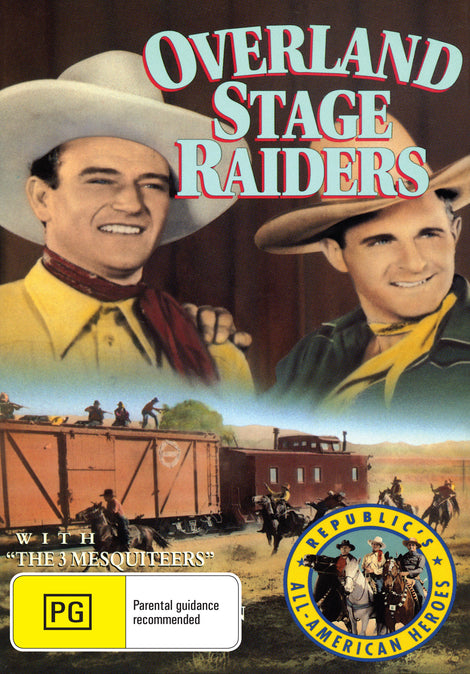
Overland Stage Raiders, the second film to feature “Duke” as Stoney Brooke, and the 18th Mesquiteers film overall, also features the oft-recurring Mesquiteers, Tuscon Smith (played here by Ray Corrigan, who appeared in 24 films, and later by Bob Steele for 20 pictures), and Lullaby Joslyn (Max Terhune, who played the character 21 times, though Syd Saylor, Rufe Davis, and Jimmie Dodd would also assume the role). And yet, this film has curiosity value for more than its audience of B-western lovers, as it has the final acting appearance of the legendary Louise Brooks.
After making films in Europe (especially her classics with G.W. Pabst, Pandora’s Box and Diary of a Lost Girl), Ms. Brooks returned to America, and never regained her limelight. Her career downfall is attributed in part to her refusal to return for sound retakes on The Canary Murder Case, and for turning down the role in The Public Enemy, which went to Jean Harlow. Her subsequent appearances were spotty: she was seen in bit parts (that is, if her scenes weren’t cut out completely). She was offered a mere $300 for her role in Overland Stage Raiders. Here, she has longer hair than her trademark bangs, but still looks great, alas, she has little to do, even though she is fourth-billed, after the three Mesquiteers.
Modern viewers may be surprised to see that many B-westerns also had cars. This one also features a plane! In this episode, our heroes invest in an airplane as a way to safety transport the gold out of the Oro Grande township, to avoid bandits. However, the bandits get wind of their plan, rob the train full of gold before it reaches the hangar, and hijack the plane to an unknown destination so they can offload the loot. Airline owner Ned Hoyt (Anthony Marsh) is accused of being in cahoots with the robbers because he is an ex-con. Brooke of course knows about his troubled past, but believes he is a reformed man, so he and his pals set out to find the real culprits. It is revealed that Joe Waddell, one of the bandits, is working for the airline. When we first meet Waddell, he is disgraced because he isn’t offered the job of a co-pilot, and instead works at the radio. Modern viewers may get a kick out of the fact that Waddell is played by Archie Hall… yes, Arch Hall Sr! (Now there is a degree of separation between Eegah, John Wayne and Louise Brooks!)
Ms. Brooks plays Hoyt’s sister Beth, who also believes in her brother’s innocence. Still, her role really doesn’t feature into the plot, except to exchange sweet nothings with Stoney Brooke in a couple of scenes. It would’ve been great to see her get on a horse and join our heroes in pursuit of the bad guys.
As a swansong for a screen icon, Overland Stage Raiders is forgettable. But for a Saturday afternoon western, it checks off the scorecard of action, humour and romance. Because it’s barely an hour long, it moves well, and is nicely shot by William Nobles. Director George Sherman had a long career, with many B-westerns for Republic, and then more adventure for Columbia and Universal. He ended his filmography with Big Jake (1971), reuniting with John Wayne! And yes, Lullaby’s ventriloquist dummy Elmer appears as comic relief in two scenes (in the latter, Elmer is decked out in aviator goggles and leather cap).
The term “episode” is used a couple of times in this review, because before TV came along, the movies were very much like episodic television for 1930s viewers who attended the bijou on a regular basis. Serials of course were episodic in nature (come back next week to see if Captain Marvel plugged the dam in time), but movie series like Blondie, The Three Mesquiteers, etc., would have a new instalment every couple of months, for viewers to catch up with their favourite characters. And like TV episodes of a future generation, perhaps a different character would be spotlighted from one to other. So, if Ray Corrigan has little to in Overland Stage Raiders, maybe we’ll see more of him in the next one.
In the 2010s, Olive Films had released several of John Wayne’s Three Mesquiteers films to Blu-ray, including this one. I’m very glad that it exists in a high-resolution format, presumably as pristine as it can be, for those who want it. However, my viewing copy is the VHS edition released by Republic Home Video, which I purchased at BMV for $3.95, and I’m perfectly fine with that. It added to my viewing experience, in part because it recalled the same kind of soft picture quality that was present in the similar B-westerns I’d used to see on the PBS series, Six Gun Heroes, which made me all warm and fuzzy inside.
Greg Woods

Greg Woods has been a film enthusiast since his teens, and began his writing "career" at the same time- prolific in capsule reviews of everything he had watched, first on index cards, then those hardcover dollar store black journals, then an old Mac IIsi. He founded The Eclectic Screening Room in 2001, as a portal to share his film love with the world, and find some like-minded enthusiasts along the way. In addition to having worked in the film industry for over two decades, he has been a co-programmer of films at Trash Palace, and a programmer/co-founder of the Toronto Film Noir Syndicate. He has also written for Broken Pencil, CU-Confidential, Micro-Film, and is currently working on his first novel. His secret desire is for someone to interview him for a podcast or a DVD extra.