This is the first of a four-part article on the American films of director Hugo Haas. To go to the next chapter, click on the link at the very bottom of this page.

Introduction
“What is my type of picture? Bad ones?”
–The Other Woman (1954)
This spring marked a minor revelation in DVD releases- but one wouldn’t blame you if you didn’t hear about it. One of Columbia’s two simultaneously released volumes Bad Girls of Film Noir featured three films of blonde starlet Cleo Moore- one of those by her frequent co-star and director, Hugo Haas. To date, that movie (One Girl’s Confession) remains the only one of Haas’ fourteen American-made potboilers to get any proper home video release. The canon of Hugo Haas has remained more wondered about than seen. One had to vicariously experience his films through the writings of cult movie authors Danny Peary or Michael Weldon, save for infrequent appearances on specialty channels or the late late show.
The Czech-born Hugo Haas (born in 1901) was a highly regarded actor-writer-director in his native land (one of his indigenous directorial efforts, 1937’s Skeleton on Horseback, received raves at a recent one-shot New York screening), who like many filmmakers fled to America when World War II broke out. Because he didn’t have conventional movie idol looks, the brawny Haas was instead given supporting character parts, often as villains or exotic roles, namely in such classics as Douglas Sirk’s melodrama Summer Storm, or the 1950 adventure film King Solomon’s Mines. As the 1950s began, Hugo Haas instead turned his attention to writing, producing, directing and co-starring in B-budgeted potboilers. The tantalizing titles of these films evoke those of trashy drugstore paperbacks: The Other Woman; Pickup; One Girl’s Confession; Bait. According to his fellow countrymen, his foray into such sensationalist fare, with tawdry budgets and lurid plots, was a long way from his work in his native land. And also, because his work has been out of proper circulation for decades, it has been largely misrepresented as camp, or “so bad they’re good”, largely due to the very scraps of cult film writings that ironically have kept his name alive for new generations of film fans.
One could call Hugo Haas a B-level Orson Welles: neither were classical leading men, yet would appear before and behind the camera in their pet projects and make the best with whatever resources they had. Many filmmakers have successfully created an identifiable body of work within B-budgeted genre fare. In truth, Hugo Haas’ films lack the innovative cinematic devices of poverty row auteur Edgar G. Ulmer, or for that matter, even the spacey literary visions of Edward D. Wood, to whom Haas has sometimes stupidly been compared. Yet they do have a unique personality: these modest pictures somehow belie their tawdry, lurid elements and become fascinating morality plays with surprising turns of redemption, sentimentality, and old world values.
The major criticism of Haas’ films is however well founded. The writer-director would often write himself in as the unlikely lead, who would have a doomed affair with a deceitful blonde woman who often had a young beau on a string to form a torrid love triangle. After seeing several of his films in a short time period, this formula becomes tiresome. He would most commonly hire Cleo Moore as the female lead, but each of the lead actresses in his Hollywood epics are typically given ingénue roles taken under the wings of the Haas characters, suggesting a Svengali-Trilby plot device that further aggrandizes the roles Hugo Haas gave himself. (To his credit though, Haas always gave good performances.)
But despite these repetitious themes, there are many fascinating undercurrents in these films. One hesitates to make autobiographical assumptions in any artist’s body of work, but in the films of Hugo Haas, one cannot help but ponder how much of the characters’ back stories or observations mirror his own.

The Beverly Michaels Films
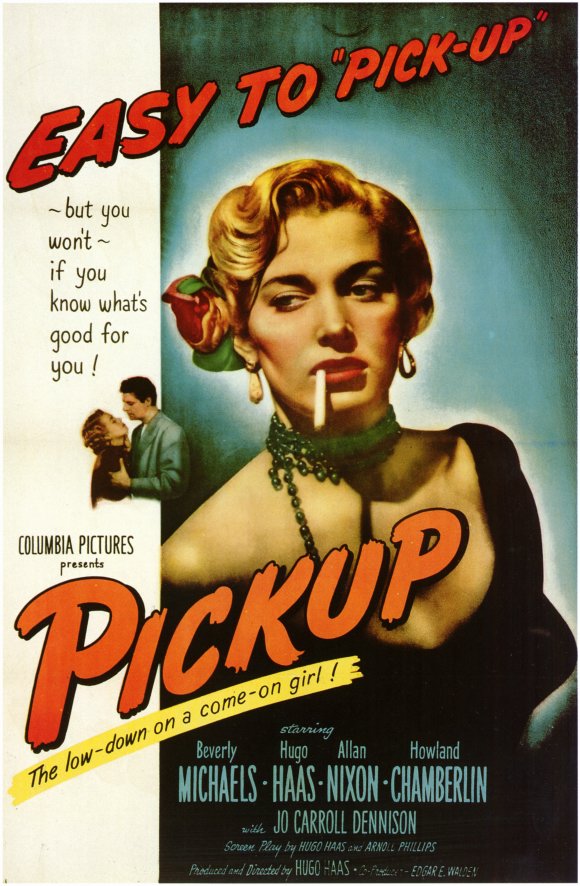
The first of Hugo Haas’ American productions as actor-writer-producer-director, is the decent film noir, Pickup (1951), released by Columbia. Haas and Arnold Phillips adapted the screenplay from the novel Watchman 47, by Czech novelist Josef Kopta, depicting the melodrama of a widowed railroad watchman, Jan Horak (Hugo Haas) who meets good-time girl Betty (Beverly Michaels) at a carnival, and eventually asks her to marry him. Only when she is completely down and out (that is, when she’s kicked out of her apartment for non-payment of arrears) does she accept his proposal.
Horak suddenly becomes deaf and must retire his position. Anticipating a big payload from his retirement, Betty conspires to have her husband killed so she can inherit his fortune. She has even smitten Horak’s employee Steve (Allan Nixon) into the plot.
The marriage of Horak and Betty is economically depicted merely with the “happy couple” standing behind a wedding cake well after the ceremony. At first this may seem like a budgetary consideration, but it is only symbolic of how the entire film really is devoid of showing any passion between these two characters— feigned or otherwise. Rather, the narrative reserves its passion for scenes between Betty and the naïve Steve. The sequence, in which the two conspire to kill Horak, is extremely erotic: the cinematographer Paul Ivano (who often worked with Haas) gives the embracing couple an eerie halo from a backlight, suggesting the urgency and passion of the moment.
As always in film noir, nothing is truly what it seems on the surface, and Pickup certainly gets more engaging in the final third. There is also an interesting supporting character in a railroad tramp named “The Professor” (Howland Chamberlain), who presages how in Haas’ world, hobos are treated with much dignity, often given an aristocratic flair (blatantly exemplified here with the nickname given this man). Although it is unknown how faithful this character is to the original novel, “The Professor” certainly is emblematic of the class struggle that exists in most of Haas’ films. Blue-collar characters are always humourous, vivacious people who see the joy and reward of a day’s work. As such, these movies have a refreshing old-world sensibility that tragically must conflict with the materialistic western world. It is not hard to see Haas’ own sensibilities being reflected his depiction of such characters.
In a 1951 Time magazine article, the following is written: “Haas still lives simply, with his wife and son, in an aging bungalow in a middle-class neighbourhood on the fringe of Hollywood. (‘I don’t see happiness in swimming pools and Cadillac convertibles.’) He tries to avoid Hollywood parties (‘full of empty talk and stupid pretension’) and ignores the offers he has been getting to work for major studios. Explains Haas: ‘I don’t feel I would do my best if I were handed a property by the studio and told to do it. I could not get enthusiastic under those conditions.’”
Even at the beginning, Haas had an independent streak. Although studios initially were interested in making Pickup, Haas instead chose to make the movie his way by funding it entirely with his own life savings and borrowed money. Columbia subsequently picked up the picture, and for the next decade, Hugo Haas would continue to make low-budget melodramas for various studios, with his own distinct flavour.
Although Beverly Michaels was often cast in films noir with such tell-all titles as Blonde Bait or Wicked Woman, and that she does exhibit a slinky sex appeal coupled with her devil-may-care demeanour, Pickup perhaps doesn’t work as well as it should because she lacks a menacing presence. The actress is put to much better use in a more tragic role in her second and last association with Haas: The Girl on the Bridge (1951), released by Twentieth Century Fox.

In this scenario, written by Haas and Arnold Phillips, Ms. Michaels plays an unwed mother named Clara who in the opening scene contemplates jumping from a bridge. She is talked out of it by an older man named David Toman (Hugo Haas). Clara and her baby move in with Toman, works with him at his watch repair shop, and eventually the two marry. The biological father of the child, Mario (Robert Dane), a traveling musician, returns to the city and discovers that she has married. Intriguingly, Mario is revealed to be a very honourable man, who respects Clara’s new life. However, a friend of Mario schemes to blackmail Toman, in a scene which ends with the accidental death of the would-be blackmailer. Astonishingly, Mario is implicated in the murder of the man. This news however devastates Clara, thus indicating she still has feelings for him. Toman, however is hesitant to reveal that he is the true murderer, ironically, because the news would create more sorrow for Clara, leaving her destitute once again. This engaging melodrama competently juggles both joy and tragedy, (as would Haas’ subsequent films) but perhaps the most chilling moment is when Toman reveals that his former wife and children were killed by the Nazis. This is a disturbing parallel to Haas’ own life, as his brother Pavel (who composed some of Hugo’s films in Europe) died at Auschwitz.
Greg Woods

Greg Woods has been a film enthusiast since his teens, and began his writing "career" at the same time- prolific in capsule reviews of everything he had watched, first on index cards, then those hardcover dollar store black journals, then an old Mac IIsi. He founded The Eclectic Screening Room in 2001, as a portal to share his film love with the world, and find some like-minded enthusiasts along the way. In addition to having worked in the film industry for over two decades, he has been a co-programmer of films at Trash Palace, and a programmer/co-founder of the Toronto Film Noir Syndicate. He has also written for Broken Pencil, CU-Confidential, Micro-Film, and is currently working on his first novel. His secret desire is for someone to interview him for a podcast or a DVD extra.