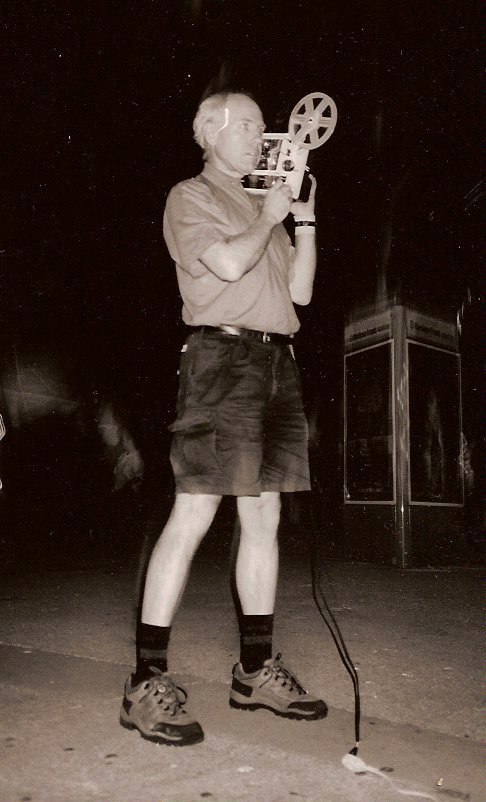
John Porter is one of Toronto’s film culture’s great treasures. In addition to his 35 years of making 300-plus films on Super 8, he has also been a tireless supporter of the independent film scene, having been associated with The Funnel and Pleasuredome in the past. I have known John for over three years, as he has also been a loyal supporter of this publication. Yet until very recently, I had never seen a single film from his prolific catalogue. In the first few months of 2007 alone, John has toured across Europe with his work, and has just done two nights at New York’s fabled Anthology Film Archives. It was in the fall of 2006, where I managed to see a sample from his work, at a rare screening in his home turf.
One rainy afternoon in October, John Porter was holding a private screening of his own work at Cinecycle, in honour of Erwin van ‘t Hart, programmer for the Rotterdam and Amsterdam Film Festivals, making his first-time visit to Toronto on the way to Denver, Colorado. In relation to other shows John has done (appearing on stage, interacting with the image playing behind him; or using a mobile projector unit to have his films playing over the contours of the room, or mimicking the motions onscreen), this was perhaps more low-key, or at least what I was able to see in my lunch hour.
Even if he is not having interplay with the projected images (and he always shows camera originals), just seeing his work alone is a rewarding and unique experience. Our colloquial mental association with Super 8 usually harkens images of home movie footage with kids opening Christmas presents, Uncle Fred at the barbecue, and trips to Disneyland. And for that matter we often regard this medium as a deeply personal visual record- a diary meant for the person turning the crank. However Super 8 has also been a healthy medium in the avant-garde, and not just for its affordability and compactness. Filmmakers have explored the narrow gauge for its aesthetic properties, and the diary-like tradition that pervades the medium.
While perhaps Porter’s work is personal in the sense that some of his films are records of various pages in his own life, it can speak to anyone, as the content is universal. He expands the parameters of this film form with striking composition, and technical ideas that makes much more of a medium designed for its simplicity. What is more, the approach to the form is usually as playful as the content.
The first film I viewed was Exams (1982, 3.5 minutes), one of his “Condensed Rituals” series, in which an event is viewed via time-lapse, beginning and ending all within one spool of Super 8 film. While I am always a sucker for time-lapse cinematography (having seen Koyaanisqatsi innumerable times), what separates this little film from most is the framing. Not settling just for the effect itself, the camera is positioned from the stands of the Varsity Hockey Arena, studying the motions of the students on the floors, entering and exiting their desk honeycombs. In a microcosmic sense, this condensed ritual is perhaps a prelude to a greater ritual, when these kids grow up and join the rat race, and spend a portion of their lives also confined to a small workspace. The lines of desks stretching to the horizon, and the spatial depth of the composition, add to the overall ominous feeling of these unknown, generic bodies speeding through their tasks.
A Trip Around Toronto Harbour (1986; 3.5 min) has a title that sounds like innumerable home movies shown in living rooms, but of course, what separates this from all of that is the craft. This film, one of his “Camera Dances”, features John Porter and his two friends in a canoe, going around various locations of the harbour, while the camera is situated on a board at the front of the canoe, facing the men rowing the boat. This film was shot in time-lapse, as the men’s pixilated rowing motion makes up the constant foreground, as the scenery magically changes behind them. In one instance, the camera still continues to record in a capsized angle, while the canoe is beached for a swimming break. The camera, then, emerges as this living entity that continues to work, even when its master is away.
The 18-minute excerpt from Toy Catalogue 3 (1996), is part of a 60-minute film on three reels, that could be played in any order. This “tabletop film” first opens with a shot of John in his housecoat eating breakfast cereal, then for the duration of the film, we see an overhead shot, of his hands producing Ziploc bags of cheap plastic toys found in cereal and snacks! Within these 18 minutes, one is amazed by this unbelievable collection of little games, figurines and other knick-knacks- not just that John has collected this mass inventory, but that we recognize so many of these pieces of pop culture ephemera. I am reminded of Peter Rowe’s long-forgotten feature film The Neon Palace (1970), in which the narrative gives way to this incredible catalogue of nostalgic artifacts.
Just to get to see these little gems is privilege enough, but it is made all the more precious under the context in which the films were shown. This generous screening invitation is a quaint reminder of the warm communal feeling that one only gets from an independent screening. The event was very spontaneous, organic, having the “let’s do one more” atmosphere of a jazz set- whereas packaging this same content on a DVD would make the presentation too final, too permanent. Getting to see these films on a lunch hour made the event even more unique. It only seems that people get some noon-time culture while during a jazz or film festival. Seeing some short films at lunch is the perfect way to make for a more pleasant afternoon, another way in which we can bring the magic of cinema into our daily routines.
For more information on John Porter and his work, visit him online at www.super8porter.ca
Note: this article originally appeared in Vol. #1, Issue #18, “Discoveries”. I’ve since watched John Porter show his work locally a few more times, including a terrific 2016 retrospective at Early Monthly Segments, also featuring live performance, interacting with the films onscreen. John continues to be an ever-present figure at independent screenings around town. His website is a “one-stop shopping” for news on upcoming screenings for films outside of the mainstream.
Greg Woods

Greg Woods has been a film enthusiast since his teens, and began his writing "career" at the same time- prolific in capsule reviews of everything he had watched, first on index cards, then those hardcover dollar store black journals, then an old Mac IIsi. He founded The Eclectic Screening Room in 2001, as a portal to share his film love with the world, and find some like-minded enthusiasts along the way. In addition to having worked in the film industry for over two decades, he has been a co-programmer of films at Trash Palace, and a programmer/co-founder of the Toronto Film Noir Syndicate. He has also written for Broken Pencil, CU-Confidential, Micro-Film, and is currently working on his first novel. His secret desire is for someone to interview him for a podcast or a DVD extra.