Juha (Finland, 1999) 77 min B&W DIR-PROD: Aki Kaurismäki. SCR: Aki Kaurismäki, based on the novel by Juhani Aho. MUSIC: Anssi Tikanmäki. DOP: Timo Salminen. CAST: Kati Outinen, Sakari Kuosmanen, André Wilms, Markku Peltola, Elina Salo. (Sputnik)
It may not be surprising that director Aki Kaurismäki has made a silent film, once you consider that long silent passages are typical of his works. (In fact, the first twelve of The Match Factory Girl’s scant 70 minutes carry on without a single word.) Perhaps more surprising is that Juha is completely unlike his other deadpan films. Yes, it is as full of despair as those of his famed “loser” trilogy (like Ariel or Shadows in Paradise), yet it is without any of his sardonic humour, or deliberately absurd endings.
The difference in tone can perhaps be ascribed to the source material. The rare Kaurismäki film to be based on another material, Juha is adapted from a 1911 Finnish novel of the same name by author Juhani Aho, chronicling the tragic love triangle of Marja, a farmer’s wife who is convinced by hustler Shemeikka to leave her husband Juha for a potentially more exciting life in the city, only to find that he is earmarking her to work in his brothel! (Despite its Finnish origins, this plot resembles a blur between two classic Expressionist silents: Sunrise and Pandora’s Box!)
For its premiere at the Berlin Film Festival, Juha was presented with live music orchestration by composer Anssi Tikanmäki. Subsequent screenings were presented with that score on the film’s soundtrack. In North America anyway, this marvellous picture was never seen beyond the confines of the film festival circuit, as no brave distributor had the gumption to pick up such a jewel of a film. As of this writing, Juha has never been given a North American commercial release, nor is it to be found domestically on DVD.
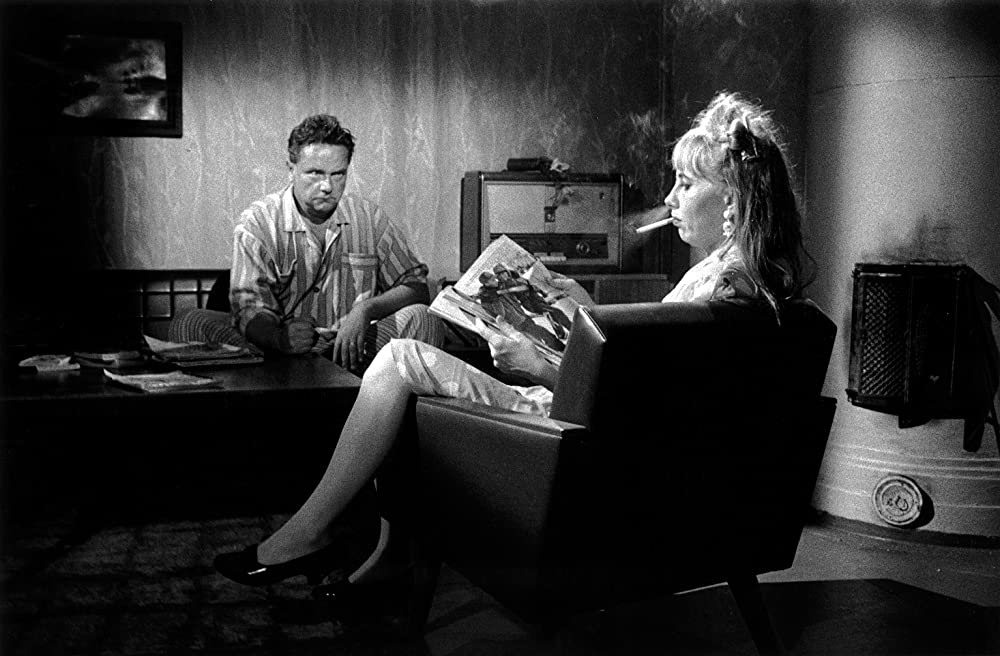
Juha is unique alone as a silent film, but it is more unconventional in context with the Finnish director’s work. Beautifully shot in crisp, glistening black and white by Timo Salminen, (Kaurismäki’s regular cinematographer), the brilliance of the images are a departure from his expressionistic black and white work in Hamlet Goes Business. This picture draws less from Kaurismäki’s usual influences (Wenders, Fassbinder, Fuller, Bresson, Jarmusch), and instead recalls the poetic lyricism of 1930s French Cinema (especially Marcel Pagnol and Jean Renoir).
Were it not for the opening scene, where Juha and Marja travel on a motorcycle (while smiling, an emotion so atypical of Kaurismäki’s characters), one would not have any sense (for some time) that it took place in the modern world, with its timeless look at the happy couple harvesting, showing the joy in work, living off the land, and the beauty of rural life. Then, when Shemeikka lures her to the city (referring to her husband as a cripple, yet he’s no prize either), the urban landscape is also eloquently depicted, in the tantalizing allure of city lights.
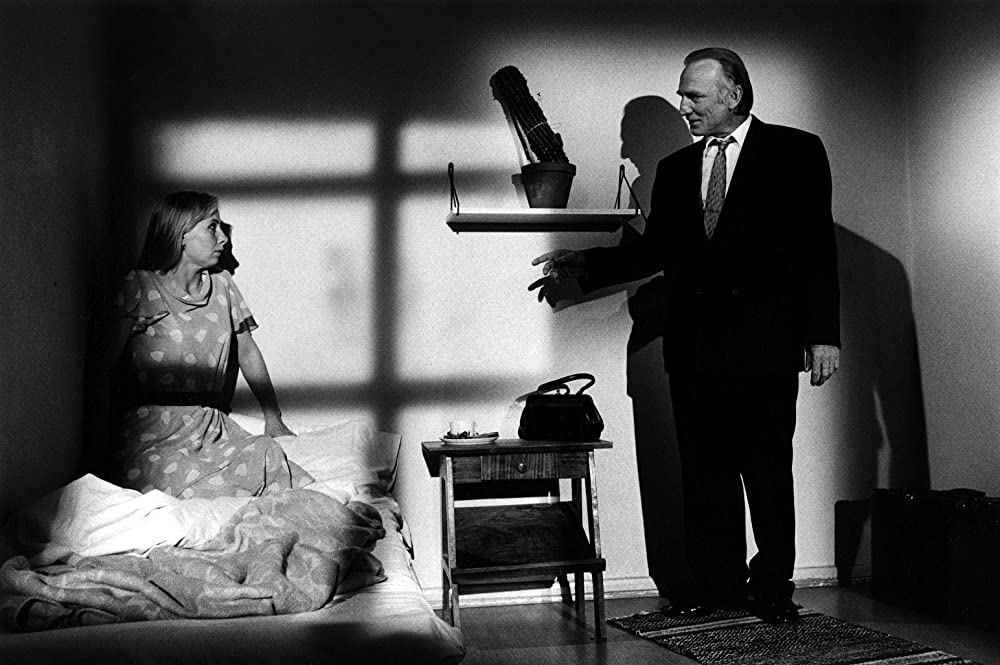
The city man’s first appearance is marked by a foreshortened close-up of the head of a car, its angles jutting out into the scene, presaging how this man will be violating their domestic life. The climax of the picture is likewise shot in foreshortened angles to intensify the melodrama. However, it is the intoxicating visual beauty of the film that stays with you long after its brief 77-minute running time. In a sense, the viewer is as smitten by the images as Marja. It isn’t necessary to have a film school degree to appreciate Juha, but it is so evocative of early 20th century European films, adding subtext for those who wish to partake.
Sakari Kuosmanen (who played the lovestruck garbageman’s friend in Kaurismäki’s masterpiece, Shadows in Paradise) recalls fond memories of Jean Gabin in his work with Marcel Carné. André Wilms (also of the director’s La Vie de Bohème) is well-cast as the city hustler. Yet the film works so well emotionally because of another captivating central performance by Kati Outinen, who actually radiates in the role, compared to her morose characters in the director’s earlier films (Shadows and Hamlet, to name some). While perhaps Kaurismäki’s most tragic film, it is ironically his most cheerful, featuring people who actually know how to laugh.
Originally presented in Vol. #1, Issue #18, “Discoveries”.
Greg Woods

Greg Woods has been a film enthusiast since his teens, and began his writing "career" at the same time- prolific in capsule reviews of everything he had watched, first on index cards, then those hardcover dollar store black journals, then an old Mac IIsi. He founded The Eclectic Screening Room in 2001, as a portal to share his film love with the world, and find some like-minded enthusiasts along the way. In addition to having worked in the film industry for over two decades, he has been a co-programmer of films at Trash Palace, and a programmer/co-founder of the Toronto Film Noir Syndicate. He has also written for Broken Pencil, CU-Confidential, Micro-Film, and is currently working on his first novel. His secret desire is for someone to interview him for a podcast or a DVD extra.