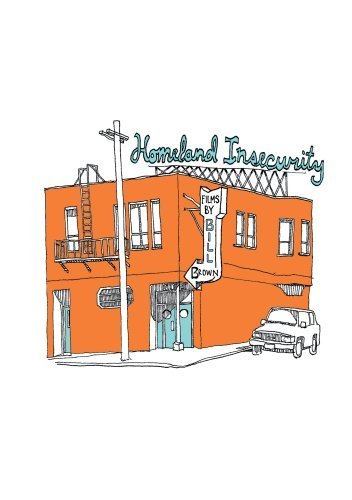
Homeland Insecurity: Films by Bill Brown
Hub City (1997) 40 min color
The Other Side (2006) 43 min color
Kustom Kamera Kommandos (2005) 2 min color
(Microcosm Publishing)
There are countless collections of shorts released by independent filmmakers these days– what a relief to find one where, yes, the movies were actually shot on film! These gems by Bill Brown have become a mini-favourite of late: the small gauge of 16mm perfectly enhances the intimate feel and portraiture of the ghostly landscapes and buildings of the American Southwest that Bill Brown has documented in his work. Brown is also an author and zinester, who unsurprisingly also lends that DIY aesthetic to this work.
Hub City (1997) is the nickname for Lubbock, Texas; whose native son Buddy Holly died in a plane crash in 1959. Brown’s poetic, prosaic narration discusses past moments of Lubbock that were related to the skies, coupled with images that are monuments to those events: a building that is slightly skewed from a 1970 tornado; eerie hazy silhouetted shots of powerlines at dusk for the 1951 “Lubbock Lights” UFO sighting; and for 1959, “the day the music died”, there are Buddy Holly monuments, oldies radio billboards, the former radio station where he first recorded, and a visit to his snowy grave 37 years to the day after his death. Bill Brown fills this mosaic with haunting shots of empty buildings and desolate roads, with a simple approach that recalls the portraiture of James Benning (minus the geometric symmetry); further, he gives it a personal “home movie diary” feel where typewritten little notes are held up in the frame to add more context to the images.
The Other Side (2006) chronicles Brown’s encounters on a 2000-mile road trip from Texas to California, emerging with a film that is by turns melancholy and playful. This bittersweet travelogue pauses for such vistas as a playground close to where Geronimo surrendered, and a wild-west re-enactment (in which the filmmaker places himself in the frame of the cowboys’ shoot-out)- all dubious markers of white American progress. Most of the narrative is devoted to the struggle with immigrants crossing the border, represented by such unique markers as a watering station for those who steal across the desert at night; piles of discarded clothes; stuffed animals attached to the fence of a truck stop where a group of immigrants died inside an 18-wheeler… all signposts to an unrecorded history, by-products of the post-9/11 crackdown along the Mexican border.
As with the previous film, the narration is poetic prose, and the images often consist of desolate vistas and empty buildings, but often these stand as monuments to a history that people don’t want to acknowledge. This movie however has additional voices: anonymous activists, government workers and immigrants each discussing off-camera their experiences with border crossing. While they speak, the images are filled with isolation: barren deserts; canyons in time-lapse photography; nocturnal makeshift migrant camps while 18-wheelers streak by.
A telling image appears near the end: an obscure monument stands outside a community college, the former site of a McDonalds where a man went on a shooting rampage in 1984. (The press coverage of the event however failed to acknowledge that most of the victims were Mexicans.)
And finally, Kustom Kamera Kommandos (2005) is a 2-minute wonder- just long enough to crack its one, very funny, joke. Made as a promo for the Ann Arbor Film Festival, this is a valentine-spoof of Kenneth Anger’s fetishistic short Kustom Kar Kommandos, which lovingly details a powder puff duster’s cleaning of a glistening red hot rod. In this one, the duster is instead cleaning a Bolex, along to the same soundtrack as its inspiration (The Paris Sisters’ recording of “Dream Lover”). The sexual connotation is seen here in the long phallic lens on the camera, and also a homoerotic shot of a light meter hanging out of a jean back pocket.
Another collection of Bill Brown films, The Next Best Place, seems to finally be back in print- after seeing this very fine DVD, we’re looking out for that one!
Originally published in Vol. #1, Issue #24.
Greg Woods

Greg Woods has been a film enthusiast since his teens, and began his writing "career" at the same time- prolific in capsule reviews of everything he had watched, first on index cards, then those hardcover dollar store black journals, then an old Mac IIsi. He founded The Eclectic Screening Room in 2001, as a portal to share his film love with the world, and find some like-minded enthusiasts along the way. In addition to having worked in the film industry for over two decades, he has been a co-programmer of films at Trash Palace, and a programmer/co-founder of the Toronto Film Noir Syndicate. He has also written for Broken Pencil, CU-Confidential, Micro-Film, and is currently working on his first novel. His secret desire is for someone to interview him for a podcast or a DVD extra.