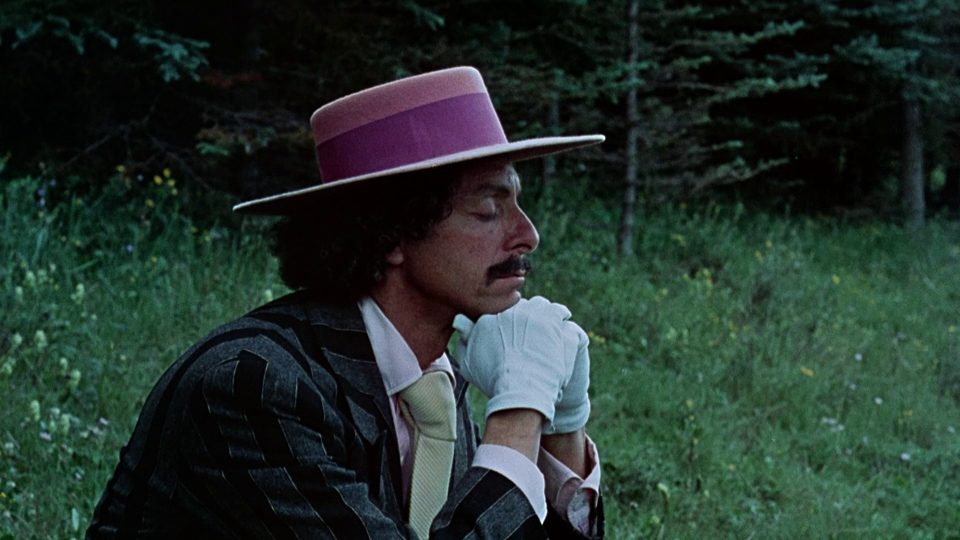
Greaser’s Palace (USA, 1972) 92 min color DIR-SCR: Robert Downey. PROD: Cyma Rubin. MUSIC: Jack Nitzsche. DOP: Peter Powell. CAST: Allan Arbus, Luana Anders, Albert Henderson, Toni Basil, Don Calfa, Pablo Ferro, Hervé Villechaize. (Image Entertainment)
It may seem like a cheat to declare Greaser’s Palace as Robert Downey’s masterpiece, since it his most “above ground” (ie- digestible) film up to that time. Although it resembles an “art film” in comparison to the scruffy works that precede it, Greaser’s Palace is likewise a biting satire with an unusual story structure.
This film is also a key work in the so-called “acid western” sub genre which, as coined by Pauline Kael in her review of El Topo, melds the western formula with the visual style and mythic feel of the spaghetti western, and Biblical, psychedelic, countercultural overtones. In some ways, this film feels like an American cousin to Sergio Leone’s spaghetti westerns, if viewed through author Danny Peary’s clever suggestion that the frontiers in Leone’s films had existed since Biblical times.
Allan Arbus (also in Putney Swope) plays a showman named Jessy who travels the godforsaken frontier on his way to Jerusalem where the agent Morris awaits him, however he’s always getting sidetracked to perform miracles and the like. In this clever satire, religion is compared to showmanship, and the conflict between Jesus and Pilate is due to Pilates’s ire over Jesus (dressed in vaudeville garb instead of robes) horning into his act!

The incarnation of Pilate is one Seaweedhead Greaser (Albert Henderson), ruler of the shabby town of Greaser’s Palace, whose entourage of people blindly follows him everywhere… even to the outhouse! His daughter, saloon strumpet Cholera (played by cult actress Luana Anders) is perhaps the Mary Magdalene figure in this madness. Then there’s also some spaceman or something (played by the distinguished character actor Don Calfa) wearing a goldfish bowl over his head, who just might be the “God” figure. One recurring joke (worthy of Buñuel) concerns Greaser’s son Lamy Homo (name is a pun?) who keeps getting killed and then revived by Jessy. But perhaps the most show-stopping miracle of all occurs when Jessy does a song and dance number on stage in the saloon. Blood begins to pour from the palms of his hands, and suddenly agents want to sign him up!
Like Downey’s earlier work, Greaser’s Palace remains a “family affair” (wife Elsie and son Robert Jr. appear as a massacred family), and has a complex structure. Because this picture moves quite slowly (as life would, in the old west or in Biblical times), where scenes often play in languid single takes, one may not at first notice its elaborate construction. When Jessy is on the cross, we believe we have just seen the entire film through his eyes: if you like, a Last Temptation of Jessy.


Cinematographer Peter Powell (whose scant credits include 1973’s Let the Good Times Roll, De Palma’s The Wedding Party, and Downey’s own Rittenhouse Square) beautifully captures the “everywhere and nowhere” setting of the material. Although it feels as otherworldly and allegorical as a timeless fable should, its unusual locations and unconventional characters (almost everyone has long hippie beards and top hats) are not so jarring as to take away from the ingenuity at hand.
Since the debut of Greaser’s Palace, we have seen how the media presents televangelists (to say nothing of politicians) as larger-than-life showbiz personalities. Like any timeless parable, it remains as relevant as ever.
Originally published in Vol. #1, Issue #14, extracted from an article on Robert Downey Sr.
Greg Woods

Greg Woods has been a film enthusiast since his teens, and began his writing "career" at the same time- prolific in capsule reviews of everything he had watched, first on index cards, then those hardcover dollar store black journals, then an old Mac IIsi. He founded The Eclectic Screening Room in 2001, as a portal to share his film love with the world, and find some like-minded enthusiasts along the way. In addition to having worked in the film industry for over two decades, he has been a co-programmer of films at Trash Palace, and a programmer/co-founder of the Toronto Film Noir Syndicate. He has also written for Broken Pencil, CU-Confidential, Micro-Film, and is currently working on his first novel. His secret desire is for someone to interview him for a podcast or a DVD extra.