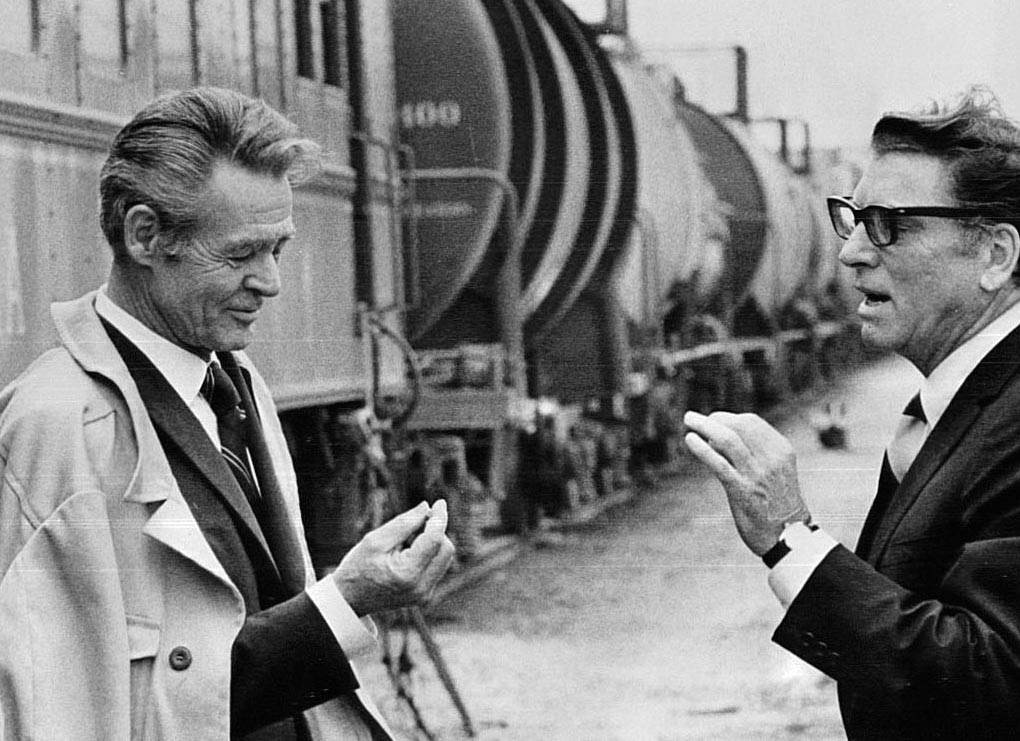
Executive Action (USA, 1973) 91 min color DIR: David Miller. PROD: Dan Bessie, Gary Horowitz, Edward Lewis. SCR: Dalton Trumbo. MUSIC: Randy Edelman. DOP: Robert Steadman. CAST: Burt Lancaster, Robert Ryan, Will Geer, John Anderson, Ed Lauter, Lloyd Gough, Dick Miller. (National General Pictures)
I can just imagine that as a struggling young screenwriter, Oliver Stone saw this picture in one of the empty theatres it played, and nearly had an orgasm. Although his own 1991 film, JFK, is a far more adventurous investigation into the conspiracy behind the assassination of John F. Kennedy, this earlier picture is nonetheless interesting. This 1973 movie mirrors Stone’s film in its play-by-play documenting of the events unfolding on that fateful day in November 1963, although it posits a different theory behind the conspiracy.
Executive Action is a movie right at home in Watergate-era America, when seeing a mainstream film about a corrupt government would be an achievement in itself. While Hollywood was slowly giving itself over to the younger generation of filmmakers who were changing the rules, there were still plenty of pictures being made, which stubbornly adhered to the studio gloss of yesteryear. That ideal makes perfect sense in a movie about the older generation trying to control radical youngsters, driven home with the hiring of a veteran studio director, and a gallery of veteran stars (Burt Lancaster and Robert Ryan) playing the parts of disreputable public figures who conspire to have the president killed to protect their interests!
Today the JFK assassination can be seen as the incident that changed America; a point made in Stone’s film that November 22, 1963, was the end of the innocence. If Stone’s treatment of the JFK conspiracy asserted that the assassination was a business interest to propagate military spending in Vietnam, Executive Action infers that the killing of JFK was actually a result of white fear. Perhaps the picture’s most telling sequence is when Lancaster’s character watches a Civil Rights protest on television, which prompts him to join the conspiracy (whose platform is to uphold white middle-class ideals in a changing social climate). Since JFK supported the Civil Rights movement, the conniving CIA agents deduced that his death would put an end to it. History of course would prove them wrong, as the decade unfolded with even more social unrest.
This film has none of Stone’s radical filmmaking techniques: its power to shock however remains in its very benign depiction of the conspiracy, as plotted among brightly-lit antiseptic Leave it to Beaver settings. This film is also subversive behind the scenes, especially in the hiring of once blacklisted screenwriter Dalton Trumbo, whose work can be read as an attack on the white picket fence society that derailed his career. Those who may have seen this on television years later may have noticed another quietly subversive act in the casting of Grandpa Walton, Will Geer, as one of the conspirators. And yet, Geer was also blacklisted in the 1950s, and had participated in the film Salt of the Earth, made outside of the studio system by fellow travellers.
Originally presented in Vol. #1, Issue #14, (“Back to the 70s”), as part of the article, “The Paranoia Machine”.
Greg Woods

Greg Woods has been a film enthusiast since his teens, and began his writing "career" at the same time- prolific in capsule reviews of everything he had watched, first on index cards, then those hardcover dollar store black journals, then an old Mac IIsi. He founded The Eclectic Screening Room in 2001, as a portal to share his film love with the world, and find some like-minded enthusiasts along the way. In addition to having worked in the film industry for over two decades, he has been a co-programmer of films at Trash Palace, and a programmer/co-founder of the Toronto Film Noir Syndicate. He has also written for Broken Pencil, CU-Confidential, Micro-Film, and is currently working on his first novel. His secret desire is for someone to interview him for a podcast or a DVD extra.