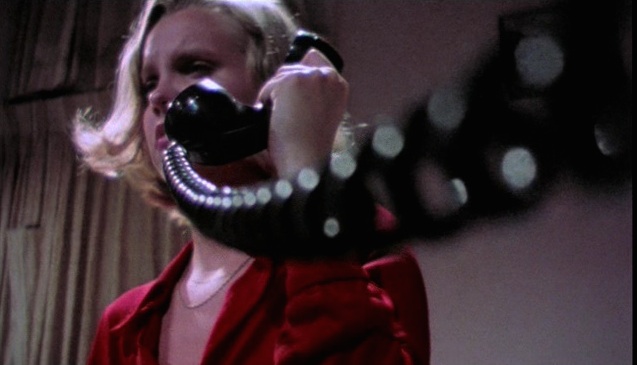
Don’t Open The Door (USA, 1974) 90 min color DIR: S.F. Brownrigg. SCR: Frank Schaefer, Kerry Newcomb. PROD: S.F. Brownrigg, Martin Jurow. MUSIC: Robert Farrar. DOP: Robert B. Alcott. CAST: Susan Bracken, Larry O’Dwyer, Gene Ross, Jim Harrell, Hugh Feagin, Annabelle Weenick, Rhea MacAdams.
A more accurate title for this picture would be Don’t Answer The Phone (which would have confused it with a 1980 exploitation film of the same name), as the heroine is constantly terrorized by her assailant on the telephone. On the other hand, this has an alternate title of Don’t Hang Up, which lacks the same punch.
Judge Stemple (Gene Ross) feeds medications to old Miss Harriett (Rhea MacAdams), in a conspiracy with Dr. Crawther (Jim Harrell) and museum curator Mr. Kearn (Larry O’Dwyer), to make her so invalid that they can gain control of her estate. Brownrigg stock company regular Annabelle Weenick plays Stemple’s psychologically abused wife Annie -not dissimilar from her role in It’s Alive (1969), by her previous frequent collaborator Larry Buchanan- who sneakily summons Harriett’s granddaughter Amanda Post (Susan Bracken), to the town of Allerton to rightfully win back custody of her grandmother’s estate. This spunky young lady stands up to these corrupt men, but in short order she is victimized by constant phone calls, which gradually wear down her defense. Susan is already in a fragile state, as thirteen years earlier, she witnessed her mother stabbed to death in the pre-credits flashback, with a great shot of a stuffed animal hitting the ground, signifying the end of her innocence.

While this is another Brownrigg film that chronicles one’s slow progression into madness, at heart this is a southern Gothic tale. Everyone has a huge mansion with spiral staircases and skeletons in the closet. This is a ghost story where the dead don’t roam the earth, but live on in people’s hearts and minds. Kearn is as haunted by Susan’s mother as her daughter, as his museum is a shrine to her past. (Mannequins are a recurrent symbol: like memories, they are representations of real things.) However, there is really no supernatural horror in Brownrigg. Human monsters performing cruel acts are frightening enough.
With constant shots through keyholes and cracks in doors, and inventive camera angles (especially in the spellbinding ending on the staircase) Brownrigg and his frequent cinematographer Robert Alcott constantly give a sense of paranoia. When we think we’ve figured out who the true villain is, we’re still unnerved by the openness of the narrative, and question if our heroine was sane before the picture started. Brownrigg’s films never end satisfactorily; they simply stop before we sense that the next stage in the game will begin.
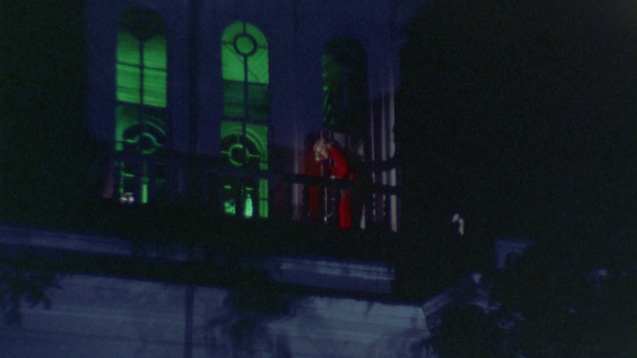


An update of a piece originally published in Volume #1, Issue #22, “Cheap Horror Movies And Why We Love Them”.
Greg Woods

Greg Woods has been a film enthusiast since his teens, and began his writing "career" at the same time- prolific in capsule reviews of everything he had watched, first on index cards, then those hardcover dollar store black journals, then an old Mac IIsi. He founded The Eclectic Screening Room in 2001, as a portal to share his film love with the world, and find some like-minded enthusiasts along the way. In addition to having worked in the film industry for over two decades, he has been a co-programmer of films at Trash Palace, and a programmer/co-founder of the Toronto Film Noir Syndicate. He has also written for Broken Pencil, CU-Confidential, Micro-Film, and is currently working on his first novel. His secret desire is for someone to interview him for a podcast or a DVD extra.