
This fall offered us the rare opportunity to see the films of the esteemed Jack Chambers (1931-1978), shown over two nights (one program of his short films, and then his feature Hart of London the following week), in concordance with the new book, The Films of Jack Chambers, published by Cinematheque, edited by Kathryn Elder. One of the most celebrated and important figures of the 1960s London, Ontario avant-garde art scene, Chambers was initially a painter before he began making films. Even though he did a short about a painter (R34), you would be hard-pressed to recognize this background in any of his films. For the cinematic medium, Chambers became a key figure of the Structuralist movement. His films are typified by marrying together seemingly opposite elements. His central themes are the universals of life and death, and he often constructed these passages via found footage.
Now, the AGO understandably treated the screenings of Chambers’ films as though they had found the missing seven hours of Greed. Sure, they had a book to sell, but for some like myself who has only had a chance to read about Chambers, and who did not see any of his films in school, this was indeed a privilege. (Cinematheque thought so, too: in celebration, they even sprung for wings at The Beverly after screening Hart of London, in an effort, like the old days, to have a post-film gathering and discussion) Bearing in mind that the Cinematheque sung such exaltations over his work, the curious may indeed go in with great expectations. Alas, Chambers’ work, like much avant-garde cinema, isn’t for everyone. While the films are not really complex, the way in which Chambers had assembled his works can prove to be too demanding for some. (There were walkouts during the short film screenings, but none, surprisingly, during his feature, Hart of London.) Because his works are terribly crude, even for experimental film, it is difficult for the average viewer to get beneath the surface and understand the beauty that is present.


Chambers’ first film Mosaic (1966; 9 min) is his most visually striking. Birth, life and death revolve around a few figures in a park: an old man, a woman and a baby. There is no real narrative thrust here, however its central logic lies in the way these figures (and their actions) are intercut. The young and the old are obviously juxtaposed, with the omnipresent elderly man in the park, and the mother playing with the infant. A recurring motif shows petals from a flower being thrown everywhere, even on a raccoon in one peculiar shot, is the cycle of nature being reborn, as plants die only to re-germinate. The human life cycle seems to be told in reverse, as the film ends with a baby being nursed, thus life is (re)born as nature is re-germinated. In fact the traveling footage to the hospital is an all-encompassing image, as people go there to be born.. and to die. Within this micro-cosmic effort, Chambers has introduced themes which would pervade his upcoming work (and in greater detail). Mosaic is the film in which Chambers shows the most interest in frame com-position, with striking use of foregrounds. In subsequent works, his visuals seem more primitive, partially because he often used found footage, but he is less interested in visual effect than how the images are married. This may seem to be his most pictorial film, but it is by no means pastoral, as the film opens with credits on ticker tape (one of many peculiar ways in which Chambers personalizes his films), and black leader is sometimes put in between footage of a singular shot (a metaphor of change perhaps?).
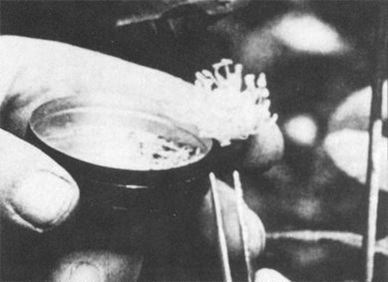

Chambers’ use of image juxtaposition is probably at its best in Hybrid (1967; 15 min), in which documentary footage of atrocities in Vietnam is intercut with images of a gardener pollinating a rose bush. A tree being planted is married to shots of soldiers and bomber jets. Blindfolded Vietnamese prisoners to be executed are followed by closeups of the rose bush being pruned. Casual destruction of nature and human life? Colour footage of roses in bloom are then incorporated with documentary footage of badly maimed or deformed people. This was the film which started the exodus of viewers. And true, it is hard to watch because of the grisly war footage, but that makes this picture all the more powerful. This could be read as a parable of the purity of nature (with its cyclical death we see scenes of winter followed by a spring rebirth) which is interrupted by the atrocities of mankind. Plus, it is a subtly sarcastic metaphor of the beauty of blood red roses versus the blood spilled by humans. And as the hippies used flowers as a symbol of peace, this imagery is also telling.
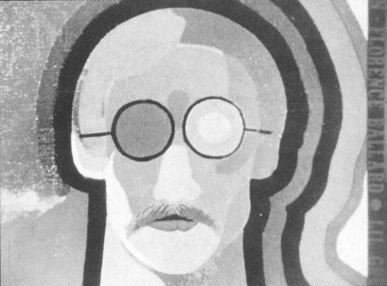
R34 (1967; 30 min), a “documentary” of his friend, fellow painter Greg Curnoe, another important figure of the London art scene, is about as far removed from documentary tradition as one could get. Narration, such as it is, is delivered in the opening (yes, after some homemade credits, which nonetheless seem to capture the material). Chambers adapts a collage-like structure to capture the collage work of Curnoe. Those who know nothing about Curnoe’s work will leave the screening with probably little more insight than the fleeting glimpses of the man’s art which adorn this movie. At thirty minutes long, it is actually too long, because Chambers only wants to take the essence of Curnoe and graft that into his own structure of filmmaking rather than tell us why we should be interested in his work. To be sure, we see some footage of the artist at work, as well as some intimate extreme closeups of his work -namely collages of “garbage art” with found things like tickets, ads, etc. However, Chambers seems to be more interested in fitting that into his own overall big picture. The problem is, we don’t know what that big picture is! For this reason, R34 is the least interesting of all his films. It’s anyone’s guess why human and animal sounds are heard on the soundtrack. Is he trying to say that Curnoe’s interior world is his own universe? The film also seems to be guided by obliquely shot, extremely grainy black-and-white footage of Curnoe exiting a door. Is this an attempt at showing the cyclical pattern in Curnoe’s life? He will be back tomorrow to continue create his little worlds on canvas? It was a wise ploy to treat his film on a collage artist as a living collage, however, we’re never certain if these juxtaposed images and sounds are supposed to mean anything else than that.

For his most famous short, Circle (1969; 28 min), Chambers would go to the same spot in his backyard at 10AM every day for a year, and shoot with the same aperture. Each “day” is four seconds of film in the final cut. This is essential Chambers, as once again he is making a film about a cycle of life. However, once again, he adds a curious home movie touch, and never more alarmingly than the slipshod opening with black-and-white footage of Chambers swinging the camera around in his house. These personalized bits seem to be a subtle way of making them look like projects from the heart. However, this overlong segment really serves no purpose, other than to purposely distance the viewer from the material. Chambers seemingly want us to be clinical about his films. It is a Brechtian approach so we will not lose ourselves in the film, and will always be aware of its meaning. Circle forces the viewer to question what criteria is involved in experimental cinema. It was perhaps unwise of Chambers to shoot every day at the same exposure. There is really no excuse for burned-out, or unfocused images. The point is already made; this isn’t helping any. Moments like these make me wonder whether technical crudity in the avant-garde is really an aesthetic choice or simple neglect. With this year-long camera setup, we see the slow but catastrophic changes in nature, and the Zen-like notion that things remain constant even though they change.

As admirable as Chambers’ shorts are, one still has reservations about them. However, his feature, Hart of London (1970; 79 min), is a truly remarkable piece of work. Unquestionably it is his masterpiece, and a milestone in the avant garde. What most strikes one about this picture is the layered images. Chambers canvassed for people to donate any home movie footage they may have had about London, and then sometimes he would scratching away at the emulsion on the film so that another image would show through it. This is a primitive way of creating such effects, but as we have seen, Chambers enjoys taking a primitive, deconstructive approach to the filmmaking process. Nonetheless, the results perfectly suit the material.
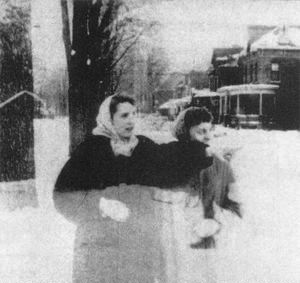
Once again we open with credits scrawled out on a notepad, which makes sense, as this is a sort of elemental love letter to his beloved London. The first sequence actually unfolds like a narrative (thanks of course to the footage afforded him), as the natural and concrete worlds subtly fuse with images of a stray deer in a suburban backyard and the comical reaction shots of such onlookers as the mailman). Then we see a series of layered historical images: people, cars, and old buildings, especially the Nabisco factory. Then the soundtrack fills with the noises of running water during a segment of kids playing in the snow, a horse driving a plough, and flooded areas due to melted snow. Once again we see a harmonium of people and nature.
Then the tone suddenly shifts. The film’s notorious slaughterhouse footage of goats being dismembered is intercut with images of a baby (and even microscopic shots of embryos). This passage is quite plain: death happens, life goes on – shown in a rhythmic pattern that observes with-out attachment. Then the film becomes comic, with kids playing at the beach, and the police helping people out of icy water (it looks like they dropped in on a Polar Bear Club event). Some of this sequence is presented in fast-motion, to turn the proceedings into a weird Keystone Kops routine. Once again we see more urbanization via trains, and footage of towers falling (evidence of mankind’s self- destruction?). This is followed with many shots of domesticated animals (dogs, budgies). Finally, in a sequence with a sound-track of goose calls, kids are feeding deer (with the inclusion of dad directing the kids on the soundtrack). Then a circular pan of a natural setting, with the audio: “You have to be very careful”.
This remarkable treatise on man’s love-hate relationship with the natural environment encompasses the life cycle and the juxtaposition of images in Chambers’ previous shorts. At last he has brought his creative powers to fruition with a hypnotic, overwhelming piece of art.

Originally published in Vol. #1, Issue #8.
Greg Woods

Greg Woods has been a film enthusiast since his teens, and began his writing "career" at the same time- prolific in capsule reviews of everything he had watched, first on index cards, then those hardcover dollar store black journals, then an old Mac IIsi. He founded The Eclectic Screening Room in 2001, as a portal to share his film love with the world, and find some like-minded enthusiasts along the way. In addition to having worked in the film industry for over two decades, he has been a co-programmer of films at Trash Palace, and a programmer/co-founder of the Toronto Film Noir Syndicate. He has also written for Broken Pencil, CU-Confidential, Micro-Film, and is currently working on his first novel. His secret desire is for someone to interview him for a podcast or a DVD extra.