Blood Harvest (USA, 1987) 88 min color DIR: Bill Rebane. SCR: Ben Benson, Leszek Burzynski. STY: Chris Vaalar, William Arthur. PROD: Leszek Burzynski. MUSIC: George Daugherty. DOP: “Ito” (aka- Bill Rebane). CAST: Tiny Tim, Itonia Salchek, Dean West, Lori Minnetti, Peter Krause.
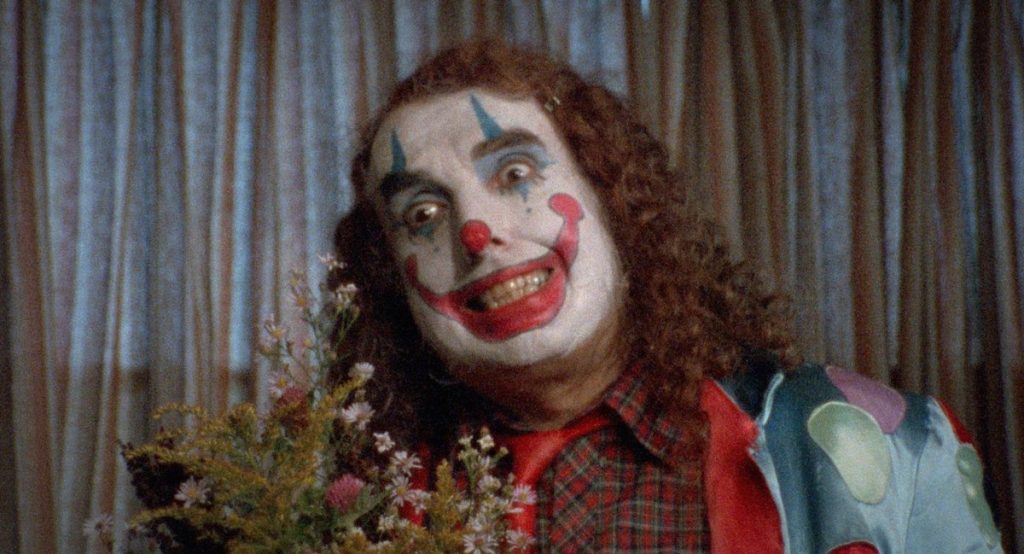
The novelty of this slasher film is the casting of the famous 15-minute celebrity, the ukulele-playing, off-key warbling, counterculture curiosity Tiny Tim, whom director Bill Rebane met at a 1985 Wisconsin “oldies” musical revue, and then began this project with Tiny Tim in mind. In this film, Tim plays Merv, whose psychological reaction to his parents’ death has him now wearing clown makeup, singing nursery rhymes and hymns. For the role of Merv, Tiny Tim more or less taps into his famous persona: the overgrown man child whose childlike singing and ukulele playing illustrates the juvenile trapped in an adult’s body. Merv, who now dubs himself The Marvelous Mervo, stopped growing psychologically after that trauma experienced during his youth, and is now cared for by his brother Gary (Dean West).
Gary is a former high school sweetheart of Jill Robinson (Itonia Salchek), now engaged to her college beau, Scott. She has returned to her home town to visit her parents, only to find them missing. The family home is littered with inflammatory graffiti, and she receives bricks through windows and threats on the telephone. Jill’s father is a banker who has foreclosed numerous farm properties, thus vilifying her family name in the area.
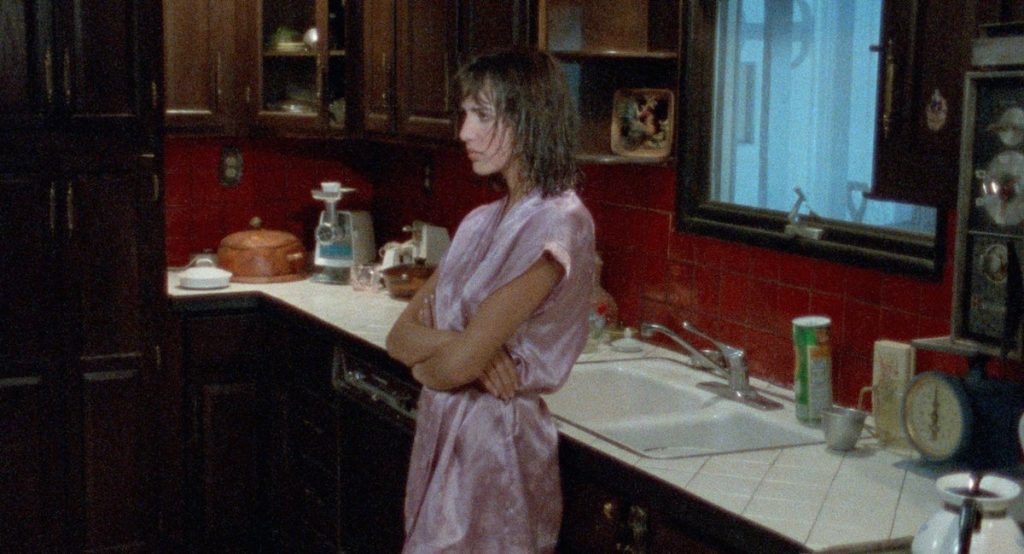
Those who hate Rebane’s earlier pictures usually have good words for this film, and rightfully so. He has shed the playful innocence of his earlier work, and made his one and only “modern horror” film, with ample doses of gore and nudity that were requirements of the day, and a previously unseen maturity. It seems that Rebane has “grown up”, and this tone surely sets the film in motion.
From the opening, this is a very well made mood piece that once again is set in rural Wisconsin, but never in his works has that landscape been so bleak. This is a vivid snapshot of a post-Reagan heartland, with empty buildings and rampant unemployment. The grainy film stock and cinematography perfectly enhance the melancholia and despair: these set pieces give the essence of faded photographs- vanishing memoirs of times we cannot get back. Rebane’s simple but effective visuals, use of canted angles (to capture the dementia) and assured editing (especially the jump-cutting) further make this an arresting psychological study. Rebane’s compact storytelling is on fine display here, in his favourite device of a voiceover summarizing in the first few minutes the events that culminated into our protagonist’s current situation.
As the camera tracks with Jill walking through her empty town, we hear a previous telephone conversation with her mother about her coming home. In B-movie world, a voiceover is often employed as a money-saving device to explain away subplots instead of filming them. However, this moment actually enhances the material. Jill’s parents are invisible to us- they have vanished from the present, much like the livelihoods of many townsfolk.
Despite the novelty value of Tiny Tim’s casting, his bizarre character is (thankfully) used very sparingly, almost like a Greek chorus to the narrative, with his childlike nursery rhymes, and even prayers for past sins, even though he often intervenes in Jill’s life. It seems more than one character in this spare melodrama has crosses to bear.
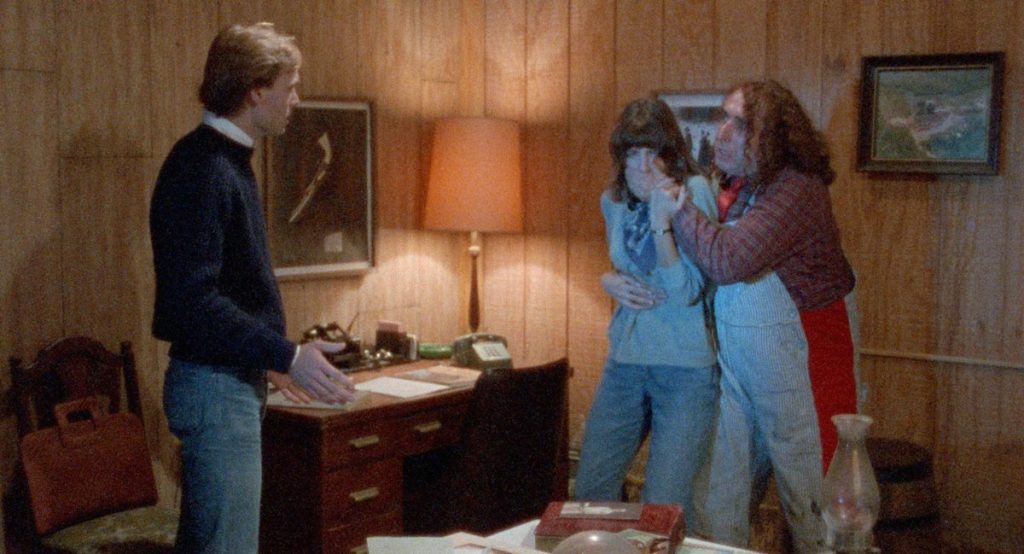
In this perverse look at Americana, there are also moments of black comedy, in such subtleties as the ineffectual sheriff who wears a baseball uniform under his police jacket, insinuating that he’d rather be pursuing a Great American pasttime than investigating threats against a person who isn’t liked by the community. What starts out as an effective mood piece eventually becomes a cat-and-mouse thriller. People who drop by Jill’s house eventually suffer the same fates as Merv’s parents of long ago: their throats are slit, and they bleed to death while suspended by rope in the nearby barn that, curiously, Jill never investigates. The film isn’t so much a whodunit (as one can easily pick out the killer’s identity early on), but more of a psychological game as Jill is being robbed of loved ones, much the same as people in the area have been robbed of something or someone cherished to them. And while the movie has completely given itself over to slasher conventions by the final third, and that the climax is about fifteen minutes too long, for a change we don’t mind as it is surprisingly well made.
When did Bill Rebane’s work mature so much? The auteurist would like to think that this was his response to the deterioration of rural communities in the era of Farm Aid and Reaganomics. Rebane retaliated with an angry piece about regret and loss, even though the movie eventually becomes slasher movie territory.
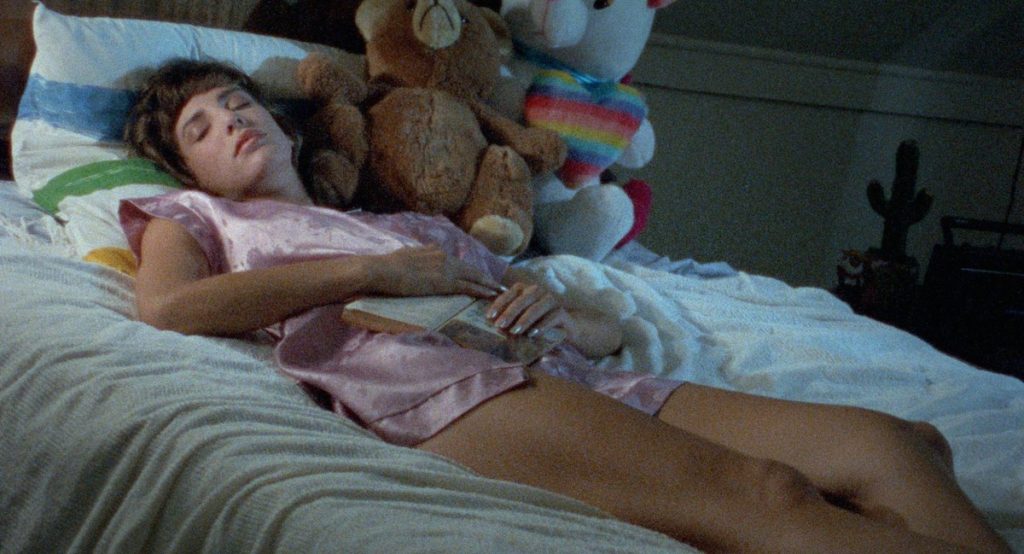
Blood Harvest at least doesn’t present us with a heroine who cowers at danger. Itonia Salchek, in her only screen role, obviously fills the physical requirements of the role with the many nude scenes (this film is as much about desire as dementia), but capably rises to the psychological demands of playing a character who eventually becomes unraveled.
Fittingly, Bill Rebane’s last horror film is his strongest. This is a proud example of what makes regional filmmaking so special. We are given a glimpse of people and places not seen in mainstream genre fare, and a vivid sense of its unique location. Although Blood Harvest was seen on VHS, Rebane eventually released his director’s cut, under his preferred title of The Nightmare, to DVD courtesy of Retromedia. Vinegar Syndrome has since released it to Blu-ray. (I’m uncertain if it is the same cut.)
Updated from its original publication in Vol. #1, Issue #24, excerpted from a larger piece on Bill Rebane. Much of the article has been dispersed accordingly in reviews of the films that have now been released on Arrow’s amazing box set, Weird Wisconsin: The Bill Rebane Collection.
Greg Woods

Greg Woods has been a film enthusiast since his teens, and began his writing "career" at the same time- prolific in capsule reviews of everything he had watched, first on index cards, then those hardcover dollar store black journals, then an old Mac IIsi. He founded The Eclectic Screening Room in 2001, as a portal to share his film love with the world, and find some like-minded enthusiasts along the way. In addition to having worked in the film industry for over two decades, he has been a co-programmer of films at Trash Palace, and a programmer/co-founder of the Toronto Film Noir Syndicate. He has also written for Broken Pencil, CU-Confidential, Micro-Film, and is currently working on his first novel. His secret desire is for someone to interview him for a podcast or a DVD extra.