
Blood from The Mummy’s Tomb (UK, 1971) 94 min color DIR: Seth Holt, Michael Carreras. SCR: Christopher Wicking, based on The Jewel of Seven Stars, by Bram Stoker. PROD: Howard Brandy. MUSIC: Tristram Cary. DOP: Arthur Grant. CAST: Valerie Leon, Andrew Keir, Mark Edwards, James Villiers, Hugh Burden, Aubrey Morris, George Coulouris, Rosalie Crutchley. (Hammer)
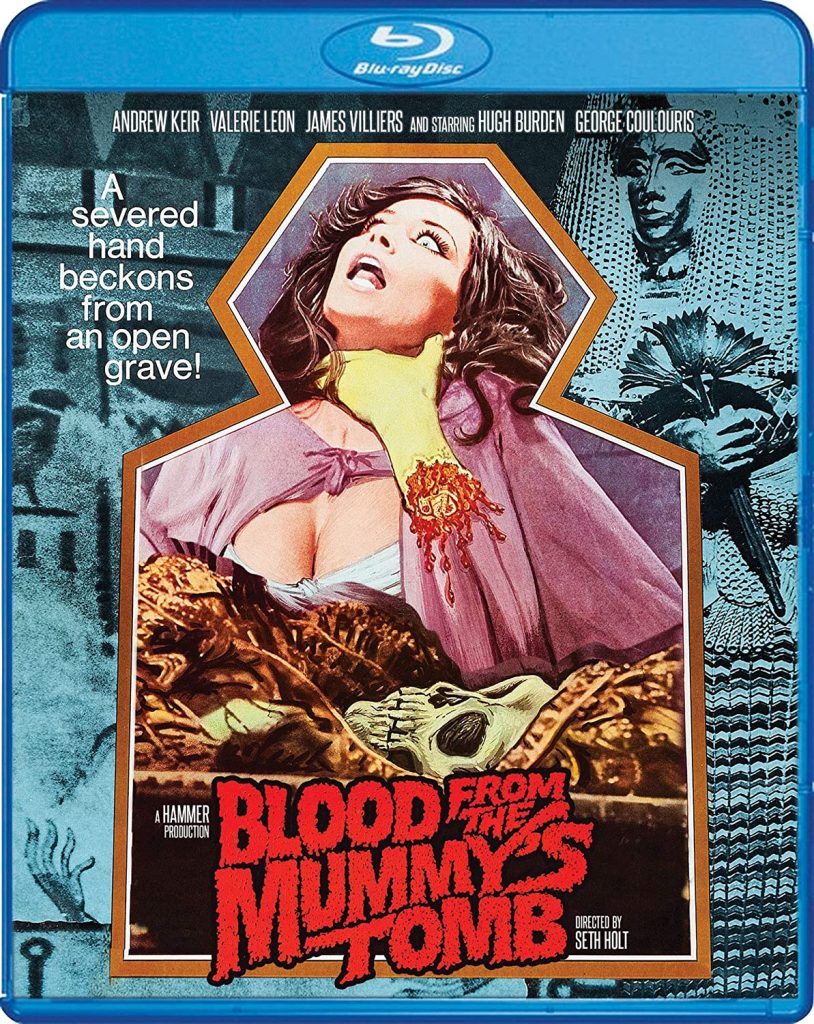
A few years back, a horror podcast had asked listeners to send in the title of their favourite Hammer horror movie. The results were not as obvious as one might think. To be sure, many votes went to perennials like Horror of Dracula or Quatermass and the Pit, however there were many titles which received only one vote, including Blood from the Mummy’s Tomb. I wrote that one in.
Perhaps my reason for picking this title is rather biased, because this was the film to turn me on to horror films. Just a few days after our household had our first VCR, I was testing out the timeshift recording. Blood from the Mummy’s Tomb was scheduled late one Sunday night, as part of the “Science Fiction Horror Night” programming on -pause, sigh- The Cat’s Pajamas, the all-night movie show on Buffalo’s WGRZ. The synopsis for the film sounded interesting, so I set it up to record. And after watching it the next day, I was hooked. From then on, I’d catch every horror film I could on the network dial, especially whatever offerings The Cat’s Pajamas would offer every Sunday night, in addition to checking them out from the town’s several video stores.
In 2001, Blood from the Mummy’s Tomb had been released to VHS and DVD by Anchor Bay, just when The Eclectic Screening Room had made its first public appearance. I didn’t have a DVD player yet, but picked up the VHS. (The film was reviewed in Issue #3 of my little publication.) Since then, the Anchor Bay DVD went out of print, and was sold on the secondary market for ridiculous mortgage payment money. I held out, and now the film is available to Blu-ray thanks to Shout! Factory’s Scream factory label. Its release fittingly coincides with ESR trying to make a comeback online. Upon revisiting the film on Blu-ray after so many years, and for that matter, after having seen many more Hammer films in the interim, I still believe what I wrote in to that podcast.
Hammer was renowned for their horror films with rich Gothic atmosphere, and a more adult approach than its American contemporaries, with more explicit violence and sexuality. Their niche was formed in several horror classics like The Curse of Frankenstein (1957), Horror of Dracula (1958), The Mummy (1959) and The Curse of the Werewolf (1961). One might say that by 1971, however, they had resurrected Dracula or Frankenstein once too often. Their films were becoming derivative, and the screens were flooded with copycat films by rival studios like Amicus or Tigon. And then Hammer released this superb adaptation of a lesser-known work by Dracula author, Bram Stoker: The Jewel of Seven Stars. (This 1903 novel was also the source for the 1980 Charlton Heston movie, The Awakening, which I still haven’t seen.)
The film opens in ancient Egypt, where the evil queen Tera is being laid to rest. A key to her power was the ruby ring on her finger, with a design of seven stars embedded in the jewel. The people laying her body to rest cut off that hand with the ring, and throw it away, symbolically destroying the evil. After sealing the tomb and leaving it unmarked, the burial party dies in a bizarre windstorm. A cutaway reveals that the severed hand is crawling around, still “alive”…
Cut to modern day, as Margaret (also Valerie Leon) awakens screaming, having just dreamed the previous scene. Her father Dr. Fuchs (Andrew Keir) comes in to comfort her. “Don’t worry”, he says, “it will soon be over.” What will?
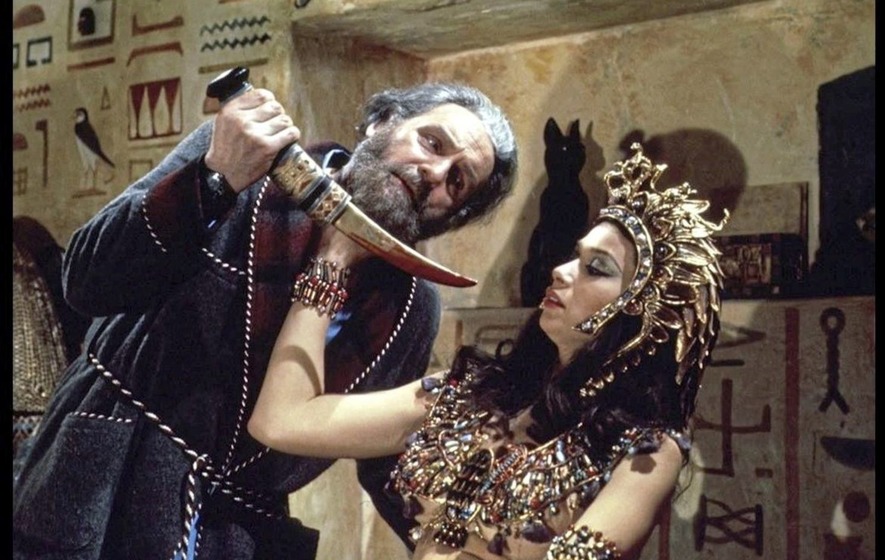
Fuchs was among the expedition which discovered Tera’s tomb. Her body was found perfectly preserved, and nearby the sarcophagus is seen the severed hand that had made it to her side. At that very moment, half a world away, Fuchs’ wife dies giving birth to their daughter Margaret, who grows up to have a striking resemblance to Tera. (Valerie Leon plays both roles.) Now, Tera’s body rests in the doctor’s basement, where he attempts to reconstruct her tomb. The remaining touches are to retrieve some objects from the tomb currently in the hands of his former colleagues, and to present Margaret with a gift in advance of her birthday… a ruby ring. “Wear it always.”
The former archaeologists now have lives more diverse than any class reunion. Berrigan (played by American expatriate George Coulouris) is now in an asylum, Professor Dickerson (Rosalie Crutchley) currently doles out psychic advice, and in the shadows is Corbeck (James Villiers), “friend of the family”, who has been patiently awaiting the resurrection.
Tera’s soul is acting out in Margaret’s flesh, collecting skulls and statues of asps and cats, from her father’s former associates, having no control over the subsequent fates these people have- all related to the objects they have hoarded all these years. Even those closest to Margaret -her father, her boyfriend Tod Browning (!) (Mark Edwards, in his film debut) – are threatened by what possesses her. The film ends in a climactic resurrection, an ensuing battle, and still leaves us with an uneasy resolution in the final credits (the only time this mummy movie shows someone in bandages).
The movie is of its time with snippets of nudity and bloodletting (primarily Tera’s gaping wrist and some gashed throats) and yet there is an old-fashioned approach to the material. The freaky death scenes – shadows of a cobra cast onto a wall of Berrigan’s cell, a closeup of a cat statue while lightning flashes behind it, as scratches emerge on Dickerson’s face – are presented in quick cuts, and imaginative mise en sc`ene to leave much to the viewer’s imagination.
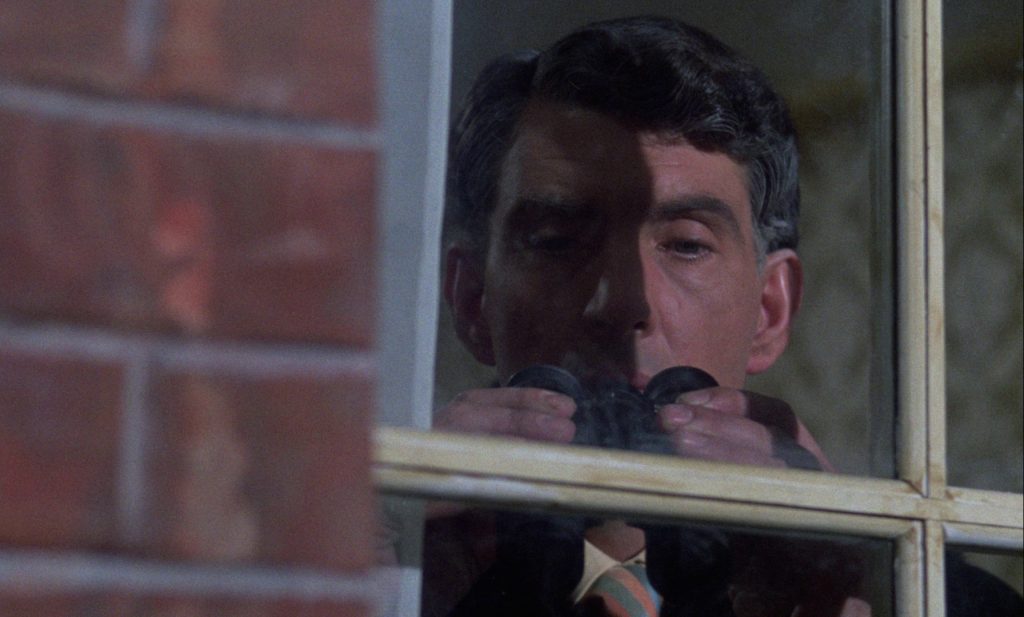
The story is engaging on its own, but the filmmakers make this a complete experience, with many added visual touches. There is much attention paid to detail: a recurring image is of course the seven stars (arranged like Ursa Major or Minor), seen in the sky, a crystal ball, even in buttons on a coat! The film also has a rich atmosphere of shadows and fog, as part of Hammer’s calling card. The mood is also helped immeasurably by the superb music of Tristram Cary, lending a creepy atmosphere with its long lines played by the string section, and unusual textures of clarinets and sitars added to the mix.
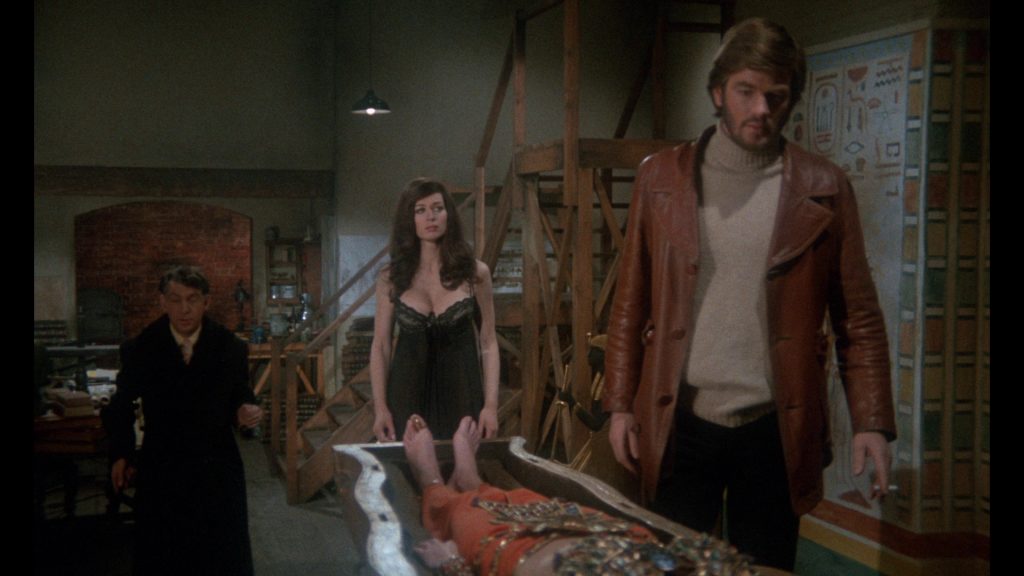
Equally important is the casting of Valerie Leon in the pivotal Margaret-Tera roles. Margaret is often shot in soft focus, with an emphasis on Leon’s wide, dreamy eyes. In the personage of Tera, her sharper facial features are more accented-it really does seem that she is portraying two different people! Alas, this beautiful actress could have been a major scream queen in the 1970s, however much of her career resulted in supporting parts for James Bond or Carry On movies. To be certain, the film is memorable for the two scenes in which she sleepwalks in her nightgown, descending to the basement to look upon the tomb. These moments are unbearably sensual while filmed in slow motion, incredibly dreamlike with the added touches of long shadows and wind (in an interior setting!), which give an unnatural accent to the real world.
Peter Cushing was originally cast as Fuchs, and had already shot a day’s worth of scenes before having to leave the production when his wife, Violet Helene Beck, contracted emphysema and passed away. (One can still find production stills from Cushing’s one day on set.) Then in the final week of shooting, director Seth Holt died, and Michael Carreras was hired to complete the film. And yet, many great films come from troubled productions. The result appears seamless, even with the knowledge of the tragedy surrounding the movie. Steve Haberman, providing the Blu-ray’s lively audio commentary track, posits that had Cushing made the film, one could easily see his old friend Christopher Lee playing the rival Corbeck. However, I’m glad they cast James Villiers, whose marvelously hiss-worthy performance is done in an old-school manner, which lends to the film’s timeless atmosphere: it is movie that at once feels modern and Victorian.
The Blu-ray presents the film with two aspect ratios (1.66:1 And 1.85:1), and also ports over some special features from the previous Anchor Bay disk: The Pharaoh’s Curse: Inside Blood From The Mummy’s Tomb, Curse Of Blood From The Mummy’s Tomb (Interviews With Star Valerie Leon And Screenwriter Christopher Wicking), US and UK theatrical trailers, radio spots, a TV spot and a stills gallery. Lest you think that to purchase this edition is to double-dip, in addition to Haberman’s commentary, the new features are interviews with sound recordist Tony Dawe and camera operator Neil Binney. The film’s lush production design and colour are upheld beautifully. If you’re a fan of this film, or a novice, this Blu-ray is a must for collectors! Of course, my reasons may still be biased…
Greg Woods

Greg Woods has been a film enthusiast since his teens, and began his writing "career" at the same time- prolific in capsule reviews of everything he had watched, first on index cards, then those hardcover dollar store black journals, then an old Mac IIsi. He founded The Eclectic Screening Room in 2001, as a portal to share his film love with the world, and find some like-minded enthusiasts along the way. In addition to having worked in the film industry for over two decades, he has been a co-programmer of films at Trash Palace, and a programmer/co-founder of the Toronto Film Noir Syndicate. He has also written for Broken Pencil, CU-Confidential, Micro-Film, and is currently working on his first novel. His secret desire is for someone to interview him for a podcast or a DVD extra.