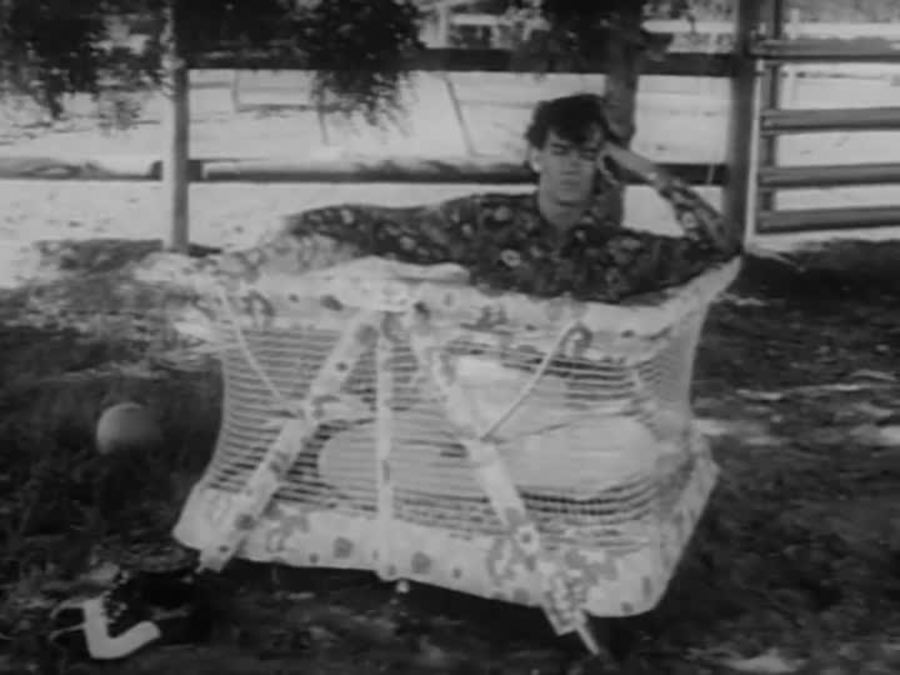
Moment to Moment (USA, 1975) 76 min B&W DIR: Robert Downey. PROD: Raymond Lofaro, Max L. Raab, Bette Wanderman. SCR: Elsie Downey, Robert Downey. MUSIC: Arica, Jack Nitzsche, David Sanborn. CAST: Elsie Downey, Leonard Buschel, Michael Sullivan, Seymour Cassel, Robert Downey Jr., Allyson Downey, Lawrence Wolf.
Note: for more context, please visit our page on Robert Downey Sr.
After comparative mainstream success with Putney Swope, Pound and Greaser’s Palace, it is ironic (and somehow poetic) that Robert Downey’s next picture is a return to the underground, with a narrative that almost defies description, and that it had only been screened a handful of times before disappearing.
This is a collage film in the most obtuse sense of the word: half-baked sketches and unfinished story ideas are chopped up further, mixed in with each other, so as to make even less narrative sense than they already do! In a few minutes of screen time, we see a restaurant skit, people asking for directions to “Jive”, a guy on a roof talking to God, and people on a park bench; we will return to more of these scenes, in whatever order. For the most part, this film (presumably) exists as a valentine to Elsie Downey, who, as in her previous film for her husband (Chafed Elbows) plays several characters. Downey’s voice rhapsodizes his love for her in the opening credits, in his own brand of wild beat poetry, and throughout Elsie (or, L.C.) is a woman for all men, as a frequent motif is her constantly being chatted up by two-bit hustlers.
Yet when you think that this movie is completely incomprehensible, one begins to see a thread of logic here. A line uttered at the end of one scene has a response to it in the next segment which for all we know, could have been shot years and miles away.
This film (like the works of underground filmmaker George Kuchar) crassly reminds you of how artificial the movie world on screen really is, with a kitchen posing as a restaurant (with piped-in crowd noise), a half-finished spaceship set (which also has a janitor… more than the Enterprise had), and people in paper wigs coming out from the hair dryer. Perhaps the most pivotal moment on screen occurs when characters storm the editing room, much to the surprise of the editor crouched over the Moviola, and shout: “Haven’t you made up your mind yet?”
Thus, one realizes what perhaps Downey is up to… he is trying to create a jazz improvisation with fragments of film, where each scene is a phrase, and thus tries to make endless “call and response” variations with them. Even moments without any plot are revisited again and again: chiefly, we see Elsie turning away from the camera, holding an umbrella and going to open a screen door, with offscreen direction heard (presumably by Downey?). Then she turns to the camera at the doorstep and utters: “I’m Terry, and I love you all.” Thus, the only narrative sense is not in the skits themselves, but in the way they are cut together.
Amidst this picture’s few screenings, it was also titled Two Tons of Turquoise to Taos, which refers to a throwaway line in a throwaway scene with some guys (who have seen way too many Leo Gorcey movies) in a pseudo-gangster plot. Similarly, Moment to Moment refers to a throwaway line in the opening of the movie, but it perhaps makes the most sense in describing this movie. All of these moments from different times are cut together, to simulate the appearance that they are all happening simultaneously… without beginning and without end.
The film itself exists out of time: a collage movie made years away from when this would have been marketable in any way. Yet, in an era when even mainstream films were experimenting with form, this movie goes even a step further. As Downey says in the opening, “In these days to be crazy, you have to be a fuckin’ lunatic.” (He signs himself in the credits as “Robert Downey; A Fool”).
But of all things, Moment To Moment ends up being quite a moving experience. It is a return to Downey’s roots, and a deeply personal movie. With a beautiful score by David Sanborn, it is a shout for artistic freedom (no matter how demented it may be), done with an uncompromising structure, made years after such a thing was fashionable. As with all of Downey’s films, this certainly isn’t for everyone, but if one hangs in there with it a bit, one begins to see the beauty and logic underneath. God help me, I liked this thing.
Originally published in Vol. #1, Issue #14, extracted from an article on Robert Downey Sr. (Update: this review applies only to the 76-minute version that fleetingly appeared on VHS. The Criterion set, “Up All Night With Robert Downey Sr.”, carries this movie in an underwhelming version running less than an hour, perhaps edited to retroactively make the appearance of Robert Downey Jr. seem greater than it is.)
Greg Woods

Greg Woods has been a film enthusiast since his teens, and began his writing "career" at the same time- prolific in capsule reviews of everything he had watched, first on index cards, then those hardcover dollar store black journals, then an old Mac IIsi. He founded The Eclectic Screening Room in 2001, as a portal to share his film love with the world, and find some like-minded enthusiasts along the way. In addition to having worked in the film industry for over two decades, he has been a co-programmer of films at Trash Palace, and a programmer/co-founder of the Toronto Film Noir Syndicate. He has also written for Broken Pencil, CU-Confidential, Micro-Film, and is currently working on his first novel. His secret desire is for someone to interview him for a podcast or a DVD extra.