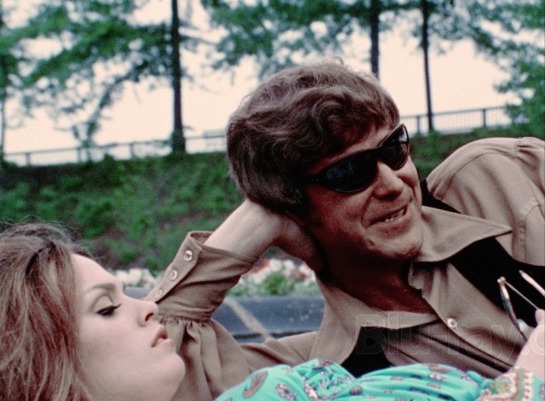
There’s Always Vanilla (USA, 1971) 93 min color DIR-DOP-EDITOR: George A. Romero. PROD: John A. Russo, Russell Streiner. SCR: Rudolph J. Ricci. MUSIC: Steve Gorn, Jim Drake. CAST: Raymond Laine, Judith Ridley, Roger McGovern. (Cambist Films)
After the success of Night of the Living Dead (1968), Pennsylvania’s eternal renegade George Romero then set to work on a trio of films which were quickly forgotten. People once again began paying attention to him upon the releases of Martin (1978) and Dawn of the Dead (1979). Of the trio of films Romero made in the early 1970s, Jack’s Wife and The Crazies have at least been re-released on VHS via Anchor Bay in widescreen format (and The Crazies still isn’t as popular as it should be). Romero’s most atypical film, There’s Always Vanilla, still hasn’t received its due exposure.
Romero himself is one reason why this film remains obscure. It is his own Fear and Desire– he refuses to comment on this film, considering it an embarrassment. Still, thanks to Video Search of Miami’s persistent efforts in unearthing films which have slipped between the cracks, we are able to see this lost film, although the print quality is absolutely horrible. (It appears that Something Weird also carried the film at one point, but I have not seen it, therefore cannot account for the print quality under that label.)
There’s Always Vanilla opened and closed after a week in New York, and then disappeared. However, since the film has been retitled The Affair (which is the title which appears onscreen in the print distributed by VSOM), one suspects it did get another (however meagre) re-release some time later.
But regardless of what George A. Romero would have you believe, There’s Always Vanilla is actually an honest movie about aimless lives. If one were to fault anything of the film, it would certainly be for the naiveté that is so common with counterculture films of the era, and today it’s rather politically incorrect (I cannot imagine a “modern woman” putting up with such an arrogant jerk for a mate).
Night of the Living Dead fans may recognize pretty Judith Streiner as Lynn. (She previously played Judy in the zombie classic, billed as Judith Ridley, before marrying its producer, Russell Streiner.) Lynn is an actress who makes a living in television commercials. Early in the film, she courts the producer of the beer spot she has just appeared in, but he soon leaves her out of frustration due to her mixed signals. (“I don’t know what it is you want”, he says, after his sexual advances become a near-rape then finally resignation.) Between these segments, we are introduced to Chris Bradley (played by Ray Laine), who is an aimless hippie wandering from one existence to another. We see him working for a record company, which he subsequently leaves with the same casualness that one changes a shirt. He meets an old girlfriend Terri Terrific whose child may be his. A rendezvous with his father then results in an all-night party with Terri and her roommate. Then his life intersects with Lynn’s as she (literally) runs into him. In a typically early 70s fashion, they shack up after knowing each other for about 10 minutes. The good times soon grind to a halt, as Chris’ irresponsible behaviour is no longer amusing but unbearable, especially now that Lynn is pregnant.
This film was perhaps marketed as a youth picture (which was in vogue in the early 1970s), but it doesn’t really belong to any genre. These people are not the caricatures that one would see in a hippie exploitation movie of the time (as much as I love those pictures)- one comes away from this film really having lived amongst these characters.
More than many studio films, one really gets a feel for the era. Romero, who also acted as the cinematographer and editor, explores the lively environments that Chris and Lynn frequent. As always, Romero is a master of frame composition and his cutting skills are always exemplary. Despite our contemporary reactions to the two lead characters, this film is nonetheless very exciting to watch. With lots of excellent coverage, an energetic eye for detail and quick cut-ins, one really feels like “you are there”. We are taken through a diverse landscape of muddy brown apartments where much of this drama unfolds, (see how suburban life stifles the carefree ways of the principal characters), as well as noisy, sweaty bars where people look for happiness, and one unforgettable place of squalor where one went for an abortion in the days prior to Henry Morgentaler. With oblique close-ups and crowded frames in nearly every scene, the film also suggests the crazy fast world everyone is caught up in. Whatever Romero’s reasons for disdain over this picture, his own efforts should not be among them.
The greatest liability one could concede is for the screenplay by Rudolph Ricci (who was also part of Romero’s production team on Night of the Living Dead). We have already mentioned the political incorrectness of the picture, but the film’s structure is also problematic. Every so often, we see Chris talking to the camera, as though he is leading the film. These scenes are interesting because they do humanize his character somewhat; he gets to explain his rotten behaviour in some scenes. Also, when one considers the heavy advertising milieu in the film, Chris almost feels like he’s selling himself to us, or that he’s in yet another interview for another stage in his life. But the film is as much Lynn’s as Chris’s, as she is featured in many early scenes in which he is not present. (This is a common structural error in many films that have a wraparound narrative led by one point of view.)
Even so, the screenplay consistently surprises. If we were to ignore the “interview” sequences, this film unfolds much like real life. One is never sure where this is headed. The film is less narrative-driven than character-driven. We see what makes Chris and Lynn tick, and we also see the subtle shades of their characters change when they are finally together. When we think we’ve figured these people out, they surprise us once again. For instance, one late scene features Chris landing a job in the advertising business with amazing ease and no credentials.
There’s Always Vanilla is a consistently fascinating film. It is more interesting than just simply being a curio in George Romero’s career. Perhaps some day someone can restore this film to its proper lustre (with or without Romero’s blessing). What remains is an addictive time capsule of the love generation at the time when freedom began charging its price.
Originally presented in Vol. #1, Issue #4. This piece is left as-is to show the means in which we had to view this once very-hard-to-find film. Since then, it was released as a bonus feature on Anchor Bay’s DVD of Season of the Witch (aka- Jack’s Wife), and is now represented in the Arrow Blu-ray set, George Romero Between Night and Dawn, which collects his three films from the early 1970s. I have since re-watched these pictures, and still greatly admire them. The Crazies has since been remade, so over the years its profile has heightened considerably.
Greg Woods

Greg Woods has been a film enthusiast since his teens, and began his writing "career" at the same time- prolific in capsule reviews of everything he had watched, first on index cards, then those hardcover dollar store black journals, then an old Mac IIsi. He founded The Eclectic Screening Room in 2001, as a portal to share his film love with the world, and find some like-minded enthusiasts along the way. In addition to having worked in the film industry for over two decades, he has been a co-programmer of films at Trash Palace, and a programmer/co-founder of the Toronto Film Noir Syndicate. He has also written for Broken Pencil, CU-Confidential, Micro-Film, and is currently working on his first novel. His secret desire is for someone to interview him for a podcast or a DVD extra.