
Much to the chagrin of the Kubrick estate, we’ve seen his early stuff. Stanley, was all the trouble worth it?
There are short lists of films conducted by every film enthusiast, filled with pieces of cinema they MUST see, even if the titles are hard to obtain. Some of them are in the Holy Grail of Cinema- titles you can only read about, save for being able to find bootleg copies on video, or a rare screening at a college or cinematheque. My first Holy Grail screening was Bresson’s first film, Les affaires publiques, which the nonagenarian director had granted to be shown for one time at the 1998 Toronto retrospective honouring his work. My second was finally being able to see the early work of Stanley Kubrick, which even after his passing, still has a mighty coup trying to suppress the existence of these films.
Kubrick’s first feature, Fear and Desire, opened and closed quickly in 1953. Once the director became an auteur, it made sense that people would want to check out his earlier films, to see how his body of work developed over the years. In his lifetime, Kubrick did anything to frustrate anyone from seeing this film, and his early shorts, because they embarrassed him. In 1994, the Film Forum in Manhattan had a once-in-a-lifetime screening of Fear and Desire, and Kubrick protested loudly over it. However, he was powerless to stop them from screening it, as the print was in public domain. Is it because of Kubrick’s status as a modern visionary that he felt compelled to live up to an image he helped create? Did he want to suppress his early work that would actually display such a thing as human weakness?

Day of the Fight (1949), The Flying Padre (1951), The Seafarers (1952) and Fear and Desire are available in the bootleg video market, albeit in contrasty, ninth-generation dubs. All right, these films are not 2001, but I still like them better than The Shining. To be sure, they have all of the naiveté, lofty ambition and too-heady philosophy that one would expect from a twentysomething director who reached beyond their grasp. It has been said that you can always tell what a director’s style and career will be like from their first feet of film; for instance, Truffaut would always be making Les mistons (which is true- many of his own works are about playful childhood, and filled with sly movie references). So are we seeing the visionary Kubrick in his earliest work? Yes, but he is not yet comfortable with that role.
Day of the Fight is a noble documentary on medium-weight fighter Walter Cartier. It chronicles the day, which ends up with his bout with Bobby James. You see him and his twin brother get up in their little flat, feed the family pet from the breakfast table, and slowly start to see the fighter come alive in his persona, as he begins to train for the night’s event. This 12-minute documentary is quite well-done; Kubrick the director and photographer both certainly have an eye, and this modest film does feature some advanced compositions that would recall the symmetry to be found in his later work. What undoes this film is the superfluously existential narration: “Walter takes communion in case something should go wrong tonight”; “Time has a way of slapping you in the face.”
The Flying Padre is another interesting little documentary (done with all the precociousness one would expect from a 23 year-old) about Father Fred Stockmiller, who must fly his private plane to preach the good word and right the wrongs among people spread out over some desolate countryside. This film also has unintentional laughs because of its soundtrack (and perhaps this is what upset Kubrick). The canned music is that generic, bouncy kind of stuff you saw in every movie in Grade 4, and the narrator is that same clinical reader who talks just half an octave higher to make it sound interesting. Kubrick the director should not have hired Kubrick the writer to assemble these words. He is too esoteric in his narrative. It makes scenes like disciplining Pedro more important than they are, less profound than he would like them to be. But still, this film is noteworthy for its interesting visual ideas.
The Seafarers is a much longer piece (an epic 28 minutes) which is basically a propaganda piece about the seafarers’ union. Sadly, one does not get to view people at sea, but is however informed of how beneficial it is to be among the union. One gets to see the men shoot pool, get haircuts, attend meetings, and even have the right to turn down work and wait for an opening at a favourite port (and does one presume that which has a favourite girl too?). Even those who have retired or are disabled are still considered part of the union body, as is seen where the injured are visited in the hospital and brought their favourite cigars. It is interesting that this is the sole film of Kubrick’s early period that has been endorsed by his estate for a legitimate video release. Actually, The Seafarers is the least of the four films. At this length, the film plods, and even lacks the visual innovation that Kubrick exhibited previously.
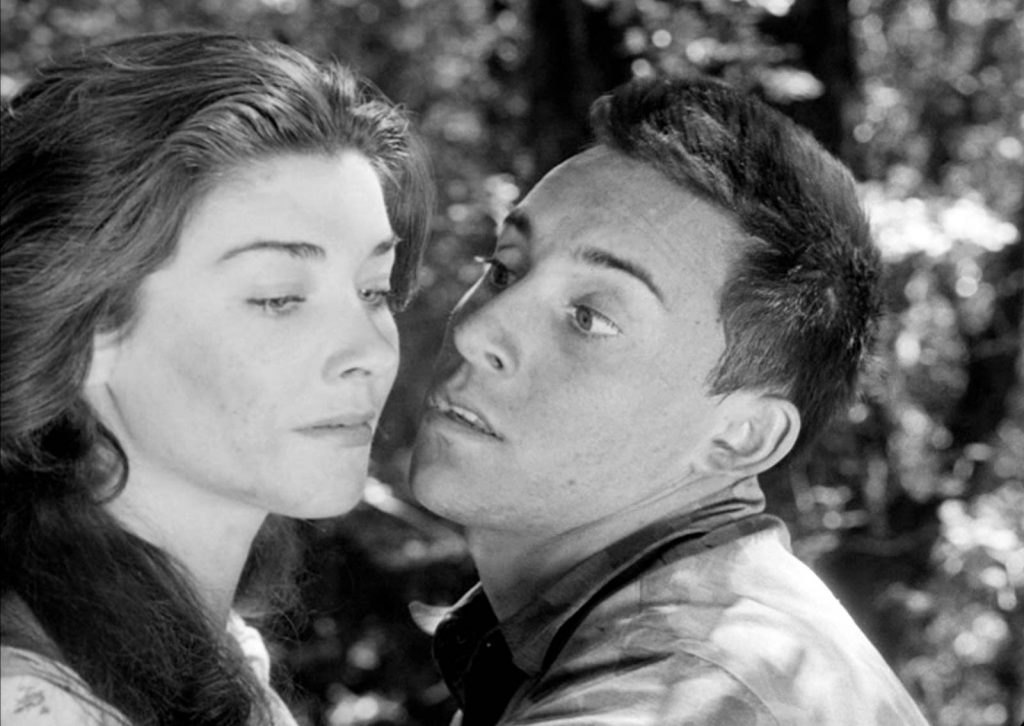
Finally, we arrive at Fear and Desire, which is probably one of the most sought-after of films, partially due to Kubrick’s own suppression of it. Really, there is little to be embarrassed about. Clocking in at over an hour, this is a tight little film about a quartet of American soldiers caught behind enemy lines who decide to knock out an enemy compound on their way to freedom. Some scribes who have seen an underground copy of it justly criticize it for its naiveté. The dialogue is silly, the narration overreaching, but it is still an imaginatively done piece. Although it suffers considerably from its bargain-basement production (certain cutaways are repeated to pad the length), it’s still not bad for a bare bones production shot in a New York countryside. The film has its flourishes of obscure framing and jagged cutting to add some effect.
Fear and Desire is actually an interesting companion piece to Kubrick’s other war films: Paths of Glory, Dr. Strangelove and Full Metal Jacket. All of these chronicle one’s descent into madness during combat. Fear and Desire features 22 year-old actor Paul Mazursky (later a great director) who just goes bonkers while he is holding a woman captive. It is one of the most berserk performances in recent memory. Kubrick the 25 year-old over-reaching boy existentialist starts to creep in by having the two principal players do double duty as the American soldiers and as the enemy commanders who sit around, drink and mutter about the horrors of war. You may not realize these are the same actors, so the doubling works. I am uncertain if this bizarre casting was a budgetary decision or if it was an attempt at symbolism to show how both foes really are the same kind of people: all have their honourable and reprehensible sides.
Overall, these films portray a side of Kubrick that one may not realize existed (or at least, he made sure one did not). It has been written that Kubrick was praised far too early in his career before he really had a chance to develop his skills. Make no mistake: as many people who laud him as a filmmaking messiah are matched in number by those who are frustrated by his ignorance of storytelling and his pretentiousness. After seeing these films, I am convinced that Kubrick suppressed them more because they are portraits of an artist as an uneasy young man. If they were kept out of view, his reputation as a superhuman would be secure. I guess someone forgot to tell him that it was okay to screw up in your 20s; that’s what that age was for… or was that too human?
Still, I guess one cannot chastise Kubrick for acting the way he has about keeping the vault door shut on these films. Just because one has a reputation as a great artist, does that mean the public has the right to see everything that person has made, against their wishes? It is a point more prevalent than one thinks. Kenneth Anger had made other films than what comprises his “Magick Lantern” cycle, yet he personally withdrew them from circulation, allowing the other works to speak for his reputation. Author Sinclair Ross had a manuscript for a second novel in his desk for decades- purposely hiding it there because he felt it was unworthy of publication: does that mean we should get to read it if we want to? J.D. Salinger, it is said, has completed twelve other novels, which are kept in his little retreat. In the age where all of a medium-weight punk band’s B-sides, alternate tracks and unreleased material are put out for the consumer, it makes sense that this completism exists. Still, I think Kubrick was trying to act like Salinger- his early films weren’t that bad. But if you create the mystique, you have to be prepared for the outcome.
Originally published in Vol. #1, Issue #3. Since then, Fear And Desire has been released to DVD and Blu-ray by Kino Video. How times change. Indeed, one often had to rely on multi-generational bootlegs of films that were near impossible to find. If YouTube had been a thing even ten years earlier, a lot of chromium dioxide would’ve been saved.
Greg Woods

Greg Woods has been a film enthusiast since his teens, and began his writing "career" at the same time- prolific in capsule reviews of everything he had watched, first on index cards, then those hardcover dollar store black journals, then an old Mac IIsi. He founded The Eclectic Screening Room in 2001, as a portal to share his film love with the world, and find some like-minded enthusiasts along the way. In addition to having worked in the film industry for over two decades, he has been a co-programmer of films at Trash Palace, and a programmer/co-founder of the Toronto Film Noir Syndicate. He has also written for Broken Pencil, CU-Confidential, Micro-Film, and is currently working on his first novel. His secret desire is for someone to interview him for a podcast or a DVD extra.