Who’s Singing Over There? (Yugoslavia, 1980) DIR: Slobodan Sijan. PROD: Milan Zmukic. SCR: Dusan Kovacevik. MUSIC: Vojislav Kostic. DOP: Bozidar Nikolic. CAST: Pavle Vujisic, Dragan Nikolic, Danilo Stojkovic.
The late, great Jay Scott, film critic for “The Globe and Mail”, also lent his talents to the television medium for Film International, which showed foreign films every Friday night on TVO. No doubt this venture exposed international cinema to a lot of people in southern Ontario who would not normally have access to it. Even more, Film International offered immeasurable insight into foreign film which still remains elusive- even to those in the big city.
In the late 1980s, before this show became a weekly entity, it was broadcast annually in the spring as a six-week series. One of the true joys of the six-week seasons was the superb Yugoslavian film, Who’s Singing Over There?, considered by many to be the finest film made in that country. In North America, the cinema of the nation is represented in the cinema (not inaccurately, mind you) of Emir Kusturica (Underground) or Dusan Makavejev (WR: Mysteries Of The Organism); but I’m told by a native of the former Yugoslavia that this film was a phenomenon in its own land. Cardboard cutouts of its characters were displayed in theater lobbies. The movie was not commercially available in this continent: happily, I still kept my copy, taped from Film International.
For his maiden effort, director Slobodan Sijan was inspired by, of all things, Roger Corman biker movies and Russ Meyer’s southern-fried sexploitation films. This funny, surreal, bawdy, harsh, violent road movie has trademarks of Luis Bunuel, transposed to an Eastern European milieu, with the emphasis more on politics than religion.
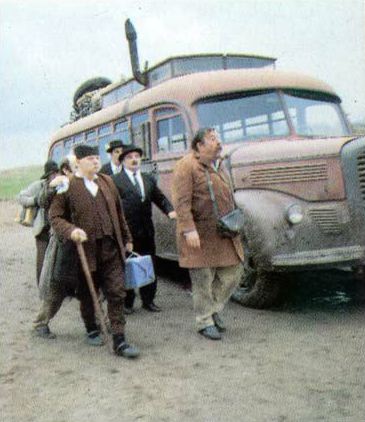
The film opens on April 5, 1941- one day before the Nazis would bomb Belgrade. A busload of eclectic characters, as fate would have it, are traveling to that city. The old bus owner and his klutzy son (who does most of the driving, sometimes even blindfolded) are joined by a fancy dan singer, a hunter (whose gun always fires at the least appropriate times), a retired Army veteran, a salesman, a newlywed couple, a TB sufferer, and two gypsy musicians.
Four times in the film, the musicians break from the story to sing to the camera- chiefly to advance the plot. The fourth wall device is not new by any means, but it makes perfect sense in context with the rest of the film, as we are seeing this film through their eyes. (They appear in every scene.) A consistent verse in the gypsies’ sung narration is “But to have dreamt it all.” As the drama escalates with hatred (especially towards them), they wish that this voyage was nothing but a dream. By the same token, the movie itself has a dreamlike, unnatural look, almost entirely shot in hazy grey overcast. This compliments the metaphor of war, itself an unnatural act, but a fact of life. Ironically, these two are the sole survivors at the end once a bomb drops on the bus, and the grey haze of the day is replaced by grey smoke from which they emerge, still wishing this life was but a dream.
This simple premise is worthy of Bunuel. As in Mexican Bus Ride or The Discreet Charm Of The Bourgeoisie, their destinations are constantly frustrated by outlandish events. Here, in most cases, the delays are politically motivated. Initially, the road is blocked by the army, so the bus has to detour over a farmer’s field. The property owner, who is suing the government anyway, makes back lost revenue owed him by the state by charging people to travel across his land because of the detour. A bridge is out of service because it was weakened by the army carrying cannons over it. Then, the bus is commandeered by the army: even the son gets enlisted!
As in Bunuel, the whole film has a subtly subversive tone. When the funeral procession appears, the dapper singer throws a stone at the horses drawing the casket to make them go faster– suddenly the procession on foot is running to catch up to it! It is also at this point that the immature newlywed groom decides to takes his bride to a meadow to consummate their marriage! Naturally, all the passengers come to watch- their “holier-than-thou” behaviour gives way to the primitive beings they really are.
Another delightful moment occurs when the roly poly man falls from the bridge that has been weakened by drawing cannons, and the passengers are unable to find his body. They put his bowler hat on his knapsack to mark his place on the bus! When the vehicle later stops to have lunch by the river, the man is spotted floating in the current! Alas, he runs into more bad luck when the hunter shoots him in the rear end while trying to bag a rabbit.
The old bus owner constantly grumbles that he must follow regulations to the letter or get reported. (He even forces the hunter to walk another 200 metres to be picked up at the next designated bus stop, instead of taking him in right then.) The army is continuously affecting their route- one man mutters that the impending German takeover would be a good thing because “at least we would have some order over here”.
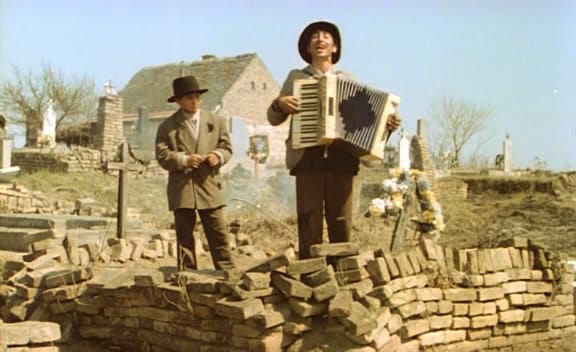
The symbol of “money as power” permeates the journey. “Following regulations”, the older bus driver rechecks everyone at a certain point to make sure that they still have their ticket stubs. The old farmer won’t let them cross his field without paying -the wizened old man’s goliath sons start to let the air out of his tires until he does- and then in order to leaven the pressure from that deflated wheel everyone has to stay on one side of the bus. This is already after they have been herded to the front after the old man has blocked off the last row of seats to put in pigs. (“I make more on one pig than on all of you.”) The gypsy musicians are always being accused of theft- the dapper singer makes sure the old man’s wallet doesn’t fall out of his pocket before the gypsies lift it. However, the owner of the bus pays them to play music while he sells food and drink to the passengers, and even promises a bonus if he sells everything! And of course, in the final fateful conflict, once a man’s wallet does disappear (it actually drops on the road), the gypsies are accused of theft and beaten up. That the gypsies are constant butts of their derogatory comments are ugly reminders of what would ensue in World War II, and even the genocide of the former Yugoslavia in the 1990s.
In this one day, we get to see the characters evolve. The foppish son of the bus driver becomes “a man” (he surprisingly shows pride for his son). The suave singer puts the moves on the lovely young bride and tries to convince her that her new husband is a waste of her life. And the hunter… well, he’s just trying to get back on the bus.
In this microcosm, people squabble pettily over money, race, religion and class. However, all of that is shockingly silenced by a bomb. The violence towards the gypsies is slowed as the sound of offscreen planes gets louder.
What Eastern European cinema I’ve seen appears timeless. Although set in the early 20th century, if you take away the bus and planes, little of the film seems modern. People still live off the land, and the road is merely two little brown lines. Its primitive feel is enhanced by the illusion that it was shot merely with available light, further adding to its gritty feel.
Who’s Singing Over There? is a very funny, quite surreal black comedy, yet also a harsh portrait of human cruelty. With such an ambitious story line, scenes of hilarity and pathos, it is a moving portrait of ordinary citizens always living under the threat of combat. Twenty-odd years later, it is a shame that we still can’t find Who’s Singing Over There? under the “Foreign” section at the video store.
Updated from a review previously published in Vol. #1, Issue #9. This originally ended with: “This may be one of the greatest films you will never see”, which may have been the case before YouTube became a thing. As of this writing, the film is available to view there.
Greg Woods

Greg Woods has been a film enthusiast since his teens, and began his writing "career" at the same time- prolific in capsule reviews of everything he had watched, first on index cards, then those hardcover dollar store black journals, then an old Mac IIsi. He founded The Eclectic Screening Room in 2001, as a portal to share his film love with the world, and find some like-minded enthusiasts along the way. In addition to having worked in the film industry for over two decades, he has been a co-programmer of films at Trash Palace, and a programmer/co-founder of the Toronto Film Noir Syndicate. He has also written for Broken Pencil, CU-Confidential, Micro-Film, and is currently working on his first novel. His secret desire is for someone to interview him for a podcast or a DVD extra.