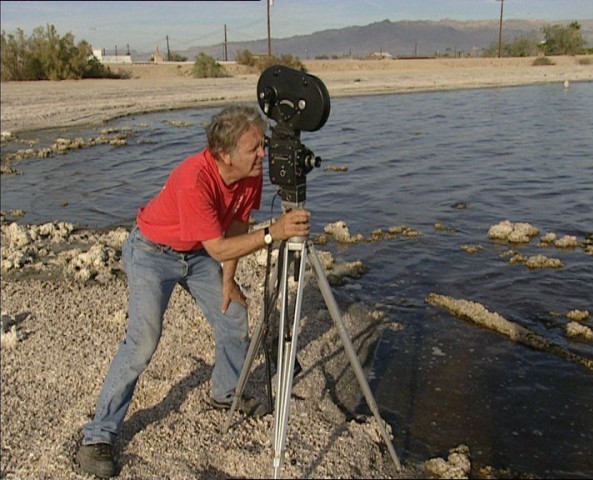
“Film grew up too quickly.”
This is a telling quote, said early in James Benning: Circling the Image (2003), a remarkable German TV documentary, directed by Reinhard Wulf. For the past four decades, James Benning has been making films with the simplicity of those made by the Lumiere brothers over a century ago. That is to say, he points the camera and films an image for as long as the celluloid continues to run through the film can on his Bolex.
In a climate where movies are full of editing, and onscreen movement, Benning takes filmmaking back to the most basic principle of cinema- the simple act of recording an image, and allowing that image to stay on screen long enough for people to immerse themselves in the composition as much as one would a photograph or a painting, or as Benning himself puts it, “so you have time to meditate on the light”. This documentary is valuable for being the rare cinematic study of this true iconoclast. While revered in (small) film circles for decades, James Benning’s work is perhaps more lionized than seen. It isn’t without a bit of irony that this documentary is probably as hard to see as Benning’s own films.
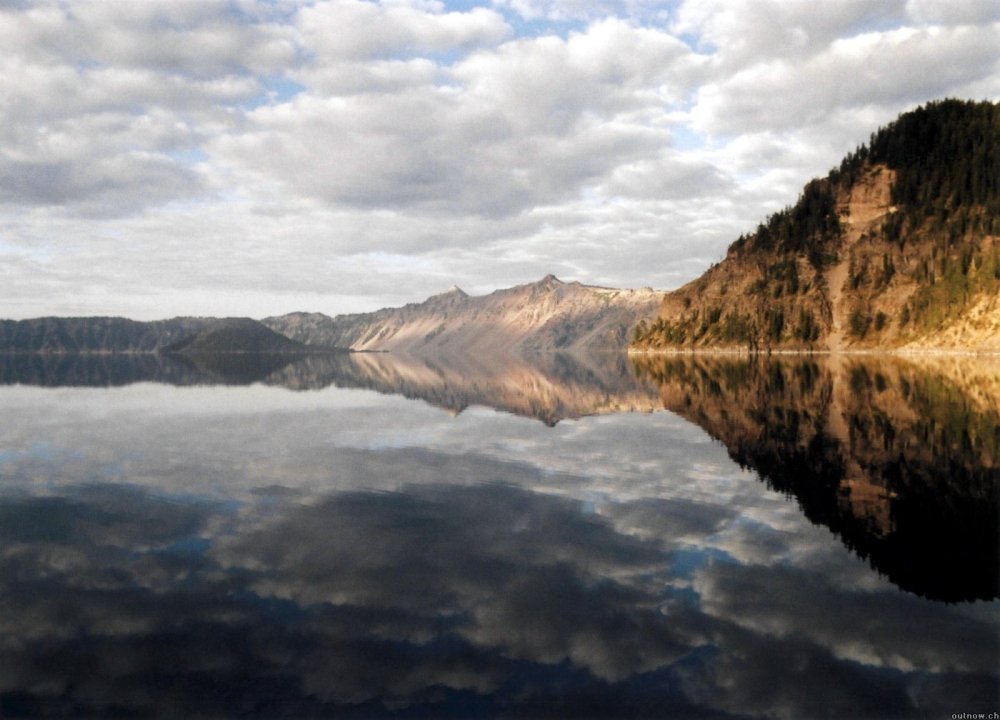
Circling the Image witnesses James Benning gathering footage for his work 13 Lakes (which was released in 2004), a film as deceptively simple as its title. Running over two hours in length, this feature is an album of 13 shots, each carefully composed images recording one of the lakes in question. The only edits are when the film cuts to the next 10-minute-long shot. The only sounds are the gentle whispers of nature being recorded on the moment.
Few other filmmakers have made a body of work that so captures the physical world, calling attention to the beauty we often ignore in our everyday existences, with his wonderfully subtle framing. Even the decay of a landscape, such as the two-minute-and-forty-second long shot (the duration of 100 feet of 16mm film) of a freeway in Los (2001), or an oil drill in Grand Opera (1998), is actually beautiful to James Benning, and he finds a way of conveying that with his impeccable eye for composition lines and contours.
Circling the Image is a valuable teaching tool for those who may be interested in James Benning, yet haven’t had a chance to experience his work. While it is filled with passages from his previous films, as well as telling segments from 13 Lakes, in progress, this documentary is also a rare glimpse at the world of the filmmaker himself.
Early on, we see Benning in his boots, drinking orange juice and listening to a CD at his Val Verde home. Appropriately, Wulf’s own footage does not mimic Benning’s style, and by doing so, he allows those valuable clips of his films stand out in all their striking detail. Wulf instead records Benning at home and at work, with the standard documentary re-enactments (where the camera is already situated at the gas station Benning drives into), and in such candid moments as watching Erin Brockovich on a fuzzy TV set in a run-down hotel room, while he is “between lakes”. Yet such sequences as these have a haunting, poetic beauty of their own. We see Benning gaze out the window of a highway diner, or driving past a lowland, thusly inhabiting these lonely landscapes that he similarly records on film. One sees that he is part of that physical world, always dressed like a modern-day explorer, his leathery face as full of detail as his filmed canvas.
Yet, Circling the Image still does not prepare you for the full, undiluted experience of seeing one of his features. 13 Lakes (shown at Cinematheque one week after they presented this documentary) was my entry point. Seldom has a movie with such a simple premise been so demanding. Even though James Benning presents film that offers nothing more (and why should it?) than some images that play long enough for the viewer to drink in that beauty, the problem is that we enter this movie with years of pre-conditioning of quick cuts, analysis, subtext, story and symbolism, and subtext. We are not used to seeing such subtle beauty, where all of this theory and form do not matter, and as a result, in our MTV-saturated minds, it takes a while for us to surrender to this film’s gentle pleasures. This two-hour-plus epic is a Zen-like calm in which one can give oneself over to. Yet, like any form of meditation, the participant must be allowing to surrender completely to it. (And by the time Lake Nine appeared, 11 out of 48 viewers had decided otherwise.)
While 13 Lakes isn’t necessarily a hypnotic, transcendental experience, it is a quietly affecting one. Sometimes, we are treated to such monolithic occurrences as seeing a ship pass on a lake jutted with ice floes, or waves gently lapping up to the camera. Subtle, “found” moments like this are what make the movie even more rewarding. It becomes clear that Benning becomes as much a slave to the unexpected as the viewer is to him. I am reminded of that classic episode of “The Mary Tyler Moore Show” where Ted Baxter has a heart attack, and then learns to appreciate such moments as stopping to watch the sun go down. 13 Lakes is a pleasure as simple as this, yet even more profound because it finds that hidden beauty of the world, and suspends time long enough for us to admire it.
Originally presented in Vol. #1, Issue #18, “Discoveries”. Since then, I’ve had the opportunity to see several other Benning films. I’m not so sure I still agree with the “simplicity…Lumiere Brothers” comment, but decided to leave that phrase in, since these two films were my entry to James Benning, and that’s how his work appeared to me at the time, through isolated clips in Mr. Wulf’s documentary.
Greg Woods

Greg Woods has been a film enthusiast since his teens, and began his writing "career" at the same time- prolific in capsule reviews of everything he had watched, first on index cards, then those hardcover dollar store black journals, then an old Mac IIsi. He founded The Eclectic Screening Room in 2001, as a portal to share his film love with the world, and find some like-minded enthusiasts along the way. In addition to having worked in the film industry for over two decades, he has been a co-programmer of films at Trash Palace, and a programmer/co-founder of the Toronto Film Noir Syndicate. He has also written for Broken Pencil, CU-Confidential, Micro-Film, and is currently working on his first novel. His secret desire is for someone to interview him for a podcast or a DVD extra.