Herbie remodelled with West German precision!
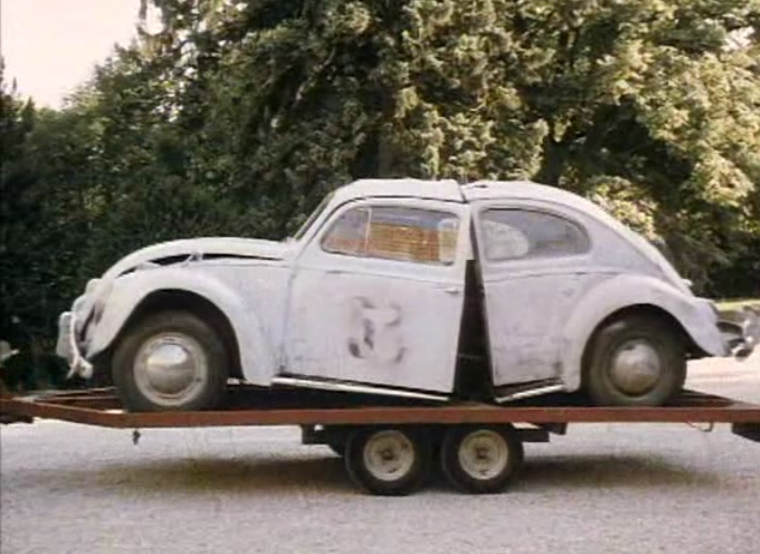
Come In Number 53, your time is up
Film knock-offs have always existed in the industry. Where there’s a title or theme, which Hollywood has already sunk millions of dollars into promoting, there are opportunities to piggyback onto the popularity with audiences at a fraction of the cost. Countries like Italy and Turkey were able to make industries out of this derivative way of film making, far away from the knowledge and consent of Hollywood.
These films imply to be legitimate sequels and hybrid-remakes by borrowing stories, characters and even actual footage from familiar Western culture origins. They play within the confines of local markets, occasionally popping up in other countries as cheap filler for theatres and television stations either at 2pm or 2am. Despite being obvious cash grabs on a successful film, in the world of movie storytelling these foreign versions can be considered as parallel universes to Hollywood’s Dream Factory. Within these cinematic multiverses, characters and plots re-occur in other parts of the world: little girls get demonically possessed, stranded aliens befriend lonely boys and sharks terrorize beachside towns. Occasionally the possible world of a re-interpreted film gets the source material mixed up, either unconcernedly or ineptly. How else to explain 3 Dev Adam, a Turkish adventure where Captain America and El Santo team up to battle a murderous Spider-Man?
In 1969 Walt Disney Pictures released The Love Bug, a live action comedy about an ex-race driver who takes ownership of a Volkswagen Beetle with a mind of its own. It was one of the highest grossing films of the year, yet Disney did not follow up with a second Herbie right away. The Love Bug had been one of the last films to involve the supervision of Mr. Walt Disney himself, and following his death his brother Roy took over operations and the corporation’s focus was set on the construction of Walt Disney World Park in Florida.
Rudolf Zehetgruber (b. 1926) found a perfect opportunity to make a film using various scrap parts of Herbie’s wondercar formula for German audiences – they invented the Beetle after all – and under the name of “David Mark” the result was Ein Käfer geht aufs Ganze (1971), roughly translated as “The Beetle Goes Again” and retitled The Love Bug Rally for English-speaking markets. Zehetgruber worked as an assistant director in the 1950s on Austrian costume period dramas, including Romy Schneider’s early films. He moved into the successful Krimi crime thriller genre of German cinema, co-writing and directing several Krimis as well as several Eurospy films in the Kommissar X series. He also acted in bit parts under the pseudonym “Rolf Zehett”, a name game racket which he would continue throughout his career to spread out the multiple duties he performed in each film as writer, actor, producer and director.
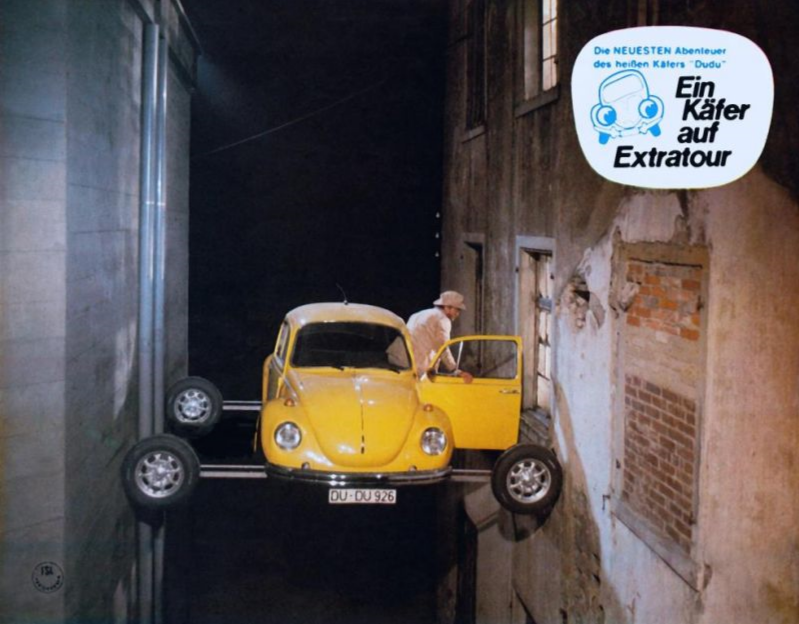
Ein Käfer geht aufs Ganze aka The Love Bug Rally aka Superbug Goes Wild, aka Superbug The Wild One
Ein Käfer geht aufs Ganze begins as drivers from around the world arrive to participate in the annual East African Safari Rally, an actual 3300 mile course running through Kenya, Tanzania, and Uganda. A globetrotter baron arrives with a present from his wife, a car sure to win because it has won every race in America and was bought at a prop sale in Hollywood! But he’s horrified to discover it’s just a battered up little white Volkswagen beetle with a faded 53 on the door and the front and rear sections split apart in the middle.
This is a sly continuation to the ending of The Love Bug in which Herbie splits in half and wins both first and third place in the big race. Rebuilt and now painted yellow, he takes it for a test drive but abandons it after the former 53 shows his bad temper. Ben (director Zehetgruber aka “Richard Lynn”) takes ownership of the car, affectionately christening it “Dudu” – “bug” in Swahili – and enters the Safari rally in hopes of using the prize money to aid the local animal clinic run by his doctor friend Jo (Zehetgruber’s wife Kathrin Oginski, who appears in every Dudu film, each one as a completely different character). Unable to cover the race entry fee, Ben teams up with another entrant’s hovercraft as a service car and the team runs into an assortment of safari obstacles from unnavigatable terrain, inquisitive wild animals and hopeful car thieves. Dudu is quite similar to Herbie, honking and blinking headlights – he is the recently immigrated post-op #53 after all.
Most of the car gimmicks are Ben’s inventions, which get more high tech and James Bondish over the course of the series. We first meet him riding on his safari-proof caged bicycle and throughout the race Ben modifies Dudu with railway wheels, rear propeller fan and even ping-pong paddles strapped to the wheels to make it across a swamp. Zehetgruber finds simple low-cost alternates to Disney’s polished camera tricks for showing Dudu’s personality, simply by showing a quick reaction shot of Dudu with black dots on the headlights that change position depending on if he’s angry or happy. Dudu even sheds a teardrop – a melted icicle slides off the headlight. To show Dudu in crazy action some miniature work is used with a remote control toy Volkswagen driving around inch-high grass and scooting under the legs of a toy giraffe!
Shot on 16mm, Ein Käfer geht aufs Ganze lacks the vivid colours and widescreen presentation of other bigger budget car rally films of the time. However, this allows Zehetgruber’s film crew to shoot on the fly and capture travelogue footage of East Africa, documenting the villages and wildlife that actual rally drivers roar through, as well as the influence of former German Colonialism such as posh hotels and railroads.
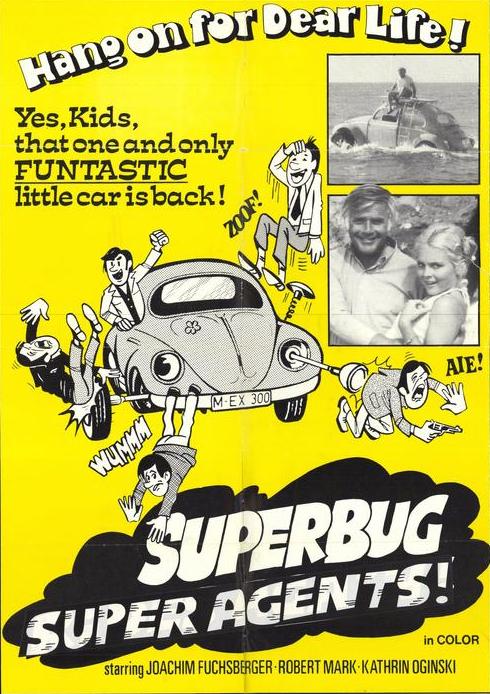
Ein Käfer gibt Vollgas aka Superbug, Super Agent (1972)
Ein Käfer gibt Vollgas (A Beetle at Full Throttle) followed and has no direct connection to any events in the first one. The emphasis on Bond gadgets is more evident – Zehetgruber still appears like before, with a stubbly beard and safari outfit, but now goes by the name Jimmi Bondi. Jimmi uses a radio mic to control Dudu, who is now a fully computerized car with artificial intelligence, speaking in robot voice through a dashboard TV screen. When he orders Dudu to attack, out pop the hubcaps, headlights, door handles, tires and bumpers to clobber the villains on the head repeatedly. Jimmi is the owner of General Service, a seemingly multi-faceted wish fulfillment foundation that can realize anything for their customers like teaching Chinese or getting World Series tickets. His assistant Maggie (Kathrin Oginski returning in a different role) builds prototype inventions such as a stuffed fox scarf that can suck wallets out of pockets and an air gun coffee pot. A lot of time is spent away from Dudu and instead follows a secondary pair of characters investigating a counterfeit money scam and tiptoeing around the bumbling villains. The moments when Dudu is the star of the scene, he’s either chained up for squirting water at a cop over a parking ticket or floating off the coast somewhere. The pacing in the middle is about as sluggish as a Yugo: talky scenes of character development are padded with endless scenes of Dudu swimming around and villains stumbling about. A May-December romance blossoms between the secondary characters and Jimmi gets cold feet about Maggie’s pressure for marriage. Finally it all comes together at the end when Jimmi shows up with Dudu to wallop more bad guys on the head with extendable car parts.
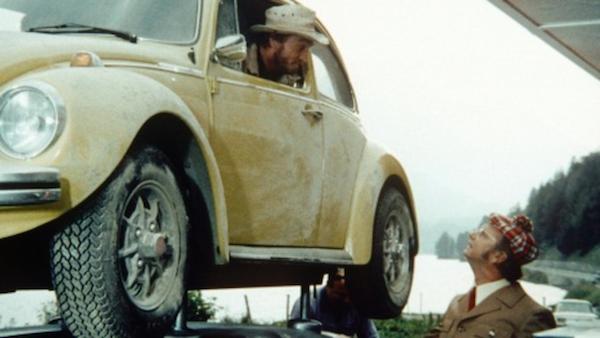
Ein Käfer auf Extratour aka Superbug Rides Again! (1973)
No acting pseudonym is used this time around, just the credit “Jimmi Bondi and his Wonder Beetle”. It begins with Dudu driving, skiing and flying around the Swiss Alps (without propellers or any other propulsion apparent… just flying!) before heading out to help out a friend win a Hell Driver stunt competition. They hitch free rides by attaching suction cups onto aerial cable cars and trucks and riding on their coat tails, but Jimmi also has a giant wind-up key that he pulls out when Dudu is low on gas. Having apparently left General Service behind, Jimmi (“Ever heard of James Bond? I’m his little brother!”) now seems like a character out of Two-Lane Blacktop, just driving around looking for prize money. Jimmi chases some crooks over the English Channel with Dudu set on autopilot. He miscalculates and accidentally ends up off the coast of Lisbon, for no reason other than to have an excuse to re-use the same shots from the previous film! It is a breathtaking shot of Dudu floating under the 25 de Abril Bridge, but it gets repeated too often throughout the series, and it won’t be the last time that a scene get extra mileage in the series.
Zehetgruber’s wife appears again in a new role with Evelyne Kraft (star of Mighty Peking Man) as tomboy mechanics who restore vintage cars. The story is a loose collection of scenes where they get mixed up with bumbling robbers (including Jess Franco regular Eric Falk) and a hidden stash of money. Dudu is featured more prominently, a relief compared to the dull non-Dudu bits that bogged down the previous film, and is controlled by Jimmi punching keys in a pocket calculator. Most scenes show what this super computer bug can do, like trapping villains inside the car, hoisting them up and spinning them silly. Kooky sound effects accompany the gadget scenes like the oft-repeated gag where the wheels rotate and Dudu suddenly drives sideways instead of forward.
It’s a stretch but it’s possible that the makers of The Man with the Golden Gun were thinking of Dudu when James Bond does a fantastic corkscrew jump with his car to the sound of a ridiculous slide-whistle. Dudu’s show-stopper moment is when Jimmi needs to reach the top floor of a building. Rather than just drive up the wall in some unrealistic manner (never mind that earlier preposterous flying scene), Dudu pushes out his wheels between two buildings and quietly scales up to the top floor! No miniatures involved, just a well-concealed crane lift does the effect nicely. Besides writing, directing and starring in the show, Zehetgruber penned and crooned the English and German versions of the opening theme song:
Dudu means beetle, thats how he looks my friend.
And with a mixture of science, good luck and voodoo
He has seen the world from end to end
Handsome or flashy is one thing that Dudu isn’t
He’ll never set any records for style or speed
But when jobs are tough,or dark dangers lurk
Then he’ll show you just how well his systems work
And he runs and he runs and he runs and he runs and he runs…
The 1970s became the lowest point of Disney’s live-action film output following Roy Disney’s death in 1971. Son-in-law Ron Miller took over production and the studio released flops like The $1,000,000 Duck and Superdad. The continued success of The Love Bug for both Disney and Volkswagen led to Herbie Rides Again (1974), this time with the VW badge prominently displayed on car doors and hood. Replicas were displayed in every showroom and striped decal sheets were available to make your own 53.
Herbiemania allowed Dudu to finally swim over to North America kiddie matinées under the re-dubbed name of Superbug. Although it was impeccable timing to release the films following the success of Disney’s cute car sequel, it’s false for nay-sayers to criticize these merely as shoddy import rip-offs – there were actually more Dudus than Herbies rolling off the assembly line by this point. Admittedly, there are more VW model inconsistencies from scene to scene (and shot to shot) compared with Herbie, but Zehetgruber was working with a shoestring budget.
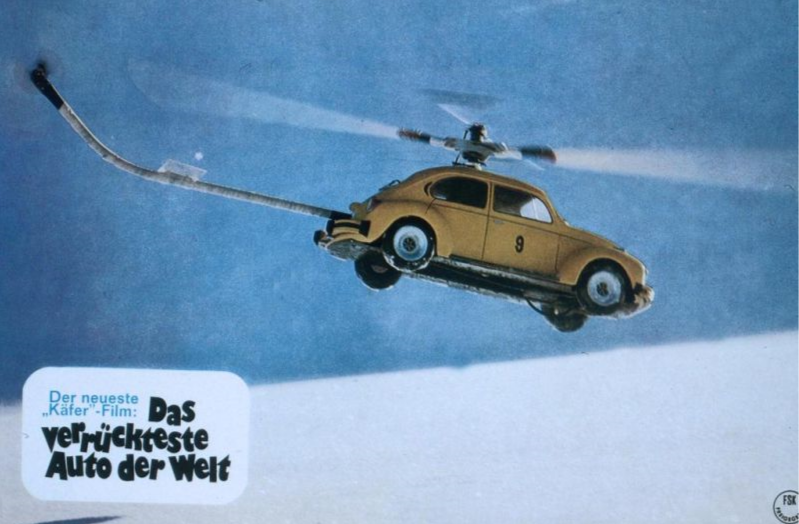
Ein Verrückteste Auto der Welt aka Superbug Superwheels aka Superbug Craziest Car in the World (1975)
A kooky animated opening sequence opens the fourth entry, with Jimmi Bondi now working as the owner and operator of a discontinued railway station and building a souped-up Dudu. This time we get a look under the front hood – it’s now completely computerized, running on blinking lights and magnetic tape data with a cine-camera peeking out for navigation. Dudu is still touchy – the usual bonks to the head with door handles and wheels are given to anyone who dares to insult him. A hotel owner wants to get rid of the local orphanage so Jimmi enters another Alpine race to win enough money to save it. Two nuns from the orphanage (Kathrin Oginski and Evelyne Kraft again) compete with their own modified car, which is built from the front ends of two different coloured Beetles hooked together so that it can go in both directions. This comes in handy when the feuding nuns can’t decide what road to take – they simply unhook and go their separate ways. Dudu has a more scientifically accurate way of flying around, with Jimmi manually attaching propellers and tail rotor to the car. A radio-controlled miniature is used for the flying scenes and during one of the aerial shots of the Alps, another 007 reference can be spotted – a glimpse of Blofeld’s Piz Gloria mountaintop hideout from On Her Majesty’s Secret Service. This is the most action-packed Dudu film because of the simple road race formula of false detours, cheating competitors and tons of wintry car crash pileups.
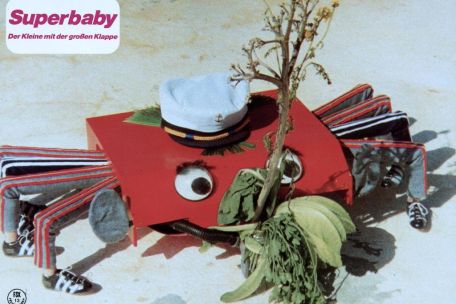
Zwei tolle Käfer räumen auf aka The Return of Superbug aka Superbaby aka Two Beetles Clean Up (1978)
The final Dudu film has little connection to the previous entries. Perhaps because it was harder to top the ongoing ridiculousness of Disney’s sequels or that Zehetgruber was winding down his film career, Superbaby takes the series in a surprisingly darker direction. Beginning right away with a car chase stitched together from two earlier Superbug films and new footage of Dudu crashing into a stock car rally. After being forcefully ejected from the track Dudu tumbles down a hill, the body shell slides off and inexplicably reveals a six-wheel all-terrain vehicle underneath! Jimmi Bondi is no longer in the series either. Now it’s El Guancho, played by a noticeably older and smooth-shaved Zehetgruber, who works as a golf caddy for millionaire Don Fernando (American bodybuilder, Eurocult regular Brad Harris). In the trunk of the six-wheeler is a briefcase-sized robot crab named Pitcho who crawls out to collect golf balls, spin around and make wisecracks. Possibly one of the most ludicrous ideas for a robot, Pitcho’s saving grace is that he carries a bottle of whiskey under his sailor hat and wears four pairs of track pants.
The story is less of a car gadget fest and actually follows the plot of a bleak Spaghetti Western. El Guancho is haunted by memories of his soldier of fortune team murdered twenty years ago over some stolen treasure which is buried somewhere on the island. Gangsters, soldiers and even the old mayor have arrived to reclaim it. There are still moments of slapstick, but it’s no longer the same kind of harmless hubcap bonking antics like before. Pitcho squirts nitroglycerin at the bad guys and El Guancho has a constant supply of exploding cigars, which at first just rip clothes to pieces in cartoon style but later on victims suffer worse fates. One character deliberately lights one up and blows himself out of the story. At one point El Guancho is captured and forced into a prison labour camp, where an old man tries to escape but is gunned down off screen. Hardly a kiddie matinée romp like the earlier films were! One of the German titles translates as Two Beetles Clean Up, an attempt to cash in on the popularity of both the American and German films. It’s possible that Zehetgruber wanted to make a serious adventure film one last time and used Dudu’s success to hook an audience.
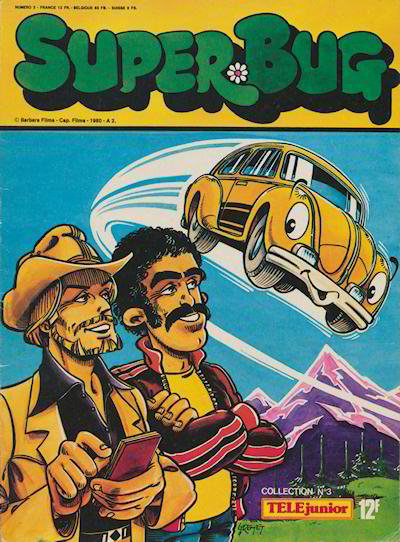
In 1980 the series was picked up for French television and the first four films were re-edited into twelve episodes. A catchy new pop rock theme song was penned – which sure beats the awful Heino-esque original – and is much beloved by French viewers who grew up watching it. Search “Générique TV Super Bug” on the Internet and you can find a video of the opening theme as well as a fan cover version. Here’s a sample of the new composition:
We do not believe
What one sees
She can do everything
She can do everything
It can even fly in the air
Superbug, Superbug, Superbug
Su-per-bug, Superbug, Superbug
By the 1980s cute robots, wonder cars and goofy gadgets were more popular than ever with C.H.O.M.P.S., Knight Rider and Inspector Gadget. Zehetgruber made his final film in 1985 with a children’s fantasy starring the Loch Ness Monster before retiring from the industry. His inventive if not slightly derivative films live on as pop culture cult items, at least in the fond memories of European audiences. In North America the Superbug films seems to be a fuzzy image from TV-watching memories where someone may recall seeing an impostor Herbie driving up a wall or repeatedly pummeling a headlight into a bad guy’s kisser but unsure where it came from.
Superbug on DVD:
There are Superbug DVDs out there, including R1 versions of Goes Wild, Super Agent and Rides Again, but those are actually unofficial bootlegs sourced from ancient video tapes yet listed at high retail prices. Legitimate DVDs have been released in Europe, including a German box set. Pre-records from Toronto-based CIC Video exist for the first four titles, the most abundant ones found on eBay being Super Agent and Rides Again, although I occasionally stumble over a completed auction for Goes Wild. Superbaby reportedly played in early 1980s American TV syndication packages but I have never seen any pre-record video catalogue listing for it.
Originally published in Vol. #1, Issue #23.
Brian Random

Brian Random occasionally dabbles in music and film and if you make it three yards, we'll have us an automobile race!