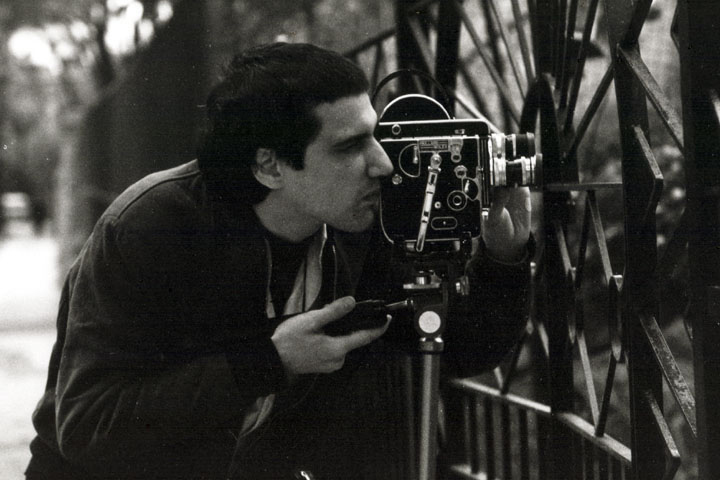
Arthur Lipsett is Canada’s undisputed master of collage cinema, standing firm amid that rarefied subgenre’s scant handful of masters (Craig Baldwin, Bruce Conner, Joseph Cornell…). In the great tradition of Canadian visionaries – I have been mourning another for two weeks straight as of this writing – Lipsett was under-appreciated when alive, and then credited with mystical omniscience after he kicked the bucket. It’s so much easier to mourn the missed opportunity for transformative change than to actually stand up for it while it’s there.
Needless to say, Arthur Lipsett was no Jack Layton in the up-with-people department. As one of his National Film Board superiors noted with a cluck, “If you were making tourist bureau films, no one would want to come here!” For shame, right? This tragic, schizophrenic suicide case was heedless of his elders, frantically negationist, and utterly unable to navigate or replace the institutional culture which cocooned him – if he hadn’t existed, it is certain that no one would have invented him. Which makes what he managed to achieve all the more precious and inspiring – and what he didn’t achieve, all the more cautionary.
A popular Lipsett quote goes like this: “If I could explain what I was doing in words, I wouldn’t be making movies.” While there’s plenty of truth lurking in this statement – the detail and density of his work is astonishing, and defies reduction – there’s also plenty of strategy. Because if Lipsett ever explained what he was doing in words, the NFB would have probably cut him loose even sooner. (A good sister quote might be the zinger punchline – a Lipsett trademark – from N-Zone: “Everybody’s innocent till they’re caught.”)
However, with a bit of context and concentration, it is possible to penetrate his remarkably consistent – if gradually evolving – aesthetic approach, and isolate distinct central concerns in each of his films. In the simplest terms, Very Nice, Very Nice (1961) is about man and society, 21-87 (1963) is about man and spirituality, Free Fall (1964) is about man and nature, A Trip Down Memory Lane (1965) is about man and empire, Fluxes (1968) is about man and machines, N-Zone (1970) is about personal despair, and the extremely rare Strange Codes (1974) is about, well, Arthur Lipsett.
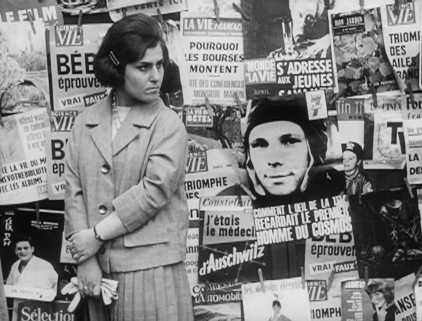
There – I did it. Impressed? However, Lipsett’s enduring stature is ultimately not due to his insight into the dilemmas of modern existence. While his mind was sharp and his iconoclasm astonishing – he articulated the entire basic program of (white) ’60s counterculture half a decade before it happened – even the man’s best work has a collegiate, half-informed feel – an air of prodigious youthful rebellion instead of wholly earned insight. It’s no wonder a certain breed of high school kid found his work to be great theme-paper fodder, because he plays into that existential angst that bedevils the uneasy transition to “adulthood” for so many, most of whom then move on to straighter things. He’s not shallow and he’s not pretentious – but one can only dream of the films he could have made had he lived a little more.
Another thing he’s not – although one must open one’s eyes and heart to understand it – is contemptuous. While his work is littered with grotesques, his basic stance is compellingly compassionate: his constructions express a deep yearning for transcendence of the controlling systems and situations in which these oceans of humanity are contained. There is nothing tentative about his mastery of this theme in his very first film, the Oscar-nominated Very Nice, Very Nice – in fact its survey of alienation may be his most enduring social statement. Pretty words about self-transformation are exploded in mushroom clouds, while becoming “really involved” reveals its outcome as a mutilated corpse, framed by a competing succession of NO’s and YES’s that never fully resolves. Nocturnally salvaged and stitched together from the Film Board’s trim bins, the verbal fragments that he recontextualizes – “And they say the situation is getting worse!”, “what the future will behold”, “If the only way you can find to express your individuality is an orange plantation in Brazil…” – leave no question that the distressed faces he strings together are victims even if they’re also perpetrators, and at the end the forces collide in a succession of disquieting photo-collages of ad imagery, a fragmentary document of the visual arts work that was his other vocation.
As the above description can only begin to suggest, though, Lipsett’s content is nothing without its form – a fluid, jazzy, uncannily rhythmic sensibility that embeds his early work in your consciousness like a favourite pop tune. The affirmative countercurrents of his work really are most fully embodied in the aliveness of his incredibly agile and assured editing.
21-87 – whose title is famously referenced in the earlier work of Lipsett’s number one fan, George Lucas – carries this sensibility forward, as the comprehensive keynote of Very Nice, Very Nice gives way to a more concentrated study of yearning amid separation, with increasing space being given to Lipsett’s self-generated 16mm urban imagery. A series of faces look up toward the unknowable ‘God’ of a stirring gospel snippet; the Book of Revelations is revealed as the solace of old ladies; a monkey in a glass cage mirrors a crowd gazing in a store window; sixties sock-hoppers gyrate to inchoate gasps and grunts, and acrobats lay down with elephants. The governing logic is accessible and tight, but as a viewing experience such concerns are again secondary to the pleasure of its aural and visual hooks – the flapping wind key on a 16mm camera, the silence-breaking ‘waitaminit’ as a horse jumps off a platform into a pool, the infernal squeak of the voice proclaiming “I wanna be freeee.” And of course the vividly grim faces of the people on the climactic escalator, ascending (to heaven?) into the end-of-reel exposure flash montage that closes.
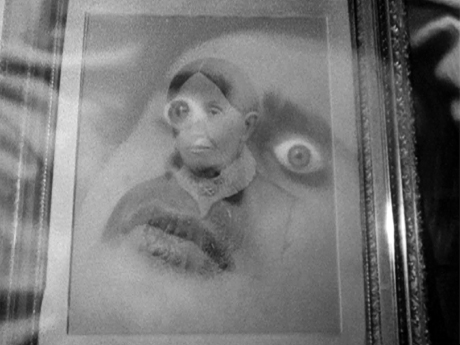
While 21-87 is in no way leisurely, it is a walk in the park compared to Free Fall, the most hyperactive and propulsive of Lipsett’s works. Frantic African-style drumming accompanies first an ant, then a hyper-montage of single-frame urban faces; the overwhelming kinesis is flexible enough to sustain itself through some remarkable transitions into stillness, as when a freeze frame of a body on the grass underpins several shifts in aural mood before screeching violins leads us into a profoundly disorienting wrecking-ball shot. The voices remain present but the sounds and images have taken center stage here, reflecting Lipsett’s increased formal confidence – watching eyes are everywhere. The overall ambience approaches horror-movie territory, perhaps reflecting an acute emotional investment in the perceived dilemma of man’s subjection to nature.
The National Film Board showed no such deference to the natural order, however, and around this time they began to aggressively straitjacket their resident angry young man into such rote make-work banalities as Perceptual Learning and Animals and Psychology. Art was all well and good, but as time went on Lipsett’s stubborn iconoclasm brought out the worst in his bureaucratic overseers, a foretaste of the controlling idiocy that would smoke out great numbers of the Board’s most vital artists by the early seventies. This stint in the ‘education’ mines visibly separates this early trifecta from the rest of Lipsett’s work. While his personal films would continue to build on the methods of his early triumphs, he was no longer ‘pop’. His work became ever more austere and bitter, which no doubt reflected on his work environment as well as the cultural one, as the sixties began to transform themselves into ‘The Sixties’.
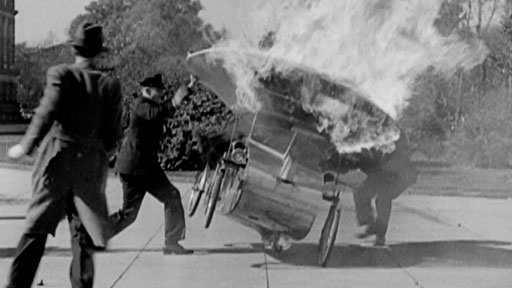
A Trip Down Memory Lane is subtitled “Additional material for a time capsule”, as though to provide a rhetorical framework that could rationalize this very personal excoriation of the culture of masters. Without losing acuity, the tempo slows down a touch; sound and image frequently retain their sync from source, so that the commentary is often limited to the joining points. But commentary it remains, and with an added bite. A compendium of unnatural skyward journeys is framed on the front end by an Indian ‘ruler’ leading his elephant procession through his loyal throngs, and on the back by a series of inarticulate military and political leaders, including a scandalous airing of some plump turkey who stumblingly hypes World War II as “a crusade in the air” before stammering to a premature halt. All interspersed with religious rhetoric, radiation burn victims, and a frantically trapped lab monkey who might as well be Lipsett himself, churning out another talking-header for the boss – we can all be thankful that he had Donald Brittain ‘running interference’ for him at the management level.
An unprecedented three years elapsed between that film and Fluxes, and by this time Lipsett’s Film Board narrative was fully present in the work; in critiquing the powerful forces who aspire to turn man into machine, the film addresses not just the war machine of Vietnam but also the sister assembly line on which Lipsett was trapped. About twice as long as his earlier personal films, Fluxes nonetheless returns to the dense constructions of his early work, only here the edits are jagged and alienating, the imagery unrelentingly cruel, and the humans largely rulers not subjects. Its escalating visual critique of life-destroying systems has such an unrelenting unity that it is the text that stands out here – “only the strong survive”, “morals are for men, not gods”, “now I can control life absolutely”, “our only morality is survival”. He also interpolates, for the first time I’ve been able to catch, rhetoric from such recognizable pop culture figures as Adam West and Donald Duck. This is shockingly direct expression for a filmmaker so long committed to evocative obliqueness, let alone one operating within a state agency; this being 1968, I’m sure he was as emboldened by the coming into being of a sympathetic countercultural audience as he was by his own horror at the things that were going on in his world.
However, Fluxes is also where some latent problematic tendencies gain prominence and become more bothersome as a result. The second appearance in his work of an African man on fire – with contextualizing voiceover declaiming “I need those electronic instruments to fill an order for my best foreign customer!” – makes sense rhetorically, but the humanity of the person in that image is worth more than rhetoric; the shot is so alienated it makes me reconsider the use of ‘jungle’ drums in Free Fall. Moreover, the way Lipsett uses extended imagery of Buddhist ceremonies to represent the other side in the conflict deploys ‘Eastern spirituality’ in a way that suggests the other kind of appropriation – the cultural kind.
Such tendencies run rampant in N-Zone, Lipsett’s NFB swan song. It’s not quite the “Metal Machine Music” contract-breaker its reputation would suggest; the asininities of his acid-tripping buddies are rather stylishly dispersed among the usual found-footage goodies, which have their marginal surface charms to complement the ramblers’ marginal documentary value. But the sense of focus and purpose is ultimately gone, the gaze turned obsessively inward, which seems to have had as much to do with the interventions of new hipster collaborator Henry Zemel as with Lipsett’s own deteriorating mental state. The depressing way the film folds Orientalist signifiers into its gallery of wacky grotesques has less affinity with Lipsett’s earlier work than it does with Richard Benner’s Outrageous!, in which Bozo Moyle’s mental patient spells out the kinship between racism and insanity.
Cut loose from the NFB, Lipsett drifted, slowly succumbing to his mental demons before offing himself on the eve of his 50th birthday in 1986. His only post-Board film output, the virtually unseen Strange Codes, is a silly ritual set-piece, documenting the artist plodding around his house in various costumes while creating a visual art collage; it’s valuable as history, but negligible as cinema.
Lipsett’s life and career is documented in two long-form documentaries (as well as an animation I haven’t seen, The Lipsett Diaries). While Eric Gaucher’s The Arthur Lipsett Project contains a couple valuable tidbits and would make an adequate study guide, it is also a transparent quickie end run on Martin Lavut’s independently produced, vastly superior Remembering Arthur. Lavut covers the exact same ground – sometimes word for word – while taking the time to treat its subjects as human beings in a moving and revealing way; also, it doesn’t pretend that Lipsett ceased to exist after he left the Board. Released just one year after Lavut opened up the market, The Arthur Lipsett Project is less a movie than a bureaucratic maneuver, depressing evidence that things are still rotten in the house of Grierson.
Originally published in Vol. #1, Issue #24.
JC Culp

JC Culp is a collage filmmaker and the founder of Unpopular Arts, which provides media production, preservation and presentation.