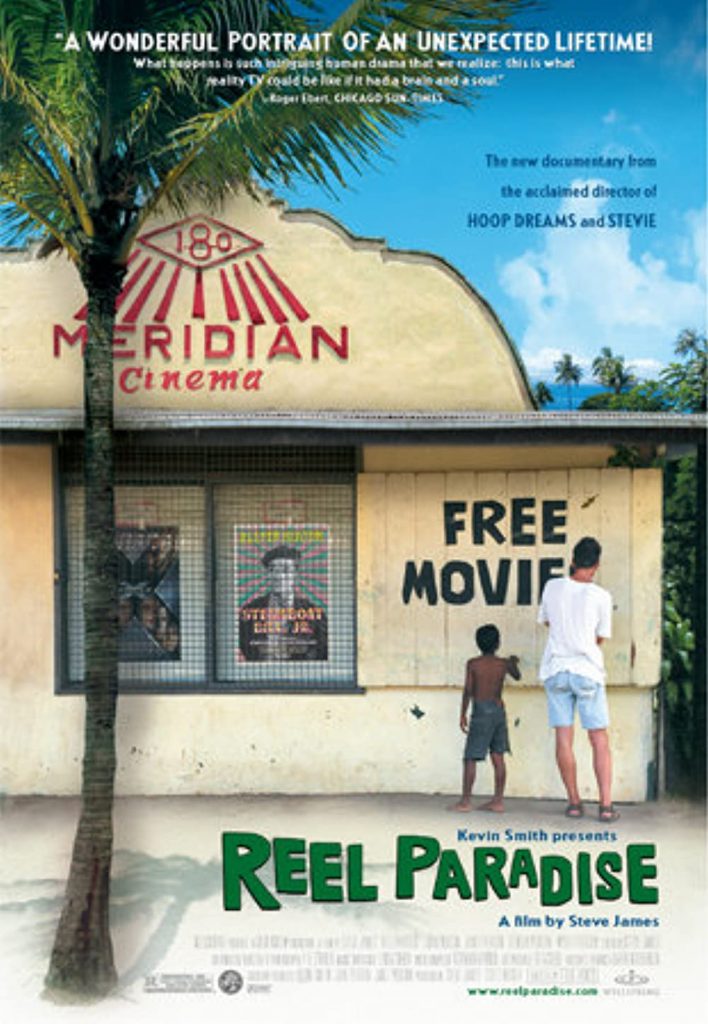
Reel Paradise (USA, 2005) 110 min color DIR: Steve James. PROD: Steve James, Scott Mosier, P.H. O’Brien. EXEC PROD: Kevin Smith. MUSIC: Norman Arnold. DOP: P.H. O’Brien. CAST: John Pierson, Janet Pierson, Georgia Pierson, Wyatt Pierson. (Wellspring Media)
I had rented this video, thinking that it would be an inspiring film about someone bringing the magic of the movies to the people. And indeed, there is that. But, like the experiences of the people in this film, there turns out to be more than one bargained for.
John Pierson, author of the book Spike, Mike, Slackers & Dykes, co-creator of the IFC show Split Screen, and producer’s representative on the films of Spike Lee, Richard Linklater and Michael Moore, traveled to the island of Fiji in 2002 with his wife Janet and their two kids Georgia and Wyatt, for a year-long sabbatical from the toils of modern urban life in New York, however living in a colonial house that is still more expensive than most dwellings on the island. (With only one exception- Janet insisted on bringing her computer.) Having been struck by the native’s enthusiastic response to a Three Stooges short (which had continuously played at the 180 Meridian Cinema in Fiji since the theatre opened in 1954), Pierson was reminded how the power of the movies transcended the lives of the everyday people for whom they were made in the first place.
During the 12 months in Fiji, Pierson owned and operated the Meridian, showing movies for free (in a place where it is prohibitively expensive to go to the cinema). What first appears to be a mini Cinema Paradiso, giving the gift of movies to introduce a world of wonders, quickly turns into a nightmare of culture clash. During the last month of the Pierson family’s stay in Fiji, director Steve James (of Hoop Dreams) arrived to film the goings-on, and the result is an unusually frank modern-day exploration of what one can call “The Ugly American Syndrome”, in which Americans visit a foreign land, and attempt to insinuate their customs and culture as the only way to live.
John Pierson emerges as a man-child, constantly stroking his self-congratulatory ego when it is bruised. He is befuddled by the Fijian natives’ lack of attendance at a film like Apocalypse Now Redux, when all they really wanted was Jackass. It becomes more apparent that his running of the cinema is more for his ego than their cultural well-being. And while he attempts to bring these fantasies to reality, Janet seems unable to control her monster children, particularly party girl Georgia, who is becoming a bad influence on the young girls of Fiji (and their Catholic denomination). (The camera rolls while Georgia sasses back to her mother, gets in a truck and refuses to come back at curfew time.) Wyatt usually rolls his eyes at his father’s egocentric dreams, however he is perhaps the one who best immerses with Fijian culture, as we see him at play with his classmates.
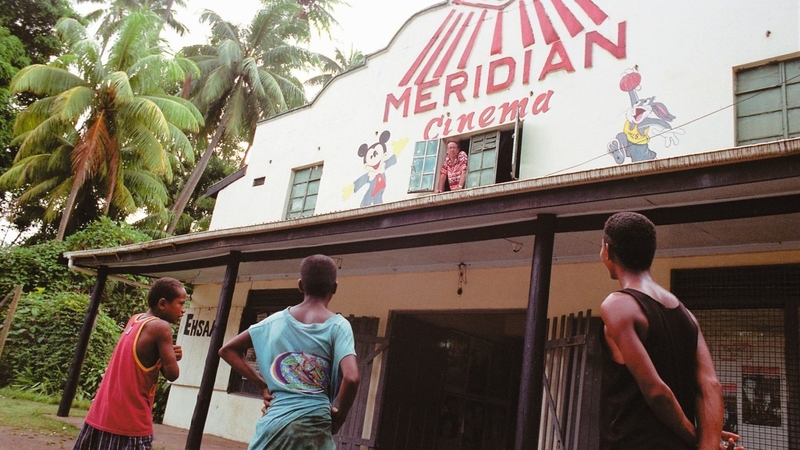
Admittedly, the camera arrives at the eleventh month, when the family is at the end of their tether. It is at this point where Janet’s computer gets stolen from the house when everyone is away at the theatre. Upon the discovery of the theft, the landlord also comes by to remind them of their fuel bill, at which point John freaks out at him for his insensitivity. This is perhaps the most telling scene of the movie, where the viewer realizes (as do the Pierson’s) that the Americans aren’t some kind of saviours, and whatever their good intentions (that have now receded), there will always be this cultural and economic clash between the people of Fiji and themselves.
The filmmakers have the bravery to present this family at its absolute worst, and yet still I wonder if the Piersons are getting a secret thrill out of being on camera. In some weird way, perhaps the movie-loving Pierson family rejoices at the fact that they get to be movie stars, and what a show they put on for us, even if it is a National Lampoon’s Vacation starring The Osbournes. Their emoting, yelling, flailing of the arms is darkly funny theatre, whether intended or not. But still, Reel Paradise surprisingly ends up just that, when for the final screening, John projects Buster Keaton’s Steamboat Bill Jr. to great enthusiasm. In a sense, the “real world-reel world” duality is complete. The big clown on screen mirrors the tragic comic in John Pierson: like silent film comedians, he is a childlike man in a world beyond his understanding. At least, at last, he manages to realize his naively innocent dreams.
Originally presented in Vol. #1, Issue #18, “Discoveries”.
Greg Woods

Greg Woods has been a film enthusiast since his teens, and began his writing "career" at the same time- prolific in capsule reviews of everything he had watched, first on index cards, then those hardcover dollar store black journals, then an old Mac IIsi. He founded The Eclectic Screening Room in 2001, as a portal to share his film love with the world, and find some like-minded enthusiasts along the way. In addition to having worked in the film industry for over two decades, he has been a co-programmer of films at Trash Palace, and a programmer/co-founder of the Toronto Film Noir Syndicate. He has also written for Broken Pencil, CU-Confidential, Micro-Film, and is currently working on his first novel. His secret desire is for someone to interview him for a podcast or a DVD extra.