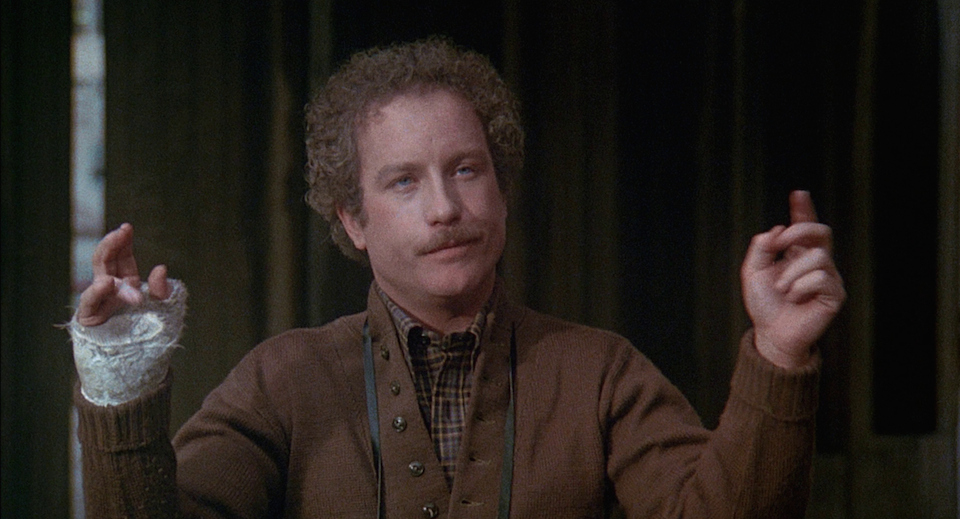
The Big Fix (USA, 1978) 108 min color DIR: Jeremy Paul Kagan. PROD: Carl Borack, Richard Dreyfuss. SCR: Roger L. Simon, based on his own novel. MUSIC: Bill Conti. DOP: Frank Stanley. CAST: Richard Dreyfuss, Susan Anspach, Bonnie Bedelia, John Lithgow, Ofelia Medina, Nicolas Coster, F. Murray Abraham, Fritz Weaver. (Universal Pictures)
This quietly effective seriocomic film is more than just a detective movie- it is an important late 1970s American film which asks what went wrong with the dreams once held by counterculture kids of a decade earlier. Roger L. Simon’s series of Moses Wine books provide a perfect detective hero for the 1970s: a dope-smoking, perpetual screw-up who is always a dollar short. He is a child of the 1960s who still holds on to the hippie ideals, even if he is now in a society that cares even less about them.
Richard Dreyfuss, fresh from his Oscar-winning performance in The Goodbye Girl, is simply perfect as Wine. With his sardonic humour, permed curly hair, and tan leather coat, his character is perfect late-70s all-flash and BS, but hollow in the center. Wine is hired by an electoral community to find out who is smearing their candidate by suggesting that he is friendly with a radical who is still underground avoiding justice.
When you see this picture, you understand why Hair was made into a movie in 1979. At the end of the 1970s, the hippies were good for nothing but nostalgia. There is a terribly moving scene in a prison, where Wine visits two inmates who are imprisoned for their radical acts, to question them about the possible whereabouts of this radical fugitive. They put on a rock n roll station and everyone sings along to Frankie Lymon’s “Why Do Fools Fall in Love,” while they exchange information on a pad of paper. While at once the music serves as a cover for those who may listen in on the conversation, it is a bittersweet moment representing the innocence now lost.
If The Big Fix has one flaw, it is the big action sequence in the conclusion that belongs to another movie. It seems more like a premonition of the brainless action movies which would follow in the next decade, in which characterizations are non-existent. It is an odd note to end an otherwise fascinating character-driven movie, in which Wine confronts the faded dreams of his youth while searching for the elusive rebel. F. Murray Abraham is smashing in his one scene as an aging radical who lives in a posh California suburb, but is quick to let it all go if the law catches up to him. Susan Anspach is as luminous as always, in her too-short role of an old friend now working for the political party in question. In one early scene, he propositions her to come over to his house, and he’ll get out some wine and put on a Buffalo Springfield album!
Originally presented in Vol. #1, Issue #14, (“Back to the 70s”), as part of the article, “Neo-Noir”.
Greg Woods

Greg Woods has been a film enthusiast since his teens, and began his writing "career" at the same time- prolific in capsule reviews of everything he had watched, first on index cards, then those hardcover dollar store black journals, then an old Mac IIsi. He founded The Eclectic Screening Room in 2001, as a portal to share his film love with the world, and find some like-minded enthusiasts along the way. In addition to having worked in the film industry for over two decades, he has been a co-programmer of films at Trash Palace, and a programmer/co-founder of the Toronto Film Noir Syndicate. He has also written for Broken Pencil, CU-Confidential, Micro-Film, and is currently working on his first novel. His secret desire is for someone to interview him for a podcast or a DVD extra.