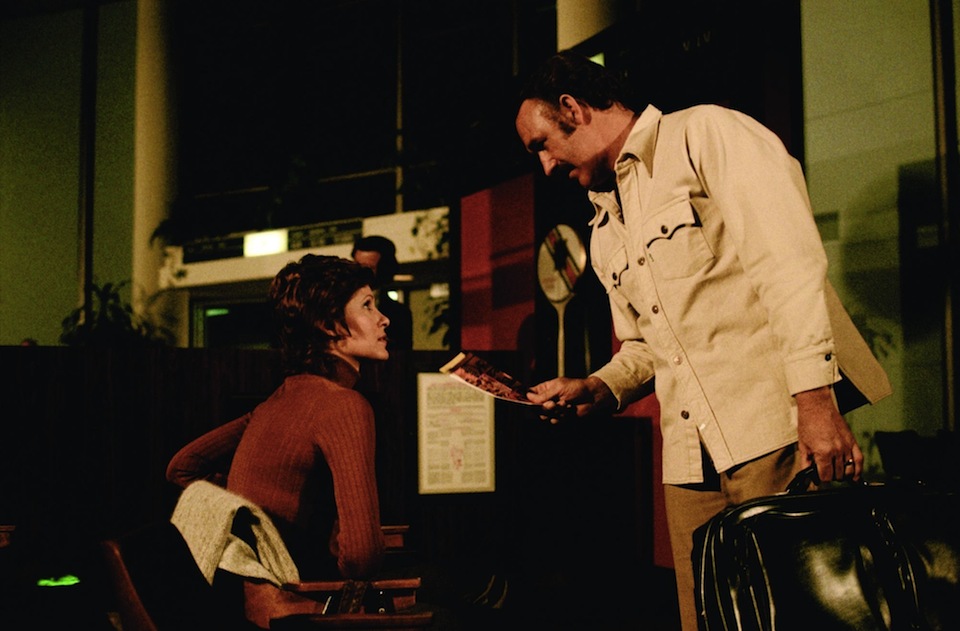
Night Moves (USA, 1975) 99 min color DIR: Arthur Penn. PROD: Robert M. Sherman. SCR: Alan Sharp. MUSIC: Michael Small. DOP: Bruce Surtees. CAST: Gene Hackman, Susan Clark, Jennifer Warren, Edward Binns, Harris Yulin, Kenneth Mars, James Woods, John Crawford, Melanie Griffith, Dennis Dugan, Max Gail. (Warner Brothers)
This film and The Conversation both cast Gene Hackman as Everymen who choose to look outside of their self-made bubbles, and ultimately pay for their indulgences. In this impressionistic, character-driven noir, written by Alan Sharp (whose scripts for The Hired Hand, Ulzana’s Raid and Billy Two Hats offer novel approaches to Westerns, as much as this does to film noir), Hackman plays private eye Harry Moseby, whose work seeps into his personal life. Perhaps because of his obsession with his job, he has estranged his wife Ellen (Susan Clark) to the point where she is now seeing another man named Marty Heller (Harris Yulin). He is oblivious to her feelings of course, and only finds out about the affair by chance, once he sees the two coming out of an Eric Rohmer movie. (There’s a metaphor there, I’m sure.) He tracks Heller down and confronts him at his own doorstep, but this climactic moment ends up in embarrassment more for Moseby than anyone else. We later learn that once upon a time Harry had tracked down his elusive father, but then didn’t bother approaching him. These scenarios, one visualized, the other only talked about, are keys to Moseby’s character, and compliment the main thread which gives the film its suspense. Even when his work skills are used in his private life for some kind of vindication, he fails miserably at the latter because in truth, he really doesn’t know how to relate to people.
The central plot of Night Moves concerns his efforts to bring a nymphet runaway (Melanie Griffith) back to her rich, yet dysfunctional family. Because Moseby is a brilliant detective, he easily succeeds in his task, but his work only brings more heartbreak. Once her sleazy older boyfriend (James Woods!) tells him, “Why did you bring her back here?”, we begin to understand that the so-called “problem child” left for damn good reason, and then fear for her safety. Only then is Moseby aware of his own moral ambiguity, and his ineffectual behaviour (as he indirectly endangered the girl by bringing her back to her family). While attempting to absolve the girl and himself, he becomes immersed in an extremely complex situation beyond his control. Even his wife says to him, “Why don’t you just call the police?” Yet he must continue in this case at the risk of his own safety, on the way to Salvation, only to find even more tragedy.
Gene Hackman is a perfect choice for Moseby- his Everyman features make him the ideal private eye, as a man who watches and can easily blend into the background (perhaps much like the characters in Rohmer’s Chloe in the Afternoon?). Bruce Surtees’ chocolate cinematography fills the everyday drabness with mystery and sorrow. Arthur Penn is a perfect choice as director, as this is another film in his career that de-mythologizes whatever genre he explores, in scenarios with eccentric characters (as in his westerns, Little Big Man or The Missouri Breaks).
Night Moves succeeds because it is equal parts mystery thriller and character study, as Moseby’s personal and professional lives blur. In the decade of the underdog, 70s detective films and television shows lacked the usual sexy thrills one associates with the genre, and proved the point that being a detective isn’t so bloody marvellous. It would have been interesting to have seen a series of Harry Moseby films.
Originally presented in Vol. #1, Issue #14, (“Back to the 70s”), as part of the article, “Neo-Noir”.
Greg Woods

Greg Woods has been a film enthusiast since his teens, and began his writing "career" at the same time- prolific in capsule reviews of everything he had watched, first on index cards, then those hardcover dollar store black journals, then an old Mac IIsi. He founded The Eclectic Screening Room in 2001, as a portal to share his film love with the world, and find some like-minded enthusiasts along the way. In addition to having worked in the film industry for over two decades, he has been a co-programmer of films at Trash Palace, and a programmer/co-founder of the Toronto Film Noir Syndicate. He has also written for Broken Pencil, CU-Confidential, Micro-Film, and is currently working on his first novel. His secret desire is for someone to interview him for a podcast or a DVD extra.