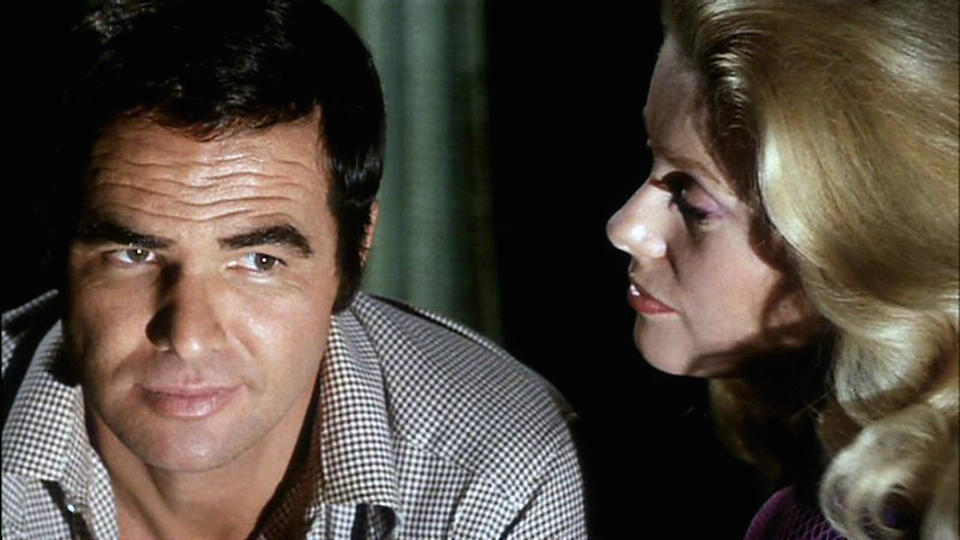
Hustle (USA, 1975) 120 min color DIR-PROD: Robert Aldrich. SCR: Steve Shagan. MUSIC: Frank De Vol. DOP: Joseph F. Biroc. CAST: Burt Reynolds, Catherine Deneuve, Ernest Borgnine, Eddie Albert, Ben Johnson, Eileen Brennan, Paul Winfield, Catherine Bach. (Paramount)
Steve Shagan adapted his own novel, City of Angels, for this strong modern film noir which most people detest, but I find quite interesting. What turned most viewers off was that everyone in this movie is foul: they swear a lot, and are all corrupt. Not one person has a redeeming quality.
After their hit The Longest Yard, director Aldrich reunites with its star, Burt Reynolds, in an amoral film which is a complete counterpoint to the light playboy roles or “good ole boy” vehicles the actor would soon receive. He doesn’t even have his cute moustache to make him somewhat adorable. He is an LA cop, who lives with a prostitute (Catherine Deneuve!), and is investigating the rape-murder of a teenaged girl.
Interestingly, we see how this murder affects everyone (or not, in some cases). We see more of the girl’s parents (Ben Johnson, Eileen Brennan) than one would in any normal detective story, and these two are not without flaws, either. The only sympathetic figure in the film is the dead girl, seen briefly in the beginning (the cops don’t even bother covering her up for when the bereaved parents come to view the body).
Whether this film is a true statement of the corrupt people who are supposed to protect us, or if it is intended as a satire of the darkest variety- it gets under your skin all the same. As is typical with Aldrich’s late period of films, Hustle has characterizations played up to grotesque caricatures (evidenced in Aldrich regular Ernest Borgnine’s portrayal as the cackling police chief) and he delivers his points with a sledgehammer, but I’m not sure a lighter approach would’ve worked. The film’s most inspired piece of perversity is in casting, of all people, Eddie Albert from Green Acres as the corrupt politician. This guy is so foul that the viewer wants to reach into the screen and throttle him.
And therein lies the strange fascination of this picture. It is so foul, it reeks. While on the surface, this film has enough sensationalism to sell tickets, Aldrich preys on the audience’s voyeurism and gives more than anyone would want or bargain for. Most of these characters are repellent, yet one can sense their helplessness. Your mileage may vary on this point, which makes the film compelling viewing. But for those who are game, Hustle is a fascinating morality play about people who are beyond redemption.
Originally published in Vol. #1, Issue #10 (“Summer in the 70s”).
Greg Woods

Greg Woods has been a film enthusiast since his teens, and began his writing "career" at the same time- prolific in capsule reviews of everything he had watched, first on index cards, then those hardcover dollar store black journals, then an old Mac IIsi. He founded The Eclectic Screening Room in 2001, as a portal to share his film love with the world, and find some like-minded enthusiasts along the way. In addition to having worked in the film industry for over two decades, he has been a co-programmer of films at Trash Palace, and a programmer/co-founder of the Toronto Film Noir Syndicate. He has also written for Broken Pencil, CU-Confidential, Micro-Film, and is currently working on his first novel. His secret desire is for someone to interview him for a podcast or a DVD extra.